

ions (i.e., at higher conductivities) decreases the Debye length. At distances longer
than the Debye length, the interactions between charged molecules are significantly
weakened. The entropical driving forces that might promote adsorption (see Sect. 2)
are weaker than at lower ionic strengths. In more practical terms, this means that
interactions between fibres and polyelectrolyte or between polyelectrolyte and
polyelectrolyte will not be as strong or as long-range at higher salt concentrations.
The pH is another important factor because many of the chemicals involved are
weak polyelectrolytes, changing their charge density with changing pH.
Together, these factors make in situ PEC formation an unreliable method. Besides
in situ PEC formation, there is another possibility: to pre-form the complexes before
addition to the pulp fibres.
3.3 Pre-formed PECs
In contrast to the formation of PEC structures in situ, PECs can also be formed
before addition to the fibre suspension. We refer to these as pre-formed PECs. They
are prepared by mixing two oppositely charged polyelectrolytes together in some
way before further use as a paper chemical. The PEC preparation method that is
predominantly used in the literature is polyelectrolyte titration, i.e., the slow
addition of a solution of one polyelectrolyte to a solution of an oppositely charged
one [11]. However, another PEC preparation method has recently been used,
the so-called jet mixing method [50, 51].
One unique advantage of pre-formed PECs over in situ PECs is the possibility of
controlling their formation and of analysing their structures and colloidal properties
before addition to the pulp fibres. Since complex formation occurs in a separate
environment, which is more controllable than the paper stock that can vary substantially with time, the PEC formation can also be made more reliable and robust
than if it occurs in the fibre suspension.
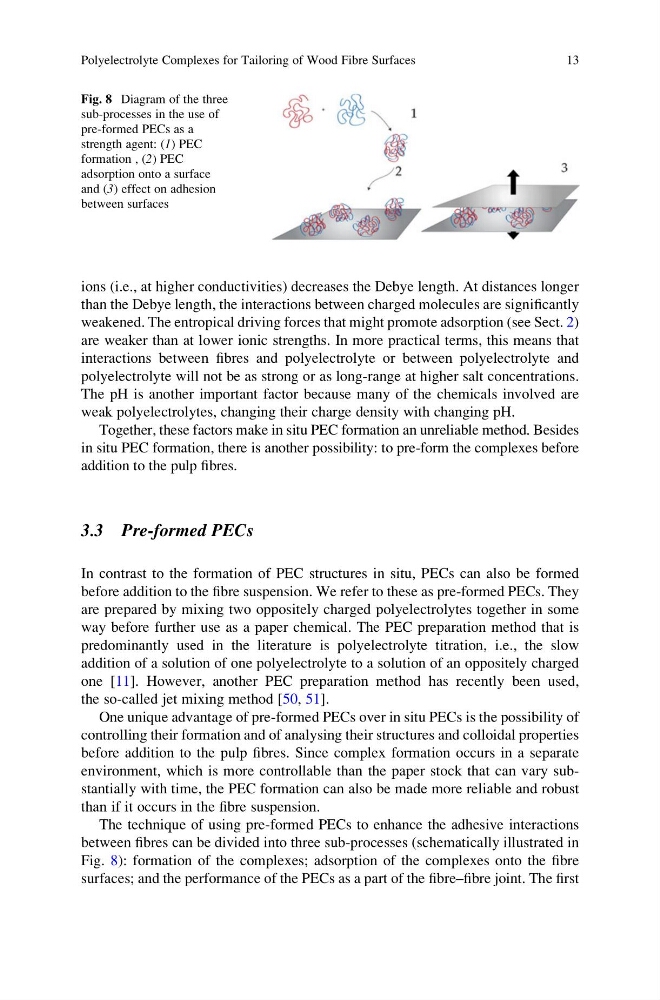
The technique of using pre-formed PECs to enhance the adhesive interactions
between fibres can be divided into three sub-processes (schematically illustrated in
Fig. 8): formation of the complexes; adsorption of the complexes onto the fibre
surfaces; and the performance of the PECs as a part of the fibre–fibre joint. The first
Fig. 8 Diagram of the three
sub-processes in the use of
pre-formed PECs as a
strength agent: (1) PEC
formation , (2) PEC
adsorption onto a surface
and (3) effect on adhesion
between surfaces
Polyelectrolyte Complexes for Tailoring of Wood Fibre Surfaces
13
than the Debye length, the interactions between charged molecules are significantly
weakened. The entropical driving forces that might promote adsorption (see Sect. 2)
are weaker than at lower ionic strengths. In more practical terms, this means that
interactions between fibres and polyelectrolyte or between polyelectrolyte and
polyelectrolyte will not be as strong or as long-range at higher salt concentrations.
The pH is another important factor because many of the chemicals involved are
weak polyelectrolytes, changing their charge density with changing pH.
Together, these factors make in situ PEC formation an unreliable method. Besides
in situ PEC formation, there is another possibility: to pre-form the complexes before
addition to the pulp fibres.
3.3 Pre-formed PECs
In contrast to the formation of PEC structures in situ, PECs can also be formed
before addition to the fibre suspension. We refer to these as pre-formed PECs. They
are prepared by mixing two oppositely charged polyelectrolytes together in some
way before further use as a paper chemical. The PEC preparation method that is
predominantly used in the literature is polyelectrolyte titration, i.e., the slow
addition of a solution of one polyelectrolyte to a solution of an oppositely charged
one [11]. However, another PEC preparation method has recently been used,
the so-called jet mixing method [50, 51].
One unique advantage of pre-formed PECs over in situ PECs is the possibility of
controlling their formation and of analysing their structures and colloidal properties
before addition to the pulp fibres. Since complex formation occurs in a separate
environment, which is more controllable than the paper stock that can vary substantially with time, the PEC formation can also be made more reliable and robust
than if it occurs in the fibre suspension.
The technique of using pre-formed PECs to enhance the adhesive interactions
between fibres can be divided into three sub-processes (schematically illustrated in
Fig. 8): formation of the complexes; adsorption of the complexes onto the fibre
surfaces; and the performance of the PECs as a part of the fibre–fibre joint. The first
Fig. 8 Diagram of the three
sub-processes in the use of
pre-formed PECs as a
strength agent: (1) PEC
formation , (2) PEC
adsorption onto a surface
and (3) effect on adhesion
between surfaces
Polyelectrolyte Complexes for Tailoring of Wood Fibre Surfaces
13