

When PDADMAC was added, 80–90% of the lignin could be precipitated from
aqueous solution if the pH was high, when most of the carboxyl groups in the lignin
are dissociated, making the lignin water soluble. In the washing of pulp, it is
desirable to have macroscopic complexes that precipitate.
In summary, PECs prepared in situ are able to increase not only retention but also
paper strength. However, this latter advantage has not been extensively studied and,
especially, not well controlled and exploited. The problem of controlling in situ
PEC formation is to a large extent related to the chemical environment in which the
in situ PEC formation occurs. The properties of the fibre material (e.g., surface
charge, flexibility and swelling behaviour) depend on the pulping and bleaching
processes used to produce the product grade. Although one paper machine (or even
one entire paper production site) usually runs on the same pulp grade, which is
seldom subject to change, different pulp qualities have different requirements with
regard to the PECs, so that a future product would have to be specifically adapted to
the given situation [42]. The concentrations of DCS may also differ over time as a
result of variations in the incoming wood raw material. The paper furnish can also
have considerable concentrations of various ions, and the concentrations can
vary with time due to variations in, e.g., the fibre raw material. The presence of
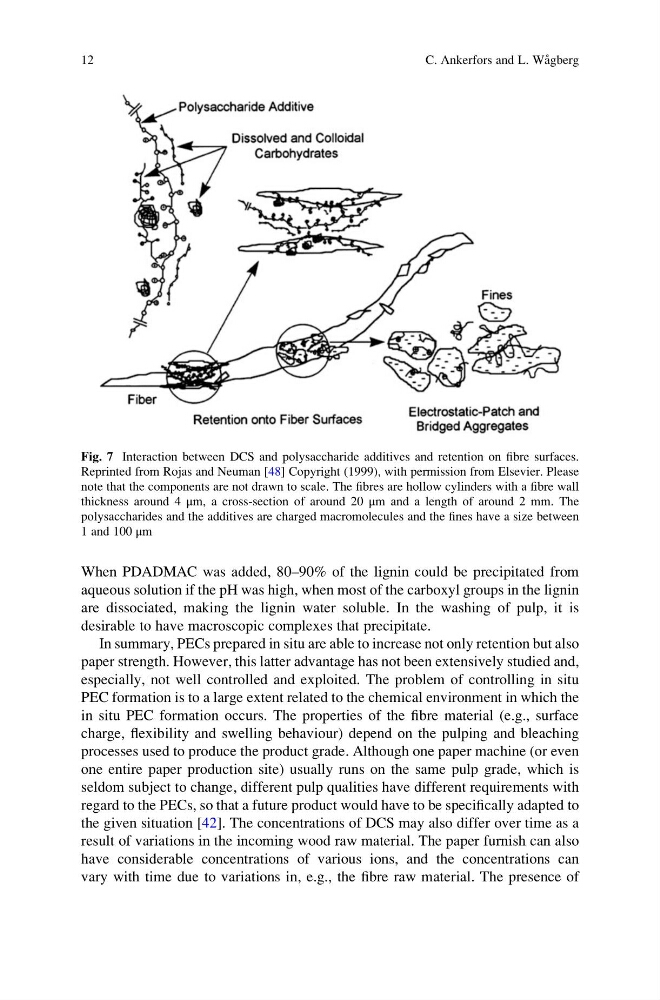
Fig. 7 Interaction between DCS and polysaccharide additives and retention on fibre surfaces.
Reprinted from Rojas and Neuman [48] Copyright (1999), with permission from Elsevier. Please
note that the components are not drawn to scale. The fibres are hollow cylinders with a fibre wall
thickness around 4 μm, a cross-section of around 20 μm and a length of around 2 mm. The
polysaccharides and the additives are charged macromolecules and the fines have a size between
1 and 100 μm
12
C. Ankerfors and L. Wa ˚gberg
aqueous solution if the pH was high, when most of the carboxyl groups in the lignin
are dissociated, making the lignin water soluble. In the washing of pulp, it is
desirable to have macroscopic complexes that precipitate.
In summary, PECs prepared in situ are able to increase not only retention but also
paper strength. However, this latter advantage has not been extensively studied and,
especially, not well controlled and exploited. The problem of controlling in situ
PEC formation is to a large extent related to the chemical environment in which the
in situ PEC formation occurs. The properties of the fibre material (e.g., surface
charge, flexibility and swelling behaviour) depend on the pulping and bleaching
processes used to produce the product grade. Although one paper machine (or even
one entire paper production site) usually runs on the same pulp grade, which is
seldom subject to change, different pulp qualities have different requirements with
regard to the PECs, so that a future product would have to be specifically adapted to
the given situation [42]. The concentrations of DCS may also differ over time as a
result of variations in the incoming wood raw material. The paper furnish can also
have considerable concentrations of various ions, and the concentrations can
vary with time due to variations in, e.g., the fibre raw material. The presence of
Fig. 7 Interaction between DCS and polysaccharide additives and retention on fibre surfaces.
Reprinted from Rojas and Neuman [48] Copyright (1999), with permission from Elsevier. Please
note that the components are not drawn to scale. The fibres are hollow cylinders with a fibre wall
thickness around 4 μm, a cross-section of around 20 μm and a length of around 2 mm. The
polysaccharides and the additives are charged macromolecules and the fines have a size between
1 and 100 μm
12
C. Ankerfors and L. Wa ˚gberg