

the environment of the pyrene did not become more hydrophobic during DNA
binding. The polyplexes showed a bell-shaped dependency of the transfection efficiency as a function of N:P ratio in 293T cells, and comparable values to
Lipofectamine™2000 at a N:P ratio of 10 and 15. The internalization of these
polyplexes was relatively slow; adherence to the cell membrane arose after 6 h,
and after 24 h internalization and release into the cytoplasm had taken place.
Hydrophobicity can be introduced via hydrophobic amino acids such as phenylalanine, as in PEG-b-PLL-b-PLPhe (Fig. 22c), which formed micelles (25–45 nm in
diameter). The CMC of PEG-b-PLL-b-PLPhe decreased with increasing hydrophobic content (i.e., phenylalanine units) [224]. These CMC values (>100 mg mL
À1 )
are quite high compared to those of other polymers. The copolymers did not exhibit
apparent toxicity until a concentration of 500 μg mL
À1 . Due to the presence of PLL,
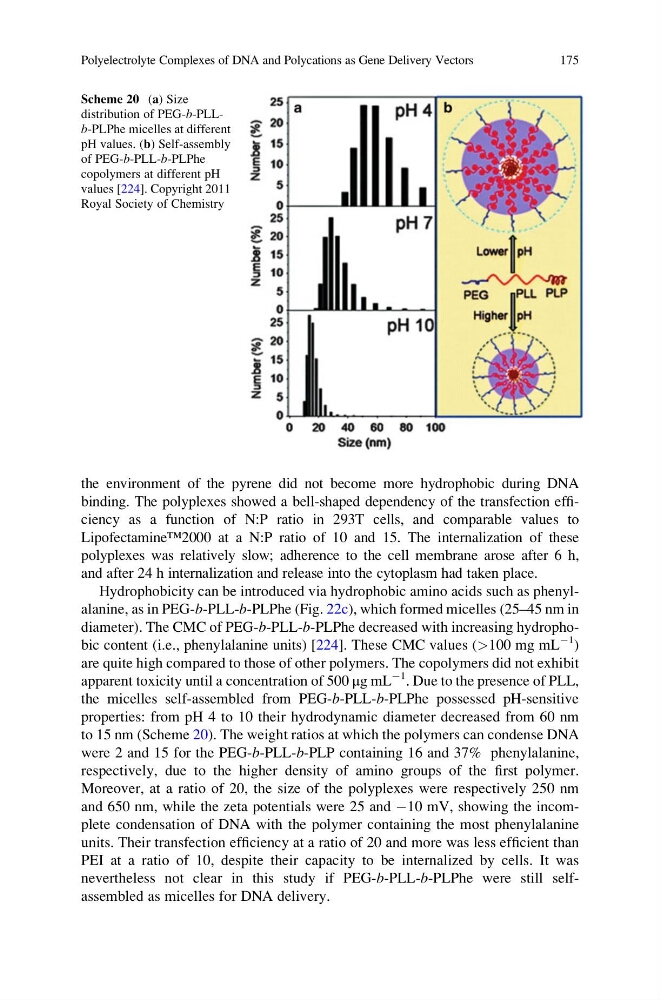
the micelles self-assembled from PEG-b-PLL-b-PLPhe possessed pH-sensitive
properties: from pH 4 to 10 their hydrodynamic diameter decreased from 60 nm
to 15 nm (Scheme 20). The weight ratios at which the polymers can condense DNA
were 2 and 15 for the PEG-b-PLL-b-PLP containing 16 and 37% phenylalanine,
respectively, due to the higher density of amino groups of the first polymer.
Moreover, at a ratio of 20, the size of the polyplexes were respectively 250 nm
and 650 nm, while the zeta potentials were 25 and À10 mV, showing the incomplete condensation of DNA with the polymer containing the most phenylalanine
units. Their transfection efficiency at a ratio of 20 and more was less efficient than
PEI at a ratio of 10, despite their capacity to be internalized by cells. It was
nevertheless not clear in this study if PEG-b-PLL-b-PLPhe were still selfassembled as micelles for DNA delivery.
Scheme 20 (a) Size
distribution of PEG-b-PLLb-PLPhe micelles at different
pH values. (b) Self-assembly
of PEG-b-PLL-b-PLPhe
copolymers at different pH
values [224]. Copyright 2011
Royal Society of Chemistry
Polyelectrolyte Complexes of DNA and Polycations as Gene Delivery Vectors
175
binding. The polyplexes showed a bell-shaped dependency of the transfection efficiency as a function of N:P ratio in 293T cells, and comparable values to
Lipofectamine™2000 at a N:P ratio of 10 and 15. The internalization of these
polyplexes was relatively slow; adherence to the cell membrane arose after 6 h,
and after 24 h internalization and release into the cytoplasm had taken place.
Hydrophobicity can be introduced via hydrophobic amino acids such as phenylalanine, as in PEG-b-PLL-b-PLPhe (Fig. 22c), which formed micelles (25–45 nm in
diameter). The CMC of PEG-b-PLL-b-PLPhe decreased with increasing hydrophobic content (i.e., phenylalanine units) [224]. These CMC values (>100 mg mL
À1 )
are quite high compared to those of other polymers. The copolymers did not exhibit
apparent toxicity until a concentration of 500 μg mL
À1 . Due to the presence of PLL,
the micelles self-assembled from PEG-b-PLL-b-PLPhe possessed pH-sensitive
properties: from pH 4 to 10 their hydrodynamic diameter decreased from 60 nm
to 15 nm (Scheme 20). The weight ratios at which the polymers can condense DNA
were 2 and 15 for the PEG-b-PLL-b-PLP containing 16 and 37% phenylalanine,
respectively, due to the higher density of amino groups of the first polymer.
Moreover, at a ratio of 20, the size of the polyplexes were respectively 250 nm
and 650 nm, while the zeta potentials were 25 and À10 mV, showing the incomplete condensation of DNA with the polymer containing the most phenylalanine
units. Their transfection efficiency at a ratio of 20 and more was less efficient than
PEI at a ratio of 10, despite their capacity to be internalized by cells. It was
nevertheless not clear in this study if PEG-b-PLL-b-PLPhe were still selfassembled as micelles for DNA delivery.
Scheme 20 (a) Size
distribution of PEG-b-PLLb-PLPhe micelles at different
pH values. (b) Self-assembly
of PEG-b-PLL-b-PLPhe
copolymers at different pH
values [224]. Copyright 2011
Royal Society of Chemistry
Polyelectrolyte Complexes of DNA and Polycations as Gene Delivery Vectors
175