

the DNA binding further increased the hydrophobicity of the pyrene’s microenvironment. The transfection efficiency of this nanocarrier was tested on HEK293,
HepG2, and 4T1 mouse breast cancer cell lines and depended strongly on the cell
type and the N:P ratio. In HepG2 cells, the uptake of nanoparticle/DNA-based
complexes was higher than for PEI/DNA, possibly due to their higher positive
charge, which at the same time probably hindered the release of DNA intracellularly, leading to slightly lower overall gene expression. Importantly the amount of
nanoparticles needed for optimal gene transfection was much lower than their
IC 50 values (around 150 μg mL
À1 depending on the cell line).
The hydrophobic part in amphiphiles can be the backbone, for instance poly
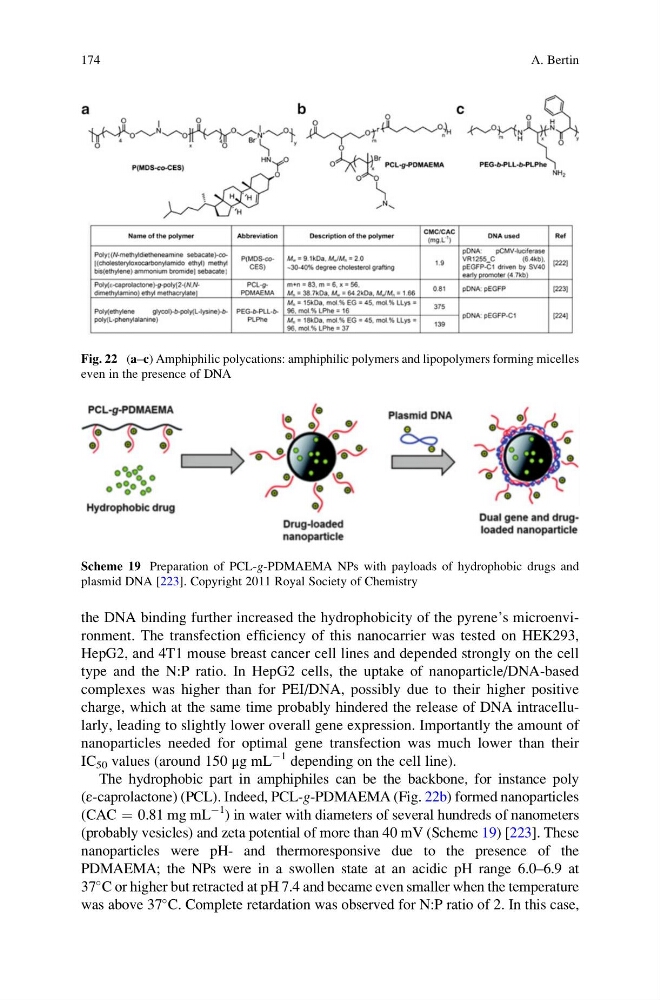
(ε-caprolactone) (PCL). Indeed, PCL-g-PDMAEMA (Fig. 22b) formed nanoparticles
(CAC ¼ 0.81 mg mL
À1
) in water with diameters of several hundreds of nanometers
(probably vesicles) and zeta potential of more than 40 mV (Scheme 19) [223]. These
nanoparticles were pH- and thermoresponsive due to the presence of the
PDMAEMA; the NPs were in a swollen state at an acidic pH range 6.0–6.9 at
37
C or higher but retracted at pH 7.4 and became even smaller when the temperature
was above 37
C. Complete retardation was observed for N:P ratio of 2. In this case,
Fig. 22 (a–c) Amphiphilic polycations: amphiphilic polymers and lipopolymers forming micelles
even in the presence of DNA
Scheme 19 Preparation of PCL-g-PDMAEMA NPs with payloads of hydrophobic drugs and
plasmid DNA [223]. Copyright 2011 Royal Society of Chemistry
174
A. Bertin
HepG2, and 4T1 mouse breast cancer cell lines and depended strongly on the cell
type and the N:P ratio. In HepG2 cells, the uptake of nanoparticle/DNA-based
complexes was higher than for PEI/DNA, possibly due to their higher positive
charge, which at the same time probably hindered the release of DNA intracellularly, leading to slightly lower overall gene expression. Importantly the amount of
nanoparticles needed for optimal gene transfection was much lower than their
IC 50 values (around 150 μg mL
À1 depending on the cell line).
The hydrophobic part in amphiphiles can be the backbone, for instance poly
(ε-caprolactone) (PCL). Indeed, PCL-g-PDMAEMA (Fig. 22b) formed nanoparticles
(CAC ¼ 0.81 mg mL
À1
) in water with diameters of several hundreds of nanometers
(probably vesicles) and zeta potential of more than 40 mV (Scheme 19) [223]. These
nanoparticles were pH- and thermoresponsive due to the presence of the
PDMAEMA; the NPs were in a swollen state at an acidic pH range 6.0–6.9 at
37
C or higher but retracted at pH 7.4 and became even smaller when the temperature
was above 37
C. Complete retardation was observed for N:P ratio of 2. In this case,
Fig. 22 (a–c) Amphiphilic polycations: amphiphilic polymers and lipopolymers forming micelles
even in the presence of DNA
Scheme 19 Preparation of PCL-g-PDMAEMA NPs with payloads of hydrophobic drugs and
plasmid DNA [223]. Copyright 2011 Royal Society of Chemistry
174
A. Bertin