

whose structure was then destroyed by addition of DNA (concentration before
mixing not given). Unfortunately, the formation of micelles has not been proven
(no TEM pictures of PEG-b-PLL-g-DOPE before complexation with DNA and no
determination of CMC), but is extremely plausible given the concentration of
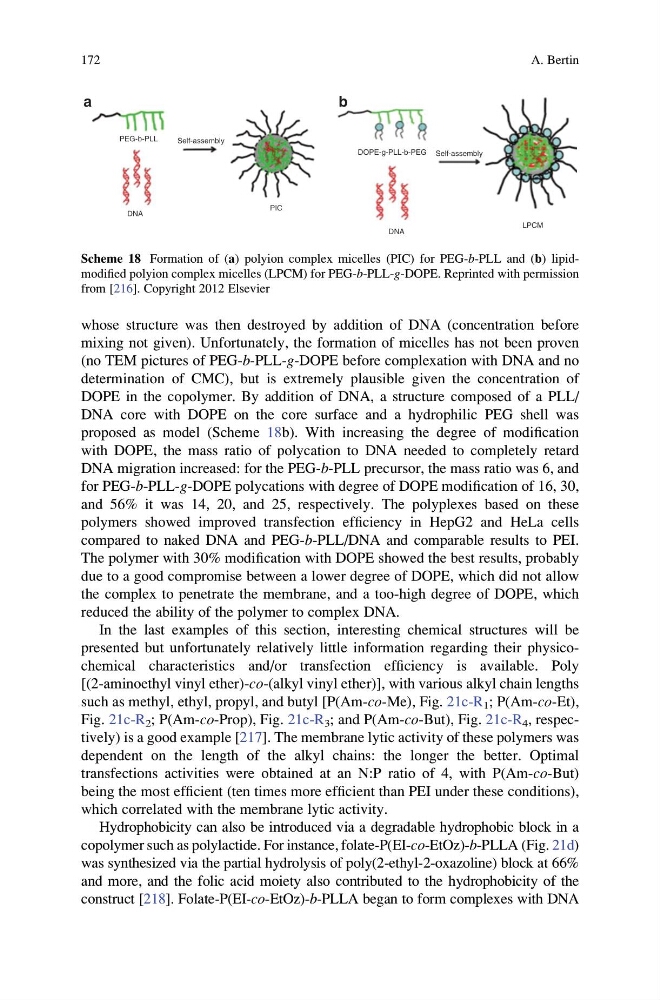
DOPE in the copolymer. By addition of DNA, a structure composed of a PLL/
DNA core with DOPE on the core surface and a hydrophilic PEG shell was
proposed as model (Scheme 18b). With increasing the degree of modification
with DOPE, the mass ratio of polycation to DNA needed to completely retard
DNA migration increased: for the PEG-b-PLL precursor, the mass ratio was 6, and
for PEG-b-PLL-g-DOPE polycations with degree of DOPE modification of 16, 30,
and 56% it was 14, 20, and 25, respectively. The polyplexes based on these
polymers showed improved transfection efficiency in HepG2 and HeLa cells
compared to naked DNA and PEG-b-PLL/DNA and comparable results to PEI.
The polymer with 30% modification with DOPE showed the best results, probably
due to a good compromise between a lower degree of DOPE, which did not allow
the complex to penetrate the membrane, and a too-high degree of DOPE, which
reduced the ability of the polymer to complex DNA.
In the last examples of this section, interesting chemical structures will be
presented but unfortunately relatively little information regarding their physicochemical characteristics and/or transfection efficiency is available. Poly
[(2-aminoethyl vinyl ether)-co-(alkyl vinyl ether)], with various alkyl chain lengths
such as methyl, ethyl, propyl, and butyl [P(Am-co-Me), Fig. 21c-R 1 ; P(Am-co-Et),
Fig. 21c-R 2 ; P(Am-co-Prop), Fig. 21c-R 3 ; and P(Am-co-But), Fig. 21c-R 4 , respectively) is a good example [217]. The membrane lytic activity of these polymers was
dependent on the length of the alkyl chains: the longer the better. Optimal
transfections activities were obtained at an N:P ratio of 4, with P(Am-co-But)
being the most efficient (ten times more efficient than PEI under these conditions),
which correlated with the membrane lytic activity.
Hydrophobicity can also be introduced via a degradable hydrophobic block in a
copolymer such as polylactide. For instance, folate-P(EI-co-EtOz)-b-PLLA (Fig. 21d)
was synthesized via the partial hydrolysis of poly(2-ethyl-2-oxazoline) block at 66%
and more, and the folic acid moiety also contributed to the hydrophobicity of the
construct [218]. Folate-P(EI-co-EtOz)-b-PLLA began to form complexes with DNA
Self-assembly
Self-assembly
PIC
DNA
LPCM
DOPE-g-PLL-b-PEG
DNA
PEG-b-PLL
a
b
Scheme 18 Formation of (a) polyion complex micelles (PIC) for PEG-b-PLL and (b) lipidmodified polyion complex micelles (LPCM) for PEG-b-PLL-g-DOPE. Reprinted with permission
from [216]. Copyright 2012 Elsevier
172
A. Bertin
mixing not given). Unfortunately, the formation of micelles has not been proven
(no TEM pictures of PEG-b-PLL-g-DOPE before complexation with DNA and no
determination of CMC), but is extremely plausible given the concentration of
DOPE in the copolymer. By addition of DNA, a structure composed of a PLL/
DNA core with DOPE on the core surface and a hydrophilic PEG shell was
proposed as model (Scheme 18b). With increasing the degree of modification
with DOPE, the mass ratio of polycation to DNA needed to completely retard
DNA migration increased: for the PEG-b-PLL precursor, the mass ratio was 6, and
for PEG-b-PLL-g-DOPE polycations with degree of DOPE modification of 16, 30,
and 56% it was 14, 20, and 25, respectively. The polyplexes based on these
polymers showed improved transfection efficiency in HepG2 and HeLa cells
compared to naked DNA and PEG-b-PLL/DNA and comparable results to PEI.
The polymer with 30% modification with DOPE showed the best results, probably
due to a good compromise between a lower degree of DOPE, which did not allow
the complex to penetrate the membrane, and a too-high degree of DOPE, which
reduced the ability of the polymer to complex DNA.
In the last examples of this section, interesting chemical structures will be
presented but unfortunately relatively little information regarding their physicochemical characteristics and/or transfection efficiency is available. Poly
[(2-aminoethyl vinyl ether)-co-(alkyl vinyl ether)], with various alkyl chain lengths
such as methyl, ethyl, propyl, and butyl [P(Am-co-Me), Fig. 21c-R 1 ; P(Am-co-Et),
Fig. 21c-R 2 ; P(Am-co-Prop), Fig. 21c-R 3 ; and P(Am-co-But), Fig. 21c-R 4 , respectively) is a good example [217]. The membrane lytic activity of these polymers was
dependent on the length of the alkyl chains: the longer the better. Optimal
transfections activities were obtained at an N:P ratio of 4, with P(Am-co-But)
being the most efficient (ten times more efficient than PEI under these conditions),
which correlated with the membrane lytic activity.
Hydrophobicity can also be introduced via a degradable hydrophobic block in a
copolymer such as polylactide. For instance, folate-P(EI-co-EtOz)-b-PLLA (Fig. 21d)
was synthesized via the partial hydrolysis of poly(2-ethyl-2-oxazoline) block at 66%
and more, and the folic acid moiety also contributed to the hydrophobicity of the
construct [218]. Folate-P(EI-co-EtOz)-b-PLLA began to form complexes with DNA
Self-assembly
Self-assembly
PIC
DNA
LPCM
DOPE-g-PLL-b-PEG
DNA
PEG-b-PLL
a
b
Scheme 18 Formation of (a) polyion complex micelles (PIC) for PEG-b-PLL and (b) lipidmodified polyion complex micelles (LPCM) for PEG-b-PLL-g-DOPE. Reprinted with permission
from [216]. Copyright 2012 Elsevier
172
A. Bertin