

the two other polycations (1.4 and 6.3 mol% cholesterol). Moreover, by fast addition
of polycations to DNA, ζ-potential increased with increasing content of cholesterol,
i.e., with the hydrophobicity of the polycations. This effect was explained by the
authors as such: DNA and polycations were intermixed in the initially formed
complex (electrostatic interactions) giving rise to hydrophobic particles. The particles
started to attract hydrophobic polycations by hydrophobic interaction, forming
core–shell structures with the strongly hydrophobic cholesterol moieties of
polycations attached to the particle surface and the remaining positively charged
parts of polycations forming the shell, increasing the ζ-potential of the particle
surface. The particle growth was then stopped by repulsive interactions of positively
charged PECs and polycations, and the colloid stability of PECs increased with
increasing content of side chains bearing cholesterol moieties, which is related to
the level of surface charge and hydrophobicity of polycations.
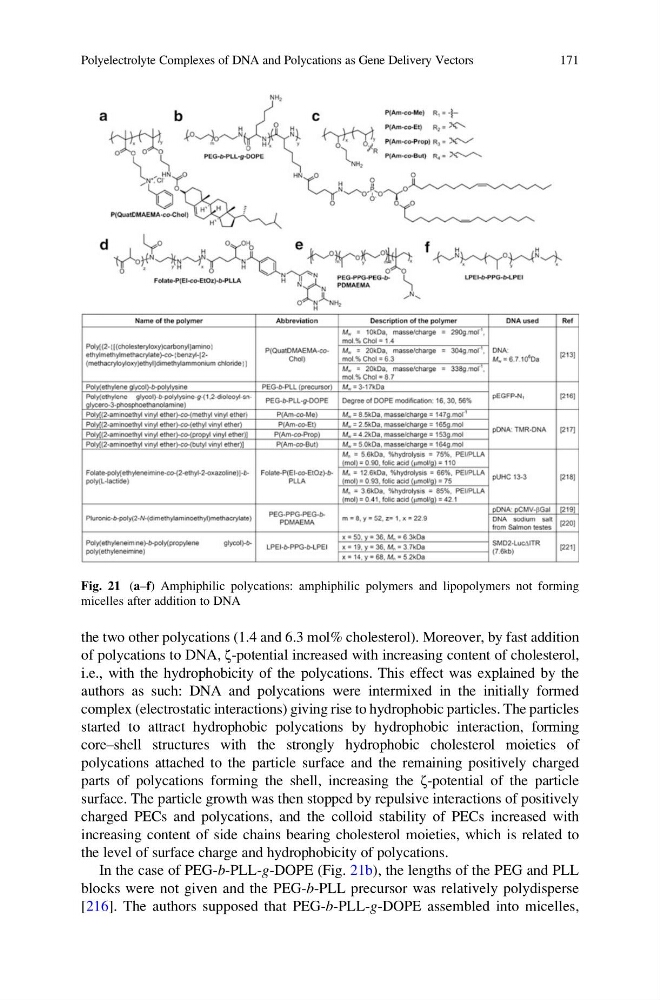
In the case of PEG-b-PLL-g-DOPE (Fig. 21b), the lengths of the PEG and PLL
blocks were not given and the PEG-b-PLL precursor was relatively polydisperse
[216]. The authors supposed that PEG-b-PLL-g-DOPE assembled into micelles,
Fig. 21 (a–f) Amphiphilic polycations: amphiphilic polymers and lipopolymers not forming
micelles after addition to DNA
Polyelectrolyte Complexes of DNA and Polycations as Gene Delivery Vectors
171
of polycations to DNA, ζ-potential increased with increasing content of cholesterol,
i.e., with the hydrophobicity of the polycations. This effect was explained by the
authors as such: DNA and polycations were intermixed in the initially formed
complex (electrostatic interactions) giving rise to hydrophobic particles. The particles
started to attract hydrophobic polycations by hydrophobic interaction, forming
core–shell structures with the strongly hydrophobic cholesterol moieties of
polycations attached to the particle surface and the remaining positively charged
parts of polycations forming the shell, increasing the ζ-potential of the particle
surface. The particle growth was then stopped by repulsive interactions of positively
charged PECs and polycations, and the colloid stability of PECs increased with
increasing content of side chains bearing cholesterol moieties, which is related to
the level of surface charge and hydrophobicity of polycations.
In the case of PEG-b-PLL-g-DOPE (Fig. 21b), the lengths of the PEG and PLL
blocks were not given and the PEG-b-PLL precursor was relatively polydisperse
[216]. The authors supposed that PEG-b-PLL-g-DOPE assembled into micelles,
Fig. 21 (a–f) Amphiphilic polycations: amphiphilic polymers and lipopolymers not forming
micelles after addition to DNA
Polyelectrolyte Complexes of DNA and Polycations as Gene Delivery Vectors
171