

2.2.1 Strong Polyelectrolytes with Alkyl Chains
A pioneering work of Kabanov et al. dealt with poly(N-ethyl-4-vinylpyridinium)
bromide (PEVP) and its copolymer with N-4-vinylpyridinium modified with a
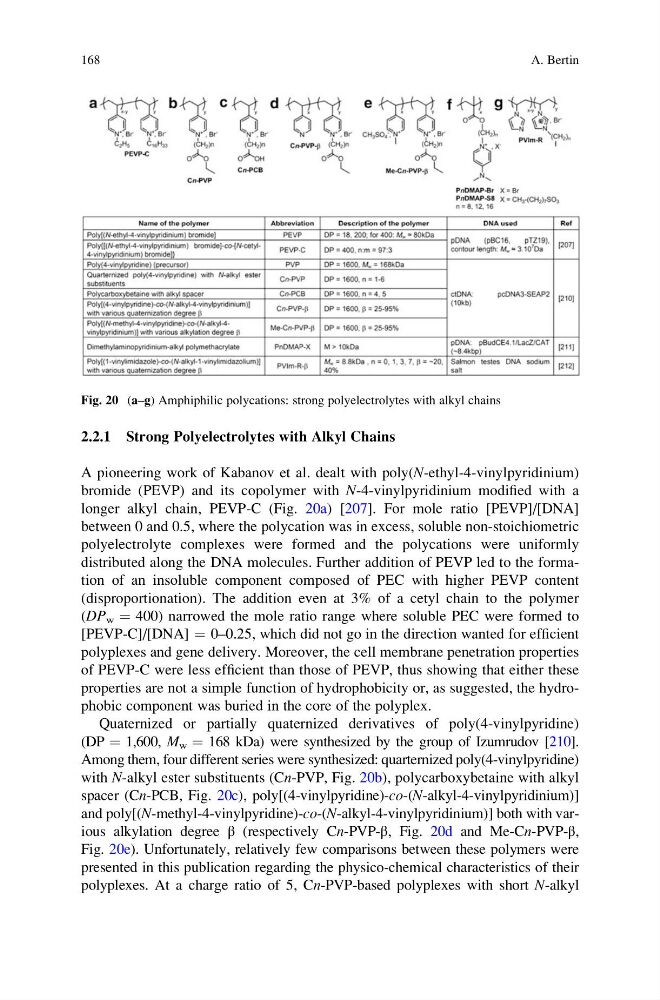
longer alkyl chain, PEVP-C (Fig. 20a) [207]. For mole ratio [PEVP]/[DNA]
between 0 and 0.5, where the polycation was in excess, soluble non-stoichiometric
polyelectrolyte complexes were formed and the polycations were uniformly
distributed along the DNA molecules. Further addition of PEVP led to the formation of an insoluble component composed of PEC with higher PEVP content
(disproportionation). The addition even at 3% of a cetyl chain to the polymer
(DP w ¼ 400) narrowed the mole ratio range where soluble PEC were formed to
[PEVP-C]/[DNA] ¼ 0–0.25, which did not go in the direction wanted for efficient
polyplexes and gene delivery. Moreover, the cell membrane penetration properties
of PEVP-C were less efficient than those of PEVP, thus showing that either these
properties are not a simple function of hydrophobicity or, as suggested, the hydrophobic component was buried in the core of the polyplex.
Quaternized or partially quaternized derivatives of poly(4-vinylpyridine)
(DP ¼ 1,600, M w ¼ 168 kDa) were synthesized by the group of Izumrudov [210].
Among them, four different series were synthesized: quarternized poly(4-vinylpyridine)
with N-alkyl ester substituents (Cn-PVP, Fig. 20b), polycarboxybetaine with alkyl
spacer (Cn-PCB, Fig. 20c), poly[(4-vinylpyridine)-co-(N-alkyl-4-vinylpyridinium)]
and poly[(N-methyl-4-vinylpyridine)-co-(N-alkyl-4-vinylpyridinium)] both with various alkylation degree β (respectively Cn-PVP-β, Fig. 20d and Me-Cn-PVP-β,
Fig. 20e). Unfortunately, relatively few comparisons between these polymers were
presented in this publication regarding the physico-chemical characteristics of their
polyplexes. At a charge ratio of 5, Cn-PVP-based polyplexes with short N-alkyl
Fig. 20 (a–g) Amphiphilic polycations: strong polyelectrolytes with alkyl chains
168
A. Bertin
A pioneering work of Kabanov et al. dealt with poly(N-ethyl-4-vinylpyridinium)
bromide (PEVP) and its copolymer with N-4-vinylpyridinium modified with a
longer alkyl chain, PEVP-C (Fig. 20a) [207]. For mole ratio [PEVP]/[DNA]
between 0 and 0.5, where the polycation was in excess, soluble non-stoichiometric
polyelectrolyte complexes were formed and the polycations were uniformly
distributed along the DNA molecules. Further addition of PEVP led to the formation of an insoluble component composed of PEC with higher PEVP content
(disproportionation). The addition even at 3% of a cetyl chain to the polymer
(DP w ¼ 400) narrowed the mole ratio range where soluble PEC were formed to
[PEVP-C]/[DNA] ¼ 0–0.25, which did not go in the direction wanted for efficient
polyplexes and gene delivery. Moreover, the cell membrane penetration properties
of PEVP-C were less efficient than those of PEVP, thus showing that either these
properties are not a simple function of hydrophobicity or, as suggested, the hydrophobic component was buried in the core of the polyplex.
Quaternized or partially quaternized derivatives of poly(4-vinylpyridine)
(DP ¼ 1,600, M w ¼ 168 kDa) were synthesized by the group of Izumrudov [210].
Among them, four different series were synthesized: quarternized poly(4-vinylpyridine)
with N-alkyl ester substituents (Cn-PVP, Fig. 20b), polycarboxybetaine with alkyl
spacer (Cn-PCB, Fig. 20c), poly[(4-vinylpyridine)-co-(N-alkyl-4-vinylpyridinium)]
and poly[(N-methyl-4-vinylpyridine)-co-(N-alkyl-4-vinylpyridinium)] both with various alkylation degree β (respectively Cn-PVP-β, Fig. 20d and Me-Cn-PVP-β,
Fig. 20e). Unfortunately, relatively few comparisons between these polymers were
presented in this publication regarding the physico-chemical characteristics of their
polyplexes. At a charge ratio of 5, Cn-PVP-based polyplexes with short N-alkyl
Fig. 20 (a–g) Amphiphilic polycations: strong polyelectrolytes with alkyl chains
168
A. Bertin