

especially at high N:P ratios, showing the importance of the presence of both
primary and secondary amines in the polymers used for polyplex formation.
Nevertheless, at comparable N:P ratio (10), this construct was less efficient by a
factor of 5 than ExGen500™, but was also less cytotoxic. In order to improve the
results of PEG-b-P(Asp-DETA) [203], Kataoka and colleagues introduced some
lysine moieties, obtaining PEG-b-P[LLys-co-(Asp-DETA)] with various percentage of lysine units, i.e., 24, 47, 71, and 100% (Fig. 18e) [204]. As expected, the
extent of fluorescence quenching in the EtBr dye-exclusion assay (i.e., tight complexation) was proportional to the amount of lysine units present in the polymer.
Interestingly, the fluorescence, which was leveled off at a N:P ratio of 2 for PEG-bP(Asp-DETA), showed a leveling off at N:P ratio of 1 for these PEG-b-P[LLys-co(Asp-DETA)] (from ~25 to 100% lysine units), indicating the beneficial effect of
the lysine units for complexation. This corresponded also to the zeta potential
results, which were nearly neutral for all polymers at this N:P ratio. In view of
the trend in the zeta potential, the authors suggested that at high concentration of
polymer, the lysine units may preferentially bind to the pDNA, replacing the
Asp-DETA units and resulting in the continuous binding of the block catiomers
until the lysine units saturate the available binding sites. By replacing half or
more of the Asp-DETA units by lysine units, the internalization of the polyplexes
was increased tenfold and the transfection efficiency was 100 times that of PEG-bP(Asp-DETA).
2.2 Amphiphilic Polycations
The cationic charges, which are needed for efficient DNA condensation, and
hydrophobic domains, which promote membrane interaction, have been combined
in hydrophobically modified polymers such as PEI, PLL, PAMAM, and poly(Nethyl-4-vinylpyridinium) salts [205–208]. Moreover, the hydrophobic part
contributes to the hydrophobically driven interaction of DNA with polycation
[209]. This increases the hydrophobic component and therefore there is need of
increased steric stabilization in order to obtain colloidally stable polyplexes. Some
examples are presented in the next sections.
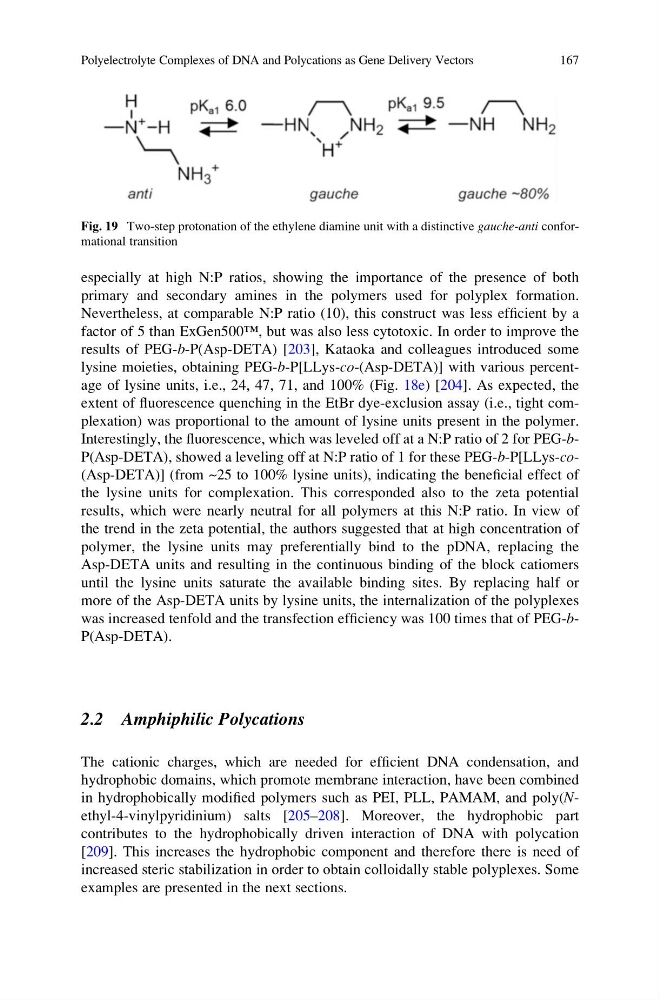
Fig. 19 Two-step protonation of the ethylene diamine unit with a distinctive gauche-anti conformational transition
Polyelectrolyte Complexes of DNA and Polycations as Gene Delivery Vectors
167
primary and secondary amines in the polymers used for polyplex formation.
Nevertheless, at comparable N:P ratio (10), this construct was less efficient by a
factor of 5 than ExGen500™, but was also less cytotoxic. In order to improve the
results of PEG-b-P(Asp-DETA) [203], Kataoka and colleagues introduced some
lysine moieties, obtaining PEG-b-P[LLys-co-(Asp-DETA)] with various percentage of lysine units, i.e., 24, 47, 71, and 100% (Fig. 18e) [204]. As expected, the
extent of fluorescence quenching in the EtBr dye-exclusion assay (i.e., tight complexation) was proportional to the amount of lysine units present in the polymer.
Interestingly, the fluorescence, which was leveled off at a N:P ratio of 2 for PEG-bP(Asp-DETA), showed a leveling off at N:P ratio of 1 for these PEG-b-P[LLys-co(Asp-DETA)] (from ~25 to 100% lysine units), indicating the beneficial effect of
the lysine units for complexation. This corresponded also to the zeta potential
results, which were nearly neutral for all polymers at this N:P ratio. In view of
the trend in the zeta potential, the authors suggested that at high concentration of
polymer, the lysine units may preferentially bind to the pDNA, replacing the
Asp-DETA units and resulting in the continuous binding of the block catiomers
until the lysine units saturate the available binding sites. By replacing half or
more of the Asp-DETA units by lysine units, the internalization of the polyplexes
was increased tenfold and the transfection efficiency was 100 times that of PEG-bP(Asp-DETA).
2.2 Amphiphilic Polycations
The cationic charges, which are needed for efficient DNA condensation, and
hydrophobic domains, which promote membrane interaction, have been combined
in hydrophobically modified polymers such as PEI, PLL, PAMAM, and poly(Nethyl-4-vinylpyridinium) salts [205–208]. Moreover, the hydrophobic part
contributes to the hydrophobically driven interaction of DNA with polycation
[209]. This increases the hydrophobic component and therefore there is need of
increased steric stabilization in order to obtain colloidally stable polyplexes. Some
examples are presented in the next sections.
Fig. 19 Two-step protonation of the ethylene diamine unit with a distinctive gauche-anti conformational transition
Polyelectrolyte Complexes of DNA and Polycations as Gene Delivery Vectors
167