

restraint than the linear-formed DNA; thus, it is likely that the differences in
molecular topology may crucially affect the condensation process of the DNA
molecules in the sense that condensation may not be complete at a stoichiometric
charge ratio for pDNA due to steric reasons, requiring excess PLL strands to
promote further condensation. They also hypothesized that such a significant
decrease in the average diameter between ratios 1 and 2 (~120 nm to ~90 nm)
could be also due to a concomitant decrease in the association number of these
micelle-like polyplexes, which was confirmed in the case of PEG 272 -b-PLL 48 by
LS. They could also show that a higher PEG content in the polymer resulted in
micellar polyplexes with a decreased association number. The transfection
efficiency in HEK293 cells was improved by increasing the length of the PLL
segment and showed a bell-shaped dependency (as a function of the N:P ratio).
The performance of PEG 272 -b-PLL 48 was comparable to that of Lipofectamine™
and was partly attributed to a more favorable cellular association than that of the
derivatives with a shorter PLL segment.
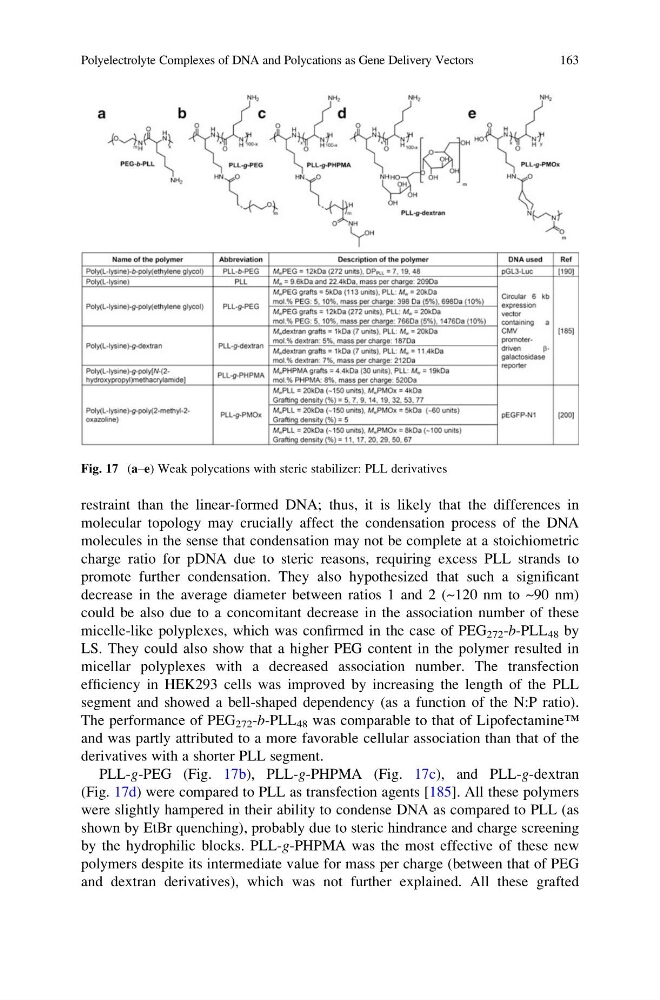
PLL-g-PEG (Fig. 17b), PLL-g-PHPMA (Fig. 17c), and PLL-g-dextran
(Fig. 17d) were compared to PLL as transfection agents [185]. All these polymers
were slightly hampered in their ability to condense DNA as compared to PLL (as
shown by EtBr quenching), probably due to steric hindrance and charge screening
by the hydrophilic blocks. PLL-g-PHPMA was the most effective of these new
polymers despite its intermediate value for mass per charge (between that of PEG
and dextran derivatives), which was not further explained. All these grafted
Fig. 17 (a–e) Weak polycations with steric stabilizer: PLL derivatives
Polyelectrolyte Complexes of DNA and Polycations as Gene Delivery Vectors
163
molecular topology may crucially affect the condensation process of the DNA
molecules in the sense that condensation may not be complete at a stoichiometric
charge ratio for pDNA due to steric reasons, requiring excess PLL strands to
promote further condensation. They also hypothesized that such a significant
decrease in the average diameter between ratios 1 and 2 (~120 nm to ~90 nm)
could be also due to a concomitant decrease in the association number of these
micelle-like polyplexes, which was confirmed in the case of PEG 272 -b-PLL 48 by
LS. They could also show that a higher PEG content in the polymer resulted in
micellar polyplexes with a decreased association number. The transfection
efficiency in HEK293 cells was improved by increasing the length of the PLL
segment and showed a bell-shaped dependency (as a function of the N:P ratio).
The performance of PEG 272 -b-PLL 48 was comparable to that of Lipofectamine™
and was partly attributed to a more favorable cellular association than that of the
derivatives with a shorter PLL segment.
PLL-g-PEG (Fig. 17b), PLL-g-PHPMA (Fig. 17c), and PLL-g-dextran
(Fig. 17d) were compared to PLL as transfection agents [185]. All these polymers
were slightly hampered in their ability to condense DNA as compared to PLL (as
shown by EtBr quenching), probably due to steric hindrance and charge screening
by the hydrophilic blocks. PLL-g-PHPMA was the most effective of these new
polymers despite its intermediate value for mass per charge (between that of PEG
and dextran derivatives), which was not further explained. All these grafted
Fig. 17 (a–e) Weak polycations with steric stabilizer: PLL derivatives
Polyelectrolyte Complexes of DNA and Polycations as Gene Delivery Vectors
163