

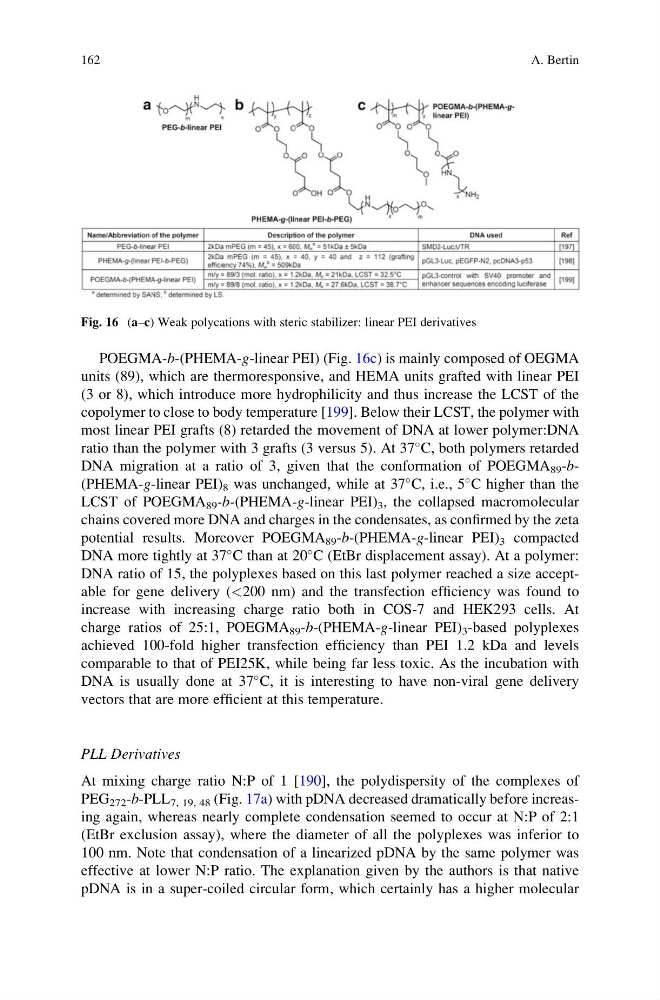
POEGMA-b-(PHEMA-g-linear PEI) (Fig. 16c) is mainly composed of OEGMA
units (89), which are thermoresponsive, and HEMA units grafted with linear PEI
(3 or 8), which introduce more hydrophilicity and thus increase the LCST of the
copolymer to close to body temperature [199]. Below their LCST, the polymer with
most linear PEI grafts (8) retarded the movement of DNA at lower polymer:DNA
ratio than the polymer with 3 grafts (3 versus 5). At 37
C, both polymers retarded
DNA migration at a ratio of 3, given that the conformation of POEGMA 89 -b(PHEMA-g-linear PEI) 8 was unchanged, while at 37
C, i.e., 5
C higher than the
LCST of POEGMA 89 -b-(PHEMA-g-linear PEI) 3 , the collapsed macromolecular
chains covered more DNA and charges in the condensates, as confirmed by the zeta
potential results. Moreover POEGMA 89 -b-(PHEMA-g-linear PEI) 3 compacted
DNA more tightly at 37
C than at 20
C (EtBr displacement assay). At a polymer:
DNA ratio of 15, the polyplexes based on this last polymer reached a size acceptable for gene delivery (<200 nm) and the transfection efficiency was found to
increase with increasing charge ratio both in COS-7 and HEK293 cells. At
charge ratios of 25:1, POEGMA 89 -b-(PHEMA-g-linear PEI) 3 -based polyplexes
achieved 100-fold higher transfection efficiency than PEI 1.2 kDa and levels
comparable to that of PEI25K, while being far less toxic. As the incubation with
DNA is usually done at 37
C, it is interesting to have non-viral gene delivery
vectors that are more efficient at this temperature.
PLL Derivatives
At mixing charge ratio N:P of 1 [190], the polydispersity of the complexes of
PEG 272 -b-PLL 7, 19, 48 (Fig. 17a) with pDNA decreased dramatically before increasing again, whereas nearly complete condensation seemed to occur at N:P of 2:1
(EtBr exclusion assay), where the diameter of all the polyplexes was inferior to
100 nm. Note that condensation of a linearized pDNA by the same polymer was
effective at lower N:P ratio. The explanation given by the authors is that native
pDNA is in a super-coiled circular form, which certainly has a higher molecular
Fig. 16 (a–c) Weak polycations with steric stabilizer: linear PEI derivatives
162
A. Bertin
units (89), which are thermoresponsive, and HEMA units grafted with linear PEI
(3 or 8), which introduce more hydrophilicity and thus increase the LCST of the
copolymer to close to body temperature [199]. Below their LCST, the polymer with
most linear PEI grafts (8) retarded the movement of DNA at lower polymer:DNA
ratio than the polymer with 3 grafts (3 versus 5). At 37
C, both polymers retarded
DNA migration at a ratio of 3, given that the conformation of POEGMA 89 -b(PHEMA-g-linear PEI) 8 was unchanged, while at 37
C, i.e., 5
C higher than the
LCST of POEGMA 89 -b-(PHEMA-g-linear PEI) 3 , the collapsed macromolecular
chains covered more DNA and charges in the condensates, as confirmed by the zeta
potential results. Moreover POEGMA 89 -b-(PHEMA-g-linear PEI) 3 compacted
DNA more tightly at 37
C than at 20
C (EtBr displacement assay). At a polymer:
DNA ratio of 15, the polyplexes based on this last polymer reached a size acceptable for gene delivery (<200 nm) and the transfection efficiency was found to
increase with increasing charge ratio both in COS-7 and HEK293 cells. At
charge ratios of 25:1, POEGMA 89 -b-(PHEMA-g-linear PEI) 3 -based polyplexes
achieved 100-fold higher transfection efficiency than PEI 1.2 kDa and levels
comparable to that of PEI25K, while being far less toxic. As the incubation with
DNA is usually done at 37
C, it is interesting to have non-viral gene delivery
vectors that are more efficient at this temperature.
PLL Derivatives
At mixing charge ratio N:P of 1 [190], the polydispersity of the complexes of
PEG 272 -b-PLL 7, 19, 48 (Fig. 17a) with pDNA decreased dramatically before increasing again, whereas nearly complete condensation seemed to occur at N:P of 2:1
(EtBr exclusion assay), where the diameter of all the polyplexes was inferior to
100 nm. Note that condensation of a linearized pDNA by the same polymer was
effective at lower N:P ratio. The explanation given by the authors is that native
pDNA is in a super-coiled circular form, which certainly has a higher molecular
Fig. 16 (a–c) Weak polycations with steric stabilizer: linear PEI derivatives
162
A. Bertin