

solution was added, there were insufficient unbound polymer chains in the solution
to induce micellization at 2 μg mL
À1 , shifting the CMC to a higher value [192].
A series of P(DMAEMA-co-OEGMA) (Fig. 12b) copolymers with constant
chain length of 120 units but with various lengths of the OEG side chains and
different comonomer compositions (variable DMAEMA/OEGMA composition,
M n ¼ 22.7–54.6 kDa) were studied by Rudolph and colleagues [193]. Among
these polymers, DNA complexation by P(DMAEMA-co-OEGMA) copolymers
with low f OEGMA (<50%) increased with increasing N:P ratios and decreased
with increasing OEGMA molar ratio (f OEGMA ) and molecular weight. At high
f OEGMA (>50%), DNA complexation was abolished. Only at low f OEGMA (~17%)
and low OEGMA molecular weight (about nine EG units) was pDNA migration
completely retarded (indicating complete DNA complexation), as observed for
PDMAEMA. Verbaan and colleagues had already observed that copolymers with
a high degree of PEG grafting (i.e., PEG < 22%) were not capable of binding to
pDNA [194]. In general, the efficiency of the polyplexes regarding complexation of
pDNA decreases with increasing f OEGMA and OEGMA chain length, due to the
reduction of the positive charge density of PDMAEMA and the introduction of
sterically bulky OEGMA. This is consistent with the increasing particle size of the
P(DMAEMA-co-OEGMA)-based polyplexes (condensation less efficient) and
decreasing zeta potential (shielding effect of PEG) in a direct proportion to increasing f OEGMA and OEG chain length. None of these copolymers were cytotoxic to
BEAS-2B cells, even at 500 μg mL
À1 . Following the same trend as for complexation, the transfection efficiency was dependent on the N:P ratio and decreased with
increasing f OEGMA , in BEAS-2B cells as well as in MLE 12 cells. The transfection
efficiency of the most efficient P(DMAEMA-co-OEGMA)-based polyplex was still
70
80
0.1
100
10
N/P ratio
1
100
90
60
Rh (nm)
50
40
30
1
free polymer
micelles
region where polymer
unimers coexist with
Polymer/DNA complexes
Polymer/DNA
complexes
free polymer
chains
plasmid DNA
2
1
0.1
0.01
PEO-b-PDEAEMA concentration (mg/mL)
0.001
a
b
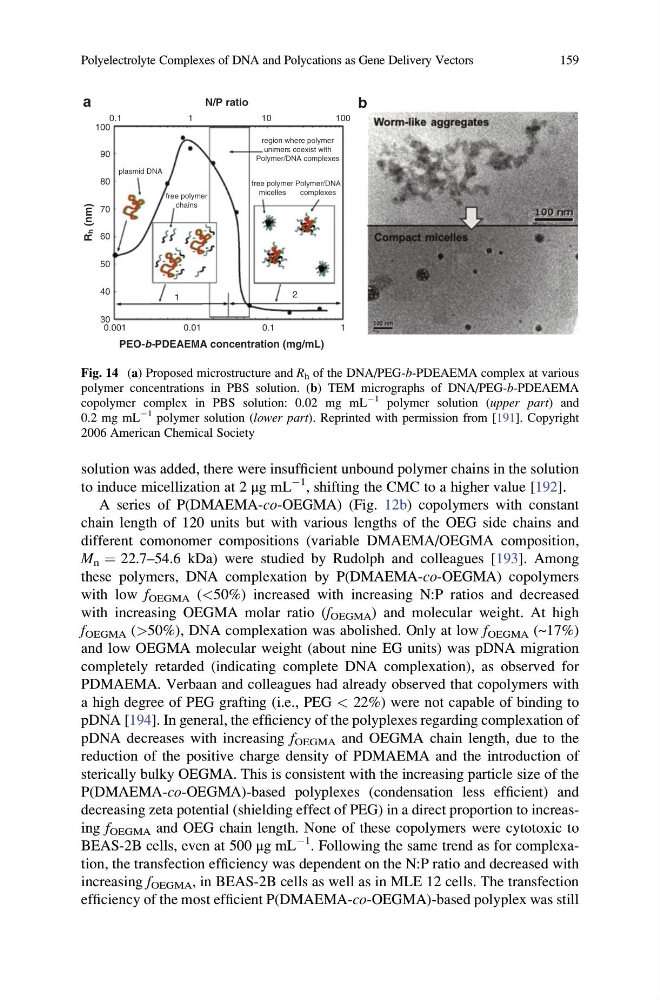
Fig. 14 (a) Proposed microstructure and R h of the DNA/PEG-b-PDEAEMA complex at various
polymer concentrations in PBS solution. (b) TEM micrographs of DNA/PEG-b-PDEAEMA
copolymer complex in PBS solution: 0.02 mg mL
À1 polymer solution (upper part) and
0.2 mg mL
À1 polymer solution (lower part). Reprinted with permission from [191]. Copyright
2006 American Chemical Society
Polyelectrolyte Complexes of DNA and Polycations as Gene Delivery Vectors
159
to induce micellization at 2 μg mL
À1 , shifting the CMC to a higher value [192].
A series of P(DMAEMA-co-OEGMA) (Fig. 12b) copolymers with constant
chain length of 120 units but with various lengths of the OEG side chains and
different comonomer compositions (variable DMAEMA/OEGMA composition,
M n ¼ 22.7–54.6 kDa) were studied by Rudolph and colleagues [193]. Among
these polymers, DNA complexation by P(DMAEMA-co-OEGMA) copolymers
with low f OEGMA (<50%) increased with increasing N:P ratios and decreased
with increasing OEGMA molar ratio (f OEGMA ) and molecular weight. At high
f OEGMA (>50%), DNA complexation was abolished. Only at low f OEGMA (~17%)
and low OEGMA molecular weight (about nine EG units) was pDNA migration
completely retarded (indicating complete DNA complexation), as observed for
PDMAEMA. Verbaan and colleagues had already observed that copolymers with
a high degree of PEG grafting (i.e., PEG < 22%) were not capable of binding to
pDNA [194]. In general, the efficiency of the polyplexes regarding complexation of
pDNA decreases with increasing f OEGMA and OEGMA chain length, due to the
reduction of the positive charge density of PDMAEMA and the introduction of
sterically bulky OEGMA. This is consistent with the increasing particle size of the
P(DMAEMA-co-OEGMA)-based polyplexes (condensation less efficient) and
decreasing zeta potential (shielding effect of PEG) in a direct proportion to increasing f OEGMA and OEG chain length. None of these copolymers were cytotoxic to
BEAS-2B cells, even at 500 μg mL
À1 . Following the same trend as for complexation, the transfection efficiency was dependent on the N:P ratio and decreased with
increasing f OEGMA , in BEAS-2B cells as well as in MLE 12 cells. The transfection
efficiency of the most efficient P(DMAEMA-co-OEGMA)-based polyplex was still
70
80
0.1
100
10
N/P ratio
1
100
90
60
Rh (nm)
50
40
30
1
free polymer
micelles
region where polymer
unimers coexist with
Polymer/DNA complexes
Polymer/DNA
complexes
free polymer
chains
plasmid DNA
2
1
0.1
0.01
PEO-b-PDEAEMA concentration (mg/mL)
0.001
a
b
Fig. 14 (a) Proposed microstructure and R h of the DNA/PEG-b-PDEAEMA complex at various
polymer concentrations in PBS solution. (b) TEM micrographs of DNA/PEG-b-PDEAEMA
copolymer complex in PBS solution: 0.02 mg mL
À1 polymer solution (upper part) and
0.2 mg mL
À1 polymer solution (lower part). Reprinted with permission from [191]. Copyright
2006 American Chemical Society
Polyelectrolyte Complexes of DNA and Polycations as Gene Delivery Vectors
159