

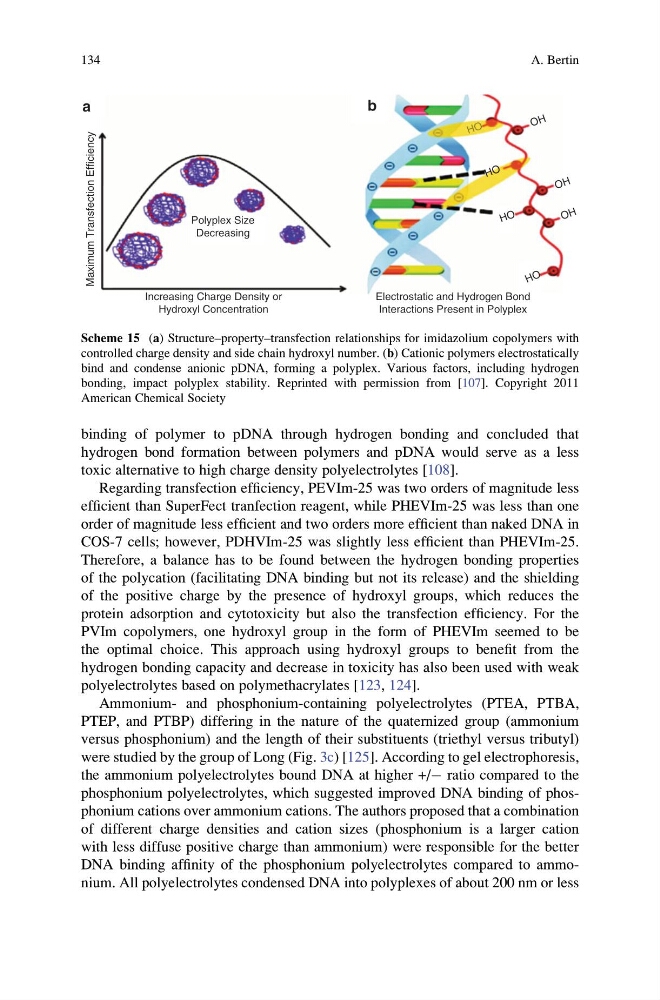
binding of polymer to pDNA through hydrogen bonding and concluded that
hydrogen bond formation between polymers and pDNA would serve as a less
toxic alternative to high charge density polyelectrolytes [108].
Regarding transfection efficiency, PEVIm-25 was two orders of magnitude less
efficient than SuperFect tranfection reagent, while PHEVIm-25 was less than one
order of magnitude less efficient and two orders more efficient than naked DNA in
COS-7 cells; however, PDHVIm-25 was slightly less efficient than PHEVIm-25.
Therefore, a balance has to be found between the hydrogen bonding properties
of the polycation (facilitating DNA binding but not its release) and the shielding
of the positive charge by the presence of hydroxyl groups, which reduces the
protein adsorption and cytotoxicity but also the transfection efficiency. For the
PVIm copolymers, one hydroxyl group in the form of PHEVIm seemed to be
the optimal choice. This approach using hydroxyl groups to benefit from the
hydrogen bonding capacity and decrease in toxicity has also been used with weak
polyelectrolytes based on polymethacrylates [123, 124].
Ammonium- and phosphonium-containing polyelectrolytes (PTEA, PTBA,
PTEP, and PTBP) differing in the nature of the quaternized group (ammonium
versus phosphonium) and the length of their substituents (triethyl versus tributyl)
were studied by the group of Long (Fig. 3c) [125]. According to gel electrophoresis,
the ammonium polyelectrolytes bound DNA at higher +/À ratio compared to the
phosphonium polyelectrolytes, which suggested improved DNA binding of phosphonium cations over ammonium cations. The authors proposed that a combination
of different charge densities and cation sizes (phosphonium is a larger cation
with less diffuse positive charge than ammonium) were responsible for the better
DNA binding affinity of the phosphonium polyelectrolytes compared to ammonium. All polyelectrolytes condensed DNA into polyplexes of about 200 nm or less
H O
O H
O H
O H
H O
Electrostatic and Hydrogen Bond
Interactions Present in Polyplex
Maximum Transfection Efficiency
Increasing Charge Density or
Hydroxyl Concentration
Polyplex Size
Decreasing
b
a
H O
H O
H O
H O
H O O O O O O O O O
Scheme 15 (a) Structure–property–transfection relationships for imidazolium copolymers with
controlled charge density and side chain hydroxyl number. (b) Cationic polymers electrostatically
bind and condense anionic pDNA, forming a polyplex. Various factors, including hydrogen
bonding, impact polyplex stability. Reprinted with permission from [107]. Copyright 2011
American Chemical Society
134
A. Bertin
hydrogen bond formation between polymers and pDNA would serve as a less
toxic alternative to high charge density polyelectrolytes [108].
Regarding transfection efficiency, PEVIm-25 was two orders of magnitude less
efficient than SuperFect tranfection reagent, while PHEVIm-25 was less than one
order of magnitude less efficient and two orders more efficient than naked DNA in
COS-7 cells; however, PDHVIm-25 was slightly less efficient than PHEVIm-25.
Therefore, a balance has to be found between the hydrogen bonding properties
of the polycation (facilitating DNA binding but not its release) and the shielding
of the positive charge by the presence of hydroxyl groups, which reduces the
protein adsorption and cytotoxicity but also the transfection efficiency. For the
PVIm copolymers, one hydroxyl group in the form of PHEVIm seemed to be
the optimal choice. This approach using hydroxyl groups to benefit from the
hydrogen bonding capacity and decrease in toxicity has also been used with weak
polyelectrolytes based on polymethacrylates [123, 124].
Ammonium- and phosphonium-containing polyelectrolytes (PTEA, PTBA,
PTEP, and PTBP) differing in the nature of the quaternized group (ammonium
versus phosphonium) and the length of their substituents (triethyl versus tributyl)
were studied by the group of Long (Fig. 3c) [125]. According to gel electrophoresis,
the ammonium polyelectrolytes bound DNA at higher +/À ratio compared to the
phosphonium polyelectrolytes, which suggested improved DNA binding of phosphonium cations over ammonium cations. The authors proposed that a combination
of different charge densities and cation sizes (phosphonium is a larger cation
with less diffuse positive charge than ammonium) were responsible for the better
DNA binding affinity of the phosphonium polyelectrolytes compared to ammonium. All polyelectrolytes condensed DNA into polyplexes of about 200 nm or less
H O
O H
O H
O H
H O
Electrostatic and Hydrogen Bond
Interactions Present in Polyplex
Maximum Transfection Efficiency
Increasing Charge Density or
Hydroxyl Concentration
Polyplex Size
Decreasing
b
a
H O
H O
H O
H O
H O O O O O O O O O
Scheme 15 (a) Structure–property–transfection relationships for imidazolium copolymers with
controlled charge density and side chain hydroxyl number. (b) Cationic polymers electrostatically
bind and condense anionic pDNA, forming a polyplex. Various factors, including hydrogen
bonding, impact polyplex stability. Reprinted with permission from [107]. Copyright 2011
American Chemical Society
134
A. Bertin