

thus the buffering capacity of the polymer decreased. With an increase in the
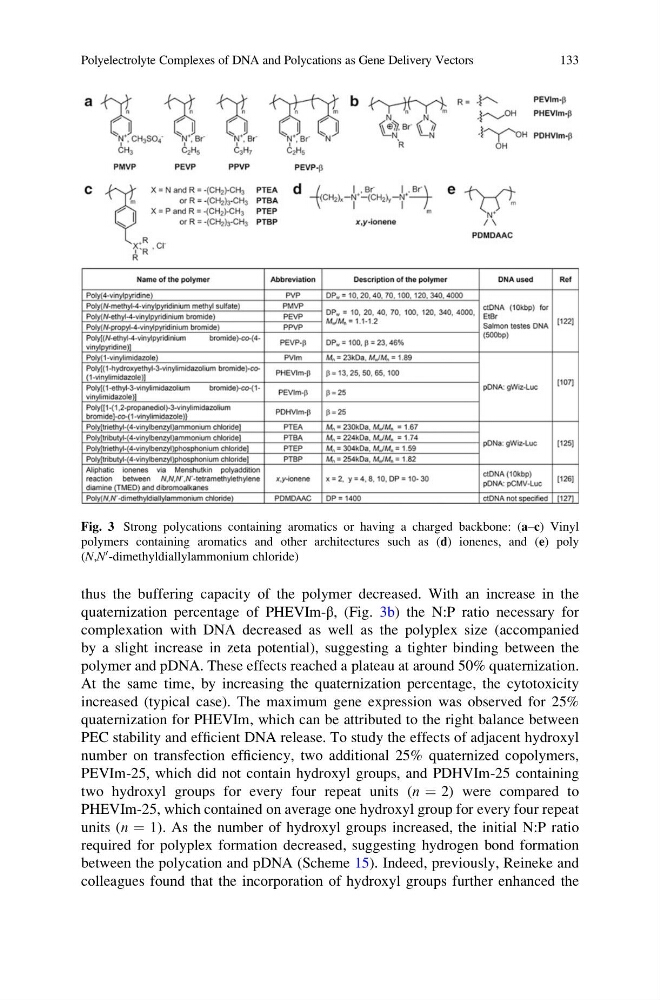
quaternization percentage of PHEVIm-β, (Fig. 3b) the N:P ratio necessary for
complexation with DNA decreased as well as the polyplex size (accompanied
by a slight increase in zeta potential), suggesting a tighter binding between the
polymer and pDNA. These effects reached a plateau at around 50% quaternization.
At the same time, by increasing the quaternization percentage, the cytotoxicity
increased (typical case). The maximum gene expression was observed for 25%
quaternization for PHEVIm, which can be attributed to the right balance between
PEC stability and efficient DNA release. To study the effects of adjacent hydroxyl
number on transfection efficiency, two additional 25% quaternized copolymers,
PEVIm-25, which did not contain hydroxyl groups, and PDHVIm-25 containing
two hydroxyl groups for every four repeat units (n ¼ 2) were compared to
PHEVIm-25, which contained on average one hydroxyl group for every four repeat
units (n ¼ 1). As the number of hydroxyl groups increased, the initial N:P ratio
required for polyplex formation decreased, suggesting hydrogen bond formation
between the polycation and pDNA (Scheme 15). Indeed, previously, Reineke and
colleagues found that the incorporation of hydroxyl groups further enhanced the
Fig. 3 Strong polycations containing aromatics or having a charged backbone: (a–c) Vinyl
polymers containing aromatics and other architectures such as (d) ionenes, and (e) poly
(N,N
0 -dimethyldiallylammonium chloride)
Polyelectrolyte Complexes of DNA and Polycations as Gene Delivery Vectors
133
quaternization percentage of PHEVIm-β, (Fig. 3b) the N:P ratio necessary for
complexation with DNA decreased as well as the polyplex size (accompanied
by a slight increase in zeta potential), suggesting a tighter binding between the
polymer and pDNA. These effects reached a plateau at around 50% quaternization.
At the same time, by increasing the quaternization percentage, the cytotoxicity
increased (typical case). The maximum gene expression was observed for 25%
quaternization for PHEVIm, which can be attributed to the right balance between
PEC stability and efficient DNA release. To study the effects of adjacent hydroxyl
number on transfection efficiency, two additional 25% quaternized copolymers,
PEVIm-25, which did not contain hydroxyl groups, and PDHVIm-25 containing
two hydroxyl groups for every four repeat units (n ¼ 2) were compared to
PHEVIm-25, which contained on average one hydroxyl group for every four repeat
units (n ¼ 1). As the number of hydroxyl groups increased, the initial N:P ratio
required for polyplex formation decreased, suggesting hydrogen bond formation
between the polycation and pDNA (Scheme 15). Indeed, previously, Reineke and
colleagues found that the incorporation of hydroxyl groups further enhanced the
Fig. 3 Strong polycations containing aromatics or having a charged backbone: (a–c) Vinyl
polymers containing aromatics and other architectures such as (d) ionenes, and (e) poly
(N,N
0 -dimethyldiallylammonium chloride)
Polyelectrolyte Complexes of DNA and Polycations as Gene Delivery Vectors
133