

the lysosomes, which are further acidified (pH ~4.5) and contain various nucleases
that promote the degradation of the DNA. To avoid lysosomal degradation, the
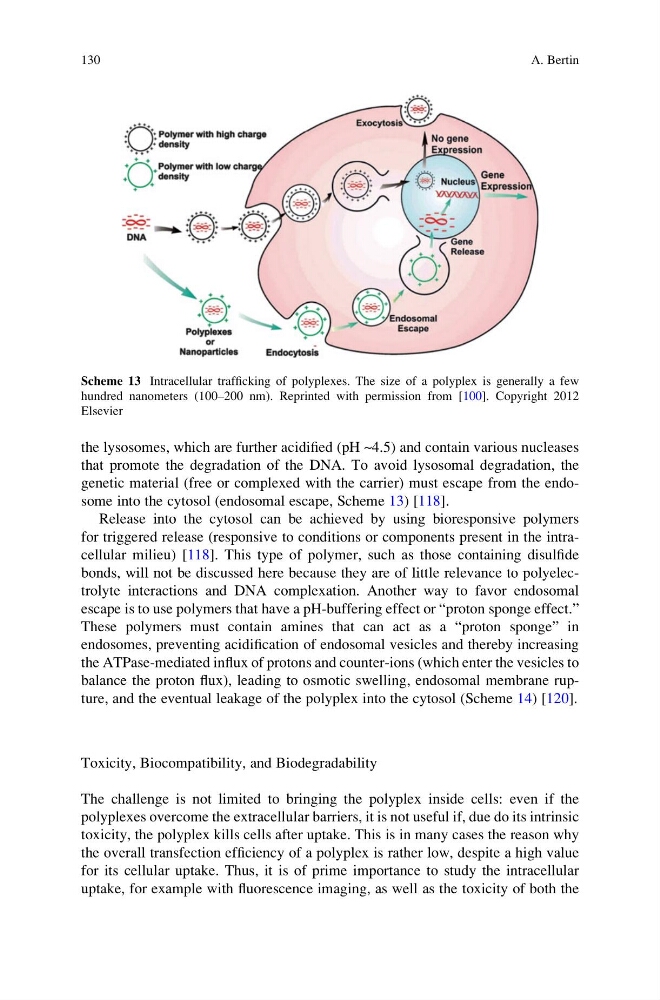
genetic material (free or complexed with the carrier) must escape from the endosome into the cytosol (endosomal escape, Scheme 13) [118].
Release into the cytosol can be achieved by using bioresponsive polymers
for triggered release (responsive to conditions or components present in the intracellular milieu) [118]. This type of polymer, such as those containing disulfide
bonds, will not be discussed here because they are of little relevance to polyelectrolyte interactions and DNA complexation. Another way to favor endosomal
escape is to use polymers that have a pH-buffering effect or “proton sponge effect.”
These polymers must contain amines that can act as a “proton sponge” in
endosomes, preventing acidification of endosomal vesicles and thereby increasing
the ATPase-mediated influx of protons and counter-ions (which enter the vesicles to
balance the proton flux), leading to osmotic swelling, endosomal membrane rupture, and the eventual leakage of the polyplex into the cytosol (Scheme 14) [120].
Toxicity, Biocompatibility, and Biodegradability
The challenge is not limited to bringing the polyplex inside cells: even if the
polyplexes overcome the extracellular barriers, it is not useful if, due do its intrinsic
toxicity, the polyplex kills cells after uptake. This is in many cases the reason why
the overall transfection efficiency of a polyplex is rather low, despite a high value
for its cellular uptake. Thus, it is of prime importance to study the intracellular
uptake, for example with fluorescence imaging, as well as the toxicity of both the
Scheme 13 Intracellular trafficking of polyplexes. The size of a polyplex is generally a few
hundred nanometers (100–200 nm). Reprinted with permission from [100]. Copyright 2012
Elsevier
130
A. Bertin
that promote the degradation of the DNA. To avoid lysosomal degradation, the
genetic material (free or complexed with the carrier) must escape from the endosome into the cytosol (endosomal escape, Scheme 13) [118].
Release into the cytosol can be achieved by using bioresponsive polymers
for triggered release (responsive to conditions or components present in the intracellular milieu) [118]. This type of polymer, such as those containing disulfide
bonds, will not be discussed here because they are of little relevance to polyelectrolyte interactions and DNA complexation. Another way to favor endosomal
escape is to use polymers that have a pH-buffering effect or “proton sponge effect.”
These polymers must contain amines that can act as a “proton sponge” in
endosomes, preventing acidification of endosomal vesicles and thereby increasing
the ATPase-mediated influx of protons and counter-ions (which enter the vesicles to
balance the proton flux), leading to osmotic swelling, endosomal membrane rupture, and the eventual leakage of the polyplex into the cytosol (Scheme 14) [120].
Toxicity, Biocompatibility, and Biodegradability
The challenge is not limited to bringing the polyplex inside cells: even if the
polyplexes overcome the extracellular barriers, it is not useful if, due do its intrinsic
toxicity, the polyplex kills cells after uptake. This is in many cases the reason why
the overall transfection efficiency of a polyplex is rather low, despite a high value
for its cellular uptake. Thus, it is of prime importance to study the intracellular
uptake, for example with fluorescence imaging, as well as the toxicity of both the
Scheme 13 Intracellular trafficking of polyplexes. The size of a polyplex is generally a few
hundred nanometers (100–200 nm). Reprinted with permission from [100]. Copyright 2012
Elsevier
130
A. Bertin