

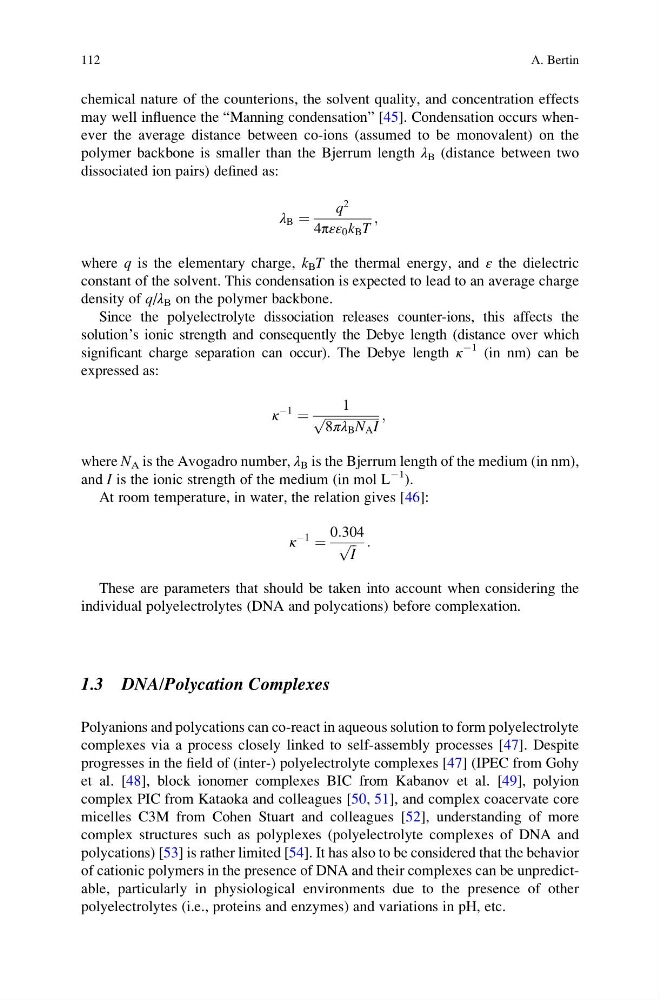
chemical nature of the counterions, the solvent quality, and concentration effects
may well influence the “Manning condensation” [45]. Condensation occurs whenever the average distance between co-ions (assumed to be monovalent) on the
polymer backbone is smaller than the Bjerrum length λ B (distance between two
dissociated ion pairs) defined as:
λ B ¼
q
2
4πεε 0 k B T
;
where q is the elementary charge, k B T the thermal energy, and ε the dielectric
constant of the solvent. This condensation is expected to lead to an average charge
density of q/λ B on the polymer backbone.
Since the polyelectrolyte dissociation releases counter-ions, this affects the
solution’s ionic strength and consequently the Debye length (distance over which
significant charge separation can occur). The Debye length κ
À1 (in nm) can be
expressed as:
κ
À1
¼
1
ffiffiffiffiffiffiffiffiffiffiffiffiffiffiffiffiffi ffi
8πλ B N A I
p
;
where N A is the Avogadro number, λ B is the Bjerrum length of the medium (in nm),
and I is the ionic strength of the medium (in mol L
À1 ).
At room temperature, in water, the relation gives [46]:
κ
À1
¼
0:304
ffiffi
I
p :
These are parameters that should be taken into account when considering the
individual polyelectrolytes (DNA and polycations) before complexation.
1.3 DNA/Polycation Complexes
Polyanions and polycations can co-react in aqueous solution to form polyelectrolyte
complexes via a process closely linked to self-assembly processes [47]. Despite
progresses in the field of (inter-) polyelectrolyte complexes [47] (IPEC from Gohy
et al. [48], block ionomer complexes BIC from Kabanov et al. [49], polyion
complex PIC from Kataoka and colleagues [50, 51], and complex coacervate core
micelles C3M from Cohen Stuart and colleagues [52], understanding of more
complex structures such as polyplexes (polyelectrolyte complexes of DNA and
polycations) [53] is rather limited [54]. It has also to be considered that the behavior
of cationic polymers in the presence of DNA and their complexes can be unpredictable, particularly in physiological environments due to the presence of other
polyelectrolytes (i.e., proteins and enzymes) and variations in pH, etc.
112
A. Bertin
may well influence the “Manning condensation” [45]. Condensation occurs whenever the average distance between co-ions (assumed to be monovalent) on the
polymer backbone is smaller than the Bjerrum length λ B (distance between two
dissociated ion pairs) defined as:
λ B ¼
q
2
4πεε 0 k B T
;
where q is the elementary charge, k B T the thermal energy, and ε the dielectric
constant of the solvent. This condensation is expected to lead to an average charge
density of q/λ B on the polymer backbone.
Since the polyelectrolyte dissociation releases counter-ions, this affects the
solution’s ionic strength and consequently the Debye length (distance over which
significant charge separation can occur). The Debye length κ
À1 (in nm) can be
expressed as:
κ
À1
¼
1
ffiffiffiffiffiffiffiffiffiffiffiffiffiffiffiffiffi ffi
8πλ B N A I
p
;
where N A is the Avogadro number, λ B is the Bjerrum length of the medium (in nm),
and I is the ionic strength of the medium (in mol L
À1 ).
At room temperature, in water, the relation gives [46]:
κ
À1
¼
0:304
ffiffi
I
p :
These are parameters that should be taken into account when considering the
individual polyelectrolytes (DNA and polycations) before complexation.
1.3 DNA/Polycation Complexes
Polyanions and polycations can co-react in aqueous solution to form polyelectrolyte
complexes via a process closely linked to self-assembly processes [47]. Despite
progresses in the field of (inter-) polyelectrolyte complexes [47] (IPEC from Gohy
et al. [48], block ionomer complexes BIC from Kabanov et al. [49], polyion
complex PIC from Kataoka and colleagues [50, 51], and complex coacervate core
micelles C3M from Cohen Stuart and colleagues [52], understanding of more
complex structures such as polyplexes (polyelectrolyte complexes of DNA and
polycations) [53] is rather limited [54]. It has also to be considered that the behavior
of cationic polymers in the presence of DNA and their complexes can be unpredictable, particularly in physiological environments due to the presence of other
polyelectrolytes (i.e., proteins and enzymes) and variations in pH, etc.
112
A. Bertin