

constant and is governed by the pH of the solution, counterion concentration, and
ionic strength; the charges are mobile within the polyelectrolyte.
The conformation of any polymer is affected by a number of factors, including the
polymer architecture and the solvent affinity. In the case of polyelectrolytes, an
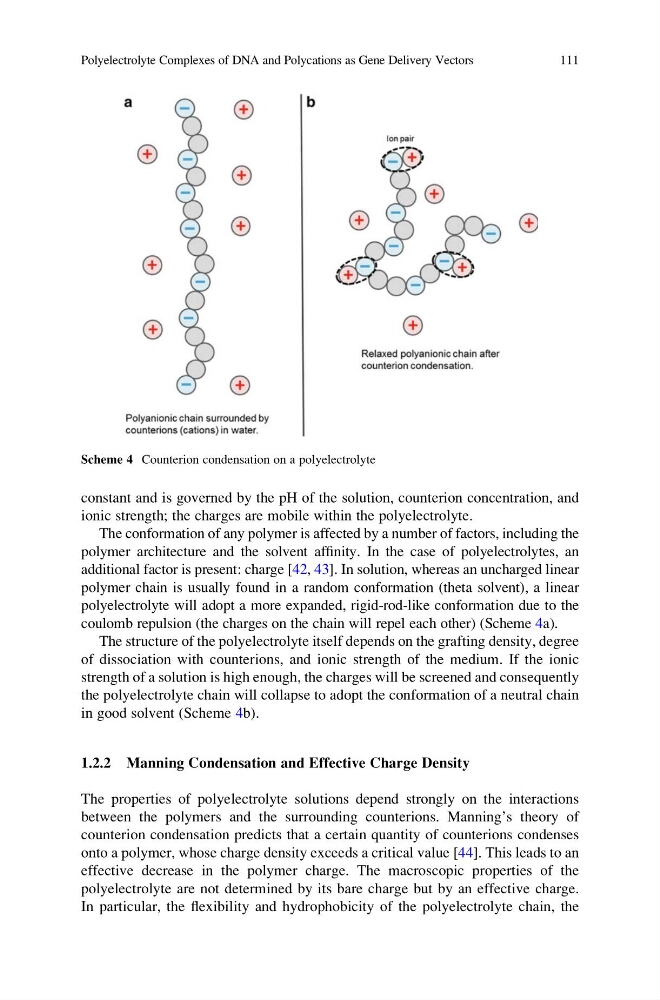
additional factor is present: charge [42, 43]. In solution, whereas an uncharged linear
polymer chain is usually found in a random conformation (theta solvent), a linear
polyelectrolyte will adopt a more expanded, rigid-rod-like conformation due to the
coulomb repulsion (the charges on the chain will repel each other) (Scheme 4a).
The structure of the polyelectrolyte itself depends on the grafting density, degree
of dissociation with counterions, and ionic strength of the medium. If the ionic
strength of a solution is high enough, the charges will be screened and consequently
the polyelectrolyte chain will collapse to adopt the conformation of a neutral chain
in good solvent (Scheme 4b).
1.2.2 Manning Condensation and Effective Charge Density
The properties of polyelectrolyte solutions depend strongly on the interactions
between the polymers and the surrounding counterions. Manning’s theory of
counterion condensation predicts that a certain quantity of counterions condenses
onto a polymer, whose charge density exceeds a critical value [44]. This leads to an
effective decrease in the polymer charge. The macroscopic properties of the
polyelectrolyte are not determined by its bare charge but by an effective charge.
In particular, the flexibility and hydrophobicity of the polyelectrolyte chain, the
Scheme 4 Counterion condensation on a polyelectrolyte
Polyelectrolyte Complexes of DNA and Polycations as Gene Delivery Vectors
111
ionic strength; the charges are mobile within the polyelectrolyte.
The conformation of any polymer is affected by a number of factors, including the
polymer architecture and the solvent affinity. In the case of polyelectrolytes, an
additional factor is present: charge [42, 43]. In solution, whereas an uncharged linear
polymer chain is usually found in a random conformation (theta solvent), a linear
polyelectrolyte will adopt a more expanded, rigid-rod-like conformation due to the
coulomb repulsion (the charges on the chain will repel each other) (Scheme 4a).
The structure of the polyelectrolyte itself depends on the grafting density, degree
of dissociation with counterions, and ionic strength of the medium. If the ionic
strength of a solution is high enough, the charges will be screened and consequently
the polyelectrolyte chain will collapse to adopt the conformation of a neutral chain
in good solvent (Scheme 4b).
1.2.2 Manning Condensation and Effective Charge Density
The properties of polyelectrolyte solutions depend strongly on the interactions
between the polymers and the surrounding counterions. Manning’s theory of
counterion condensation predicts that a certain quantity of counterions condenses
onto a polymer, whose charge density exceeds a critical value [44]. This leads to an
effective decrease in the polymer charge. The macroscopic properties of the
polyelectrolyte are not determined by its bare charge but by an effective charge.
In particular, the flexibility and hydrophobicity of the polyelectrolyte chain, the
Scheme 4 Counterion condensation on a polyelectrolyte
Polyelectrolyte Complexes of DNA and Polycations as Gene Delivery Vectors
111