

weight 1,000 g/mol (PEG-1000) acting as an auxiliary porogen [182]. At PEG-1000
concentrations below 10 wt%, although the initial solution is homophase, two
liquid phases appear within the UFLMP during the course of the freezing/frozenstorage stage due to the freeze-induced concentrating effect. NMR studies show
that these are PVA-rich and PEG-rich phases [151, 189]. Cryotropic gelation of the
PVA-rich phase fixes the morphology of the complex system containing segregated
phases. Thus, the PEG-rich phase acts as the auxiliary porogen causing the formation of so-called “compartments” [189], i.e., the large pores in addition to the
ice-templated pores.
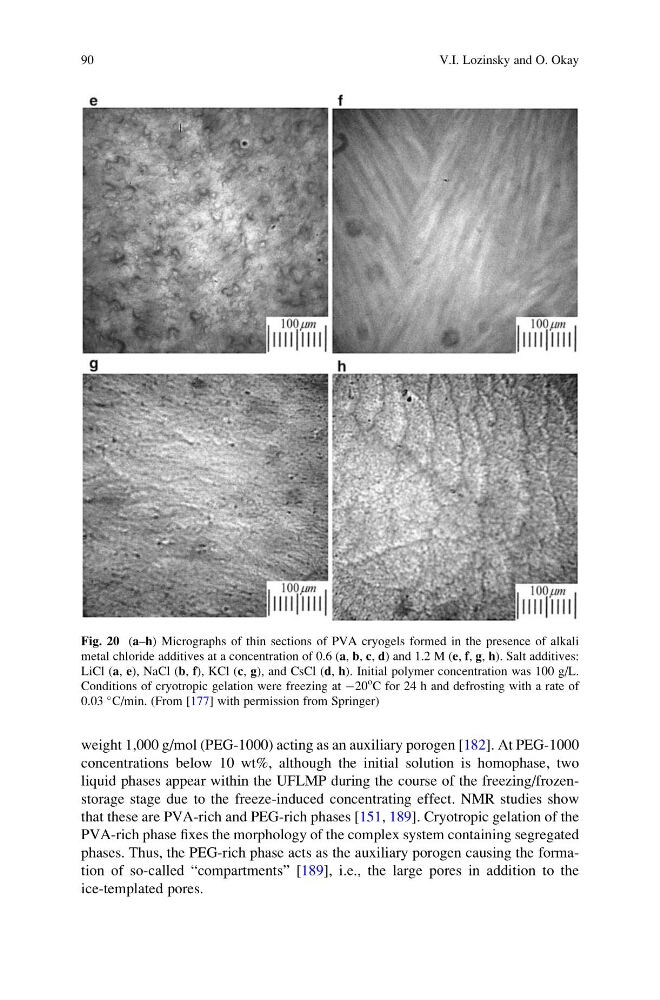
Fig. 20 (a–h) Micrographs of thin sections of PVA cryogels formed in the presence of alkali
metal chloride additives at a concentration of 0.6 (a, b, c, d) and 1.2 M (e, f, g, h). Salt additives:
LiCl (a, e), NaCl (b, f), KCl (c, g), and CsCl (d, h). Initial polymer concentration was 100 g/L.
Conditions of cryotropic gelation were freezing at À20
o
C for 24 h and defrosting with a rate of
0.03
C/min. (From [177] with permission from Springer)
90
V.I. Lozinsky and O. Okay
concentrations below 10 wt%, although the initial solution is homophase, two
liquid phases appear within the UFLMP during the course of the freezing/frozenstorage stage due to the freeze-induced concentrating effect. NMR studies show
that these are PVA-rich and PEG-rich phases [151, 189]. Cryotropic gelation of the
PVA-rich phase fixes the morphology of the complex system containing segregated
phases. Thus, the PEG-rich phase acts as the auxiliary porogen causing the formation of so-called “compartments” [189], i.e., the large pores in addition to the
ice-templated pores.
Fig. 20 (a–h) Micrographs of thin sections of PVA cryogels formed in the presence of alkali
metal chloride additives at a concentration of 0.6 (a, b, c, d) and 1.2 M (e, f, g, h). Salt additives:
LiCl (a, e), NaCl (b, f), KCl (c, g), and CsCl (d, h). Initial polymer concentration was 100 g/L.
Conditions of cryotropic gelation were freezing at À20
o
C for 24 h and defrosting with a rate of
0.03
C/min. (From [177] with permission from Springer)
90
V.I. Lozinsky and O. Okay