

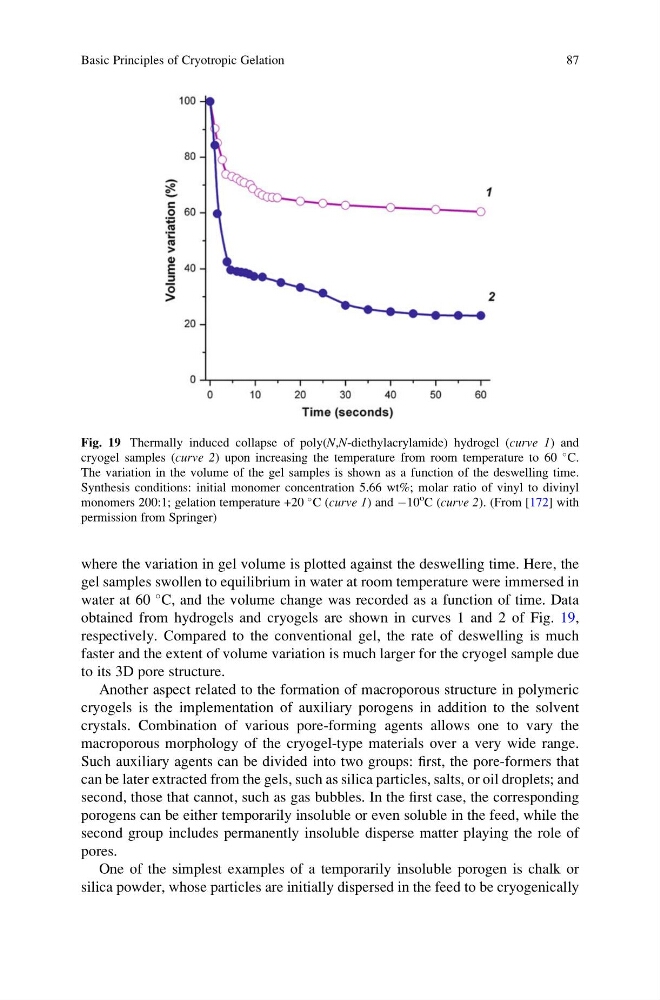
where the variation in gel volume is plotted against the deswelling time. Here, the
gel samples swollen to equilibrium in water at room temperature were immersed in
water at 60
C, and the volume change was recorded as a function of time. Data
obtained from hydrogels and cryogels are shown in curves 1 and 2 of Fig. 19,
respectively. Compared to the conventional gel, the rate of deswelling is much
faster and the extent of volume variation is much larger for the cryogel sample due
to its 3D pore structure.
Another aspect related to the formation of macroporous structure in polymeric
cryogels is the implementation of auxiliary porogens in addition to the solvent
crystals. Combination of various pore-forming agents allows one to vary the
macroporous morphology of the cryogel-type materials over a very wide range.
Such auxiliary agents can be divided into two groups: first, the pore-formers that
can be later extracted from the gels, such as silica particles, salts, or oil droplets; and
second, those that cannot, such as gas bubbles. In the first case, the corresponding
porogens can be either temporarily insoluble or even soluble in the feed, while the
second group includes permanently insoluble disperse matter playing the role of
pores.
One of the simplest examples of a temporarily insoluble porogen is chalk or
silica powder, whose particles are initially dispersed in the feed to be cryogenically
Fig. 19 Thermally induced collapse of poly(N,N-diethylacrylamide) hydrogel (curve 1) and
cryogel samples (curve 2) upon increasing the temperature from room temperature to 60
C.
The variation in the volume of the gel samples is shown as a function of the deswelling time.
Synthesis conditions: initial monomer concentration 5.66 wt%; molar ratio of vinyl to divinyl
monomers 200:1; gelation temperature +20
C (curve 1) and À10
o
C (curve 2). (From [172] with
permission from Springer)
Basic Principles of Cryotropic Gelation
87
gel samples swollen to equilibrium in water at room temperature were immersed in
water at 60
C, and the volume change was recorded as a function of time. Data
obtained from hydrogels and cryogels are shown in curves 1 and 2 of Fig. 19,
respectively. Compared to the conventional gel, the rate of deswelling is much
faster and the extent of volume variation is much larger for the cryogel sample due
to its 3D pore structure.
Another aspect related to the formation of macroporous structure in polymeric
cryogels is the implementation of auxiliary porogens in addition to the solvent
crystals. Combination of various pore-forming agents allows one to vary the
macroporous morphology of the cryogel-type materials over a very wide range.
Such auxiliary agents can be divided into two groups: first, the pore-formers that
can be later extracted from the gels, such as silica particles, salts, or oil droplets; and
second, those that cannot, such as gas bubbles. In the first case, the corresponding
porogens can be either temporarily insoluble or even soluble in the feed, while the
second group includes permanently insoluble disperse matter playing the role of
pores.
One of the simplest examples of a temporarily insoluble porogen is chalk or
silica powder, whose particles are initially dispersed in the feed to be cryogenically
Fig. 19 Thermally induced collapse of poly(N,N-diethylacrylamide) hydrogel (curve 1) and
cryogel samples (curve 2) upon increasing the temperature from room temperature to 60
C.
The variation in the volume of the gel samples is shown as a function of the deswelling time.
Synthesis conditions: initial monomer concentration 5.66 wt%; molar ratio of vinyl to divinyl
monomers 200:1; gelation temperature +20
C (curve 1) and À10
o
C (curve 2). (From [172] with
permission from Springer)
Basic Principles of Cryotropic Gelation
87