

strongly unequal, and crystal growth dominates in the direction that follows the
vector of temperature gradient. Nonetheless, other facets are also enlarged and have
the possibility to come into contact with their neighbors, thus forming future
connections between the unidirected macropores in the defrosted cryogel.
The interconnected character of the pores in stimuli-responsive cryogels is also
responsible for their fast response rate to a change in the external conditions. As is
well known [170, 171], hydrogels may exhibit drastic volume changes in response
to specific external stimuli, such as temperature, solvent quality, pH, electric field,
etc. However, such stimuli-responsive hydrogels prepared by conventional techniques exhibit a slow rate of response to external stimuli. For instance, the kinetics
of the collapse of temperature-sensitive swollen hydrogels is controlled by heat
transfer into the gel and by diffusion of the solvent out of the gel, where both of
these processes depend on the size of the gel sample. The larger the gel size, the
lower is its response rate. The presence of interconnected pores of capillary size in
cryogels, as well as the high polymer content of their pore walls, ensure their very
fast volumetric response to external stimuli. Thermoresponsive poly(N,N-diethylacrylamide) and poly(N-isopropylacrylamide) cryogels are typical examples of
stimuli-responsive cryogels [172, 173]. As the temperature passes across the critical
(LCST) point, the gel phase (pore walls) deswells so that the inner water is rapidly
squeezed out of the cryogel through the system of interconnected capillaries. In
such spongy gel matrices, absorption or desorption of water occurs through the
macropores by convection, which is much faster than the diffusion process that
dominates inside the conventional hydrogels. Figure 19 shows a typical example of
the dynamics of heating-induced collapse of poly(N,N-diethylacrylamide) gels,
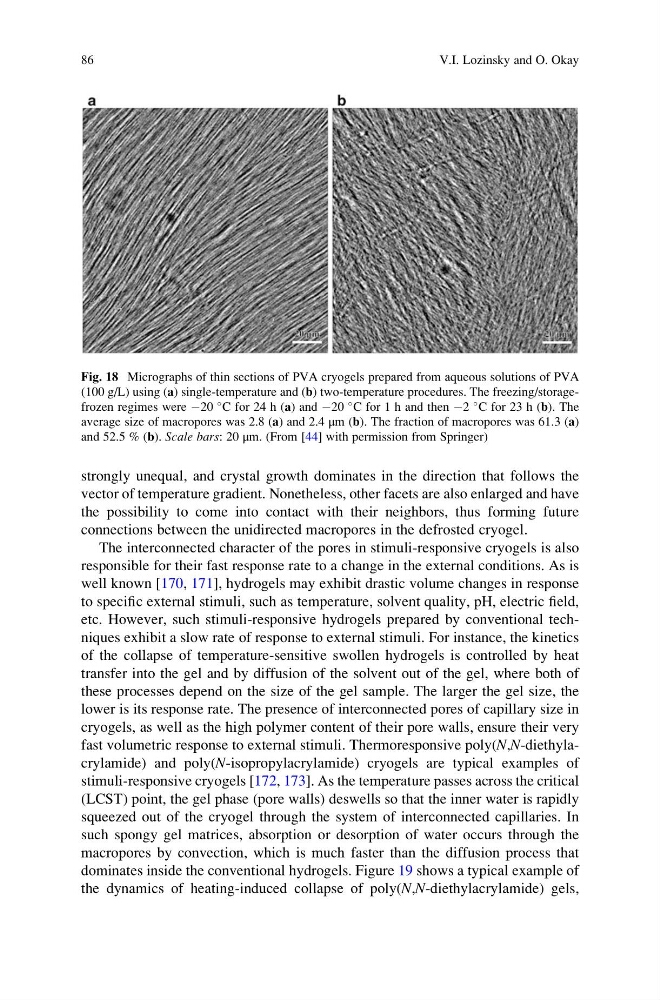
Fig. 18 Micrographs of thin sections of PVA cryogels prepared from aqueous solutions of PVA
(100 g/L) using (a) single-temperature and (b) two-temperature procedures. The freezing/storagefrozen regimes were À20
C for 24 h (a) and À20
C for 1 h and then À2
C for 23 h (b). The
average size of macropores was 2.8 (a) and 2.4 μm (b). The fraction of macropores was 61.3 (a)
and 52.5 % (b). Scale bars: 20 μm. (From [44] with permission from Springer)
86
V.I. Lozinsky and O. Okay
vector of temperature gradient. Nonetheless, other facets are also enlarged and have
the possibility to come into contact with their neighbors, thus forming future
connections between the unidirected macropores in the defrosted cryogel.
The interconnected character of the pores in stimuli-responsive cryogels is also
responsible for their fast response rate to a change in the external conditions. As is
well known [170, 171], hydrogels may exhibit drastic volume changes in response
to specific external stimuli, such as temperature, solvent quality, pH, electric field,
etc. However, such stimuli-responsive hydrogels prepared by conventional techniques exhibit a slow rate of response to external stimuli. For instance, the kinetics
of the collapse of temperature-sensitive swollen hydrogels is controlled by heat
transfer into the gel and by diffusion of the solvent out of the gel, where both of
these processes depend on the size of the gel sample. The larger the gel size, the
lower is its response rate. The presence of interconnected pores of capillary size in
cryogels, as well as the high polymer content of their pore walls, ensure their very
fast volumetric response to external stimuli. Thermoresponsive poly(N,N-diethylacrylamide) and poly(N-isopropylacrylamide) cryogels are typical examples of
stimuli-responsive cryogels [172, 173]. As the temperature passes across the critical
(LCST) point, the gel phase (pore walls) deswells so that the inner water is rapidly
squeezed out of the cryogel through the system of interconnected capillaries. In
such spongy gel matrices, absorption or desorption of water occurs through the
macropores by convection, which is much faster than the diffusion process that
dominates inside the conventional hydrogels. Figure 19 shows a typical example of
the dynamics of heating-induced collapse of poly(N,N-diethylacrylamide) gels,
Fig. 18 Micrographs of thin sections of PVA cryogels prepared from aqueous solutions of PVA
(100 g/L) using (a) single-temperature and (b) two-temperature procedures. The freezing/storagefrozen regimes were À20
C for 24 h (a) and À20
C for 1 h and then À2
C for 23 h (b). The
average size of macropores was 2.8 (a) and 2.4 μm (b). The fraction of macropores was 61.3 (a)
and 52.5 % (b). Scale bars: 20 μm. (From [44] with permission from Springer)
86
V.I. Lozinsky and O. Okay