

low-temperature quenching procedure using liquid nitrogen markedly alters the
temperature dependence between À10 and À20
C. This result most probably
indicates that, when a deeply frozen system is heated to the subzero level, the
concentration of the reactants in the resulting UFLMP at the early stages of gel
formation is higher than that in the UFLMP formed as a result of a conventional
mode of freezing. The reason for such an effect is obviously a low rate of solid-toliquid phase transition of solvent crystals after the low-temperature quenching [23,
50, 65]. This phenomenon in its nature resembles prolonged (days) thawing of snow
and ice in spring when the environmental temperature is already considerably
higher than the ice melting point.
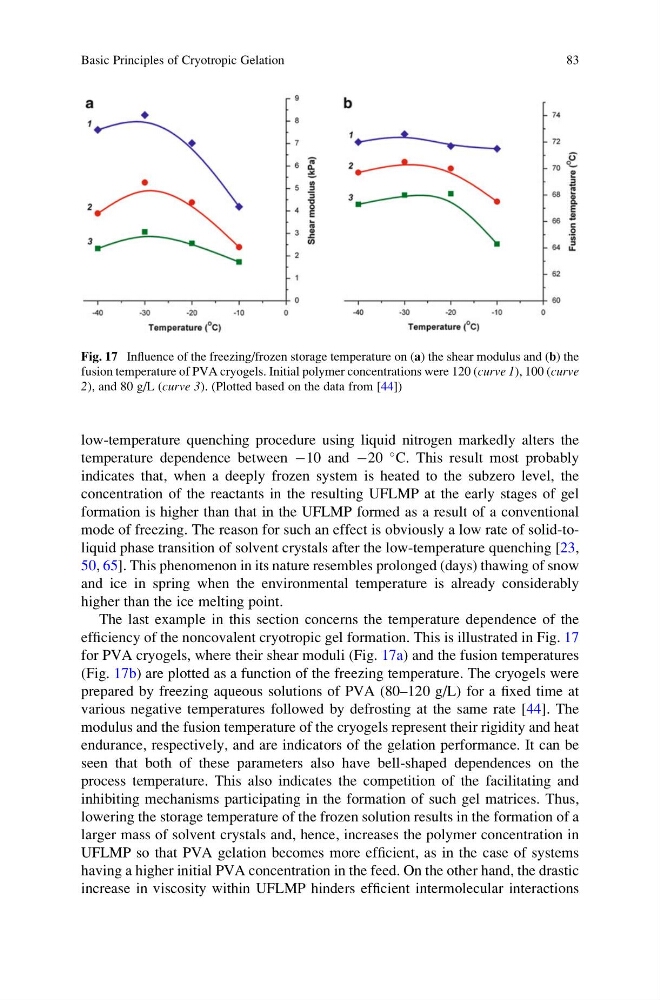
The last example in this section concerns the temperature dependence of the
efficiency of the noncovalent cryotropic gel formation. This is illustrated in Fig. 17
for PVA cryogels, where their shear moduli (Fig. 17a) and the fusion temperatures
(Fig. 17b) are plotted as a function of the freezing temperature. The cryogels were
prepared by freezing aqueous solutions of PVA (80–120 g/L) for a fixed time at
various negative temperatures followed by defrosting at the same rate [44]. The
modulus and the fusion temperature of the cryogels represent their rigidity and heat
endurance, respectively, and are indicators of the gelation performance. It can be
seen that both of these parameters also have bell-shaped dependences on the
process temperature. This also indicates the competition of the facilitating and
inhibiting mechanisms participating in the formation of such gel matrices. Thus,
lowering the storage temperature of the frozen solution results in the formation of a
larger mass of solvent crystals and, hence, increases the polymer concentration in
UFLMP so that PVA gelation becomes more efficient, as in the case of systems
having a higher initial PVA concentration in the feed. On the other hand, the drastic
increase in viscosity within UFLMP hinders efficient intermolecular interactions
Fig. 17 Influence of the freezing/frozen storage temperature on (a) the shear modulus and (b) the
fusion temperature of PVA cryogels. Initial polymer concentrations were 120 (curve 1), 100 (curve
2), and 80 g/L (curve 3). (Plotted based on the data from [44])
Basic Principles of Cryotropic Gelation
83
temperature dependence between À10 and À20
C. This result most probably
indicates that, when a deeply frozen system is heated to the subzero level, the
concentration of the reactants in the resulting UFLMP at the early stages of gel
formation is higher than that in the UFLMP formed as a result of a conventional
mode of freezing. The reason for such an effect is obviously a low rate of solid-toliquid phase transition of solvent crystals after the low-temperature quenching [23,
50, 65]. This phenomenon in its nature resembles prolonged (days) thawing of snow
and ice in spring when the environmental temperature is already considerably
higher than the ice melting point.
The last example in this section concerns the temperature dependence of the
efficiency of the noncovalent cryotropic gel formation. This is illustrated in Fig. 17
for PVA cryogels, where their shear moduli (Fig. 17a) and the fusion temperatures
(Fig. 17b) are plotted as a function of the freezing temperature. The cryogels were
prepared by freezing aqueous solutions of PVA (80–120 g/L) for a fixed time at
various negative temperatures followed by defrosting at the same rate [44]. The
modulus and the fusion temperature of the cryogels represent their rigidity and heat
endurance, respectively, and are indicators of the gelation performance. It can be
seen that both of these parameters also have bell-shaped dependences on the
process temperature. This also indicates the competition of the facilitating and
inhibiting mechanisms participating in the formation of such gel matrices. Thus,
lowering the storage temperature of the frozen solution results in the formation of a
larger mass of solvent crystals and, hence, increases the polymer concentration in
UFLMP so that PVA gelation becomes more efficient, as in the case of systems
having a higher initial PVA concentration in the feed. On the other hand, the drastic
increase in viscosity within UFLMP hinders efficient intermolecular interactions
Fig. 17 Influence of the freezing/frozen storage temperature on (a) the shear modulus and (b) the
fusion temperature of PVA cryogels. Initial polymer concentrations were 120 (curve 1), 100 (curve
2), and 80 g/L (curve 3). (Plotted based on the data from [44])
Basic Principles of Cryotropic Gelation
83