

The volume and concentration of solutes in UFLMP depend on the cryoscopic
properties of the solvent, the freezing temperature, concentration of the precursors
in the feed, their solubility, and their dimensions, i.e., molecular weights. In this
connection, it is of interest to demonstrate how the presence of an inert additive
(e.g., an inert polymer) can affect the reaction kinetics in such non-deeply frozen
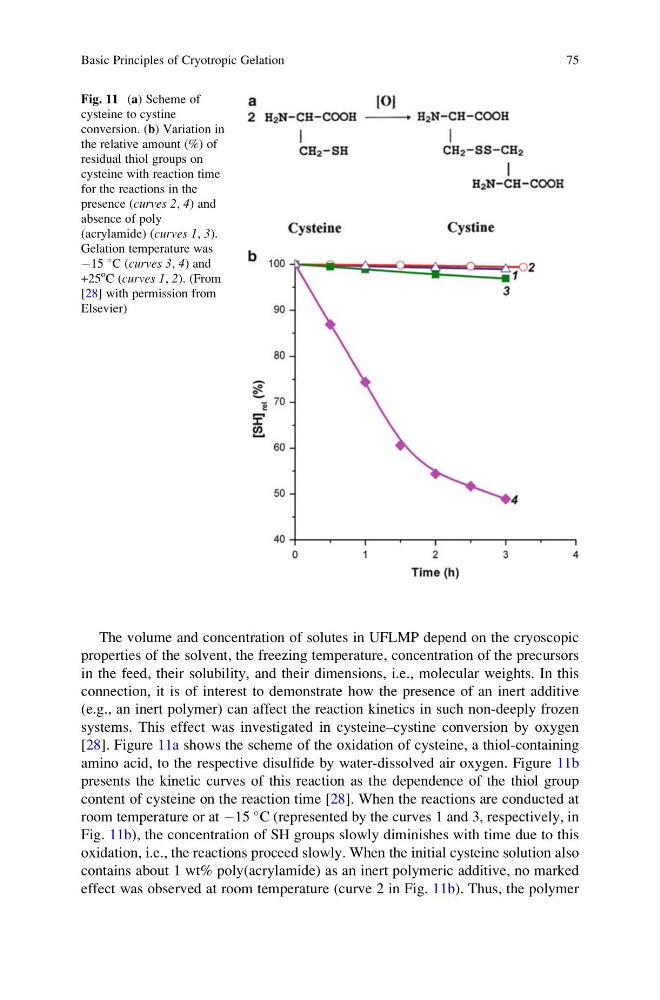
systems. This effect was investigated in cysteine–cystine conversion by oxygen
[28]. Figure 11a shows the scheme of the oxidation of cysteine, a thiol-containing
amino acid, to the respective disulfide by water-dissolved air oxygen. Figure 11b
presents the kinetic curves of this reaction as the dependence of the thiol group
content of cysteine on the reaction time [28]. When the reactions are conducted at
room temperature or at À15
C (represented by the curves 1 and 3, respectively, in
Fig. 11b), the concentration of SH groups slowly diminishes with time due to this
oxidation, i.e., the reactions proceed slowly. When the initial cysteine solution also
contains about 1 wt% poly(acrylamide) as an inert polymeric additive, no marked
effect was observed at room temperature (curve 2 in Fig. 11b). Thus, the polymer
Fig. 11 (a) Scheme of
cysteine to cystine
conversion. (b) Variation in
the relative amount (%) of
residual thiol groups on
cysteine with reaction time
for the reactions in the
presence (curves 2, 4) and
absence of poly
(acrylamide) (curves 1, 3).
Gelation temperature was
À15
C (curves 3, 4) and
+25
o
C (curves 1, 2). (From
[28] with permission from
Elsevier)
Basic Principles of Cryotropic Gelation
75
properties of the solvent, the freezing temperature, concentration of the precursors
in the feed, their solubility, and their dimensions, i.e., molecular weights. In this
connection, it is of interest to demonstrate how the presence of an inert additive
(e.g., an inert polymer) can affect the reaction kinetics in such non-deeply frozen
systems. This effect was investigated in cysteine–cystine conversion by oxygen
[28]. Figure 11a shows the scheme of the oxidation of cysteine, a thiol-containing
amino acid, to the respective disulfide by water-dissolved air oxygen. Figure 11b
presents the kinetic curves of this reaction as the dependence of the thiol group
content of cysteine on the reaction time [28]. When the reactions are conducted at
room temperature or at À15
C (represented by the curves 1 and 3, respectively, in
Fig. 11b), the concentration of SH groups slowly diminishes with time due to this
oxidation, i.e., the reactions proceed slowly. When the initial cysteine solution also
contains about 1 wt% poly(acrylamide) as an inert polymeric additive, no marked
effect was observed at room temperature (curve 2 in Fig. 11b). Thus, the polymer
Fig. 11 (a) Scheme of
cysteine to cystine
conversion. (b) Variation in
the relative amount (%) of
residual thiol groups on
cysteine with reaction time
for the reactions in the
presence (curves 2, 4) and
absence of poly
(acrylamide) (curves 1, 3).
Gelation temperature was
À15
C (curves 3, 4) and
+25
o
C (curves 1, 2). (From
[28] with permission from
Elsevier)
Basic Principles of Cryotropic Gelation
75