

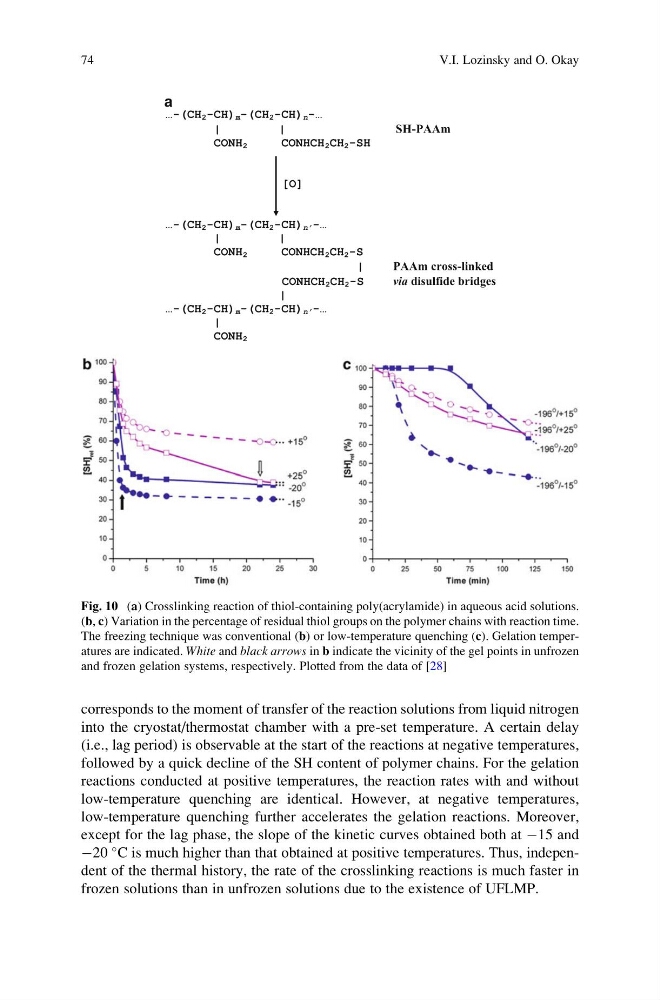
corresponds to the moment of transfer of the reaction solutions from liquid nitrogen
into the cryostat/thermostat chamber with a pre-set temperature. A certain delay
(i.e., lag period) is observable at the start of the reactions at negative temperatures,
followed by a quick decline of the SH content of polymer chains. For the gelation
reactions conducted at positive temperatures, the reaction rates with and without
low-temperature quenching are identical. However, at negative temperatures,
low-temperature quenching further accelerates the gelation reactions. Moreover,
except for the lag phase, the slope of the kinetic curves obtained both at À15 and
À20
C is much higher than that obtained at positive temperatures. Thus, independent of the thermal history, the rate of the crosslinking reactions is much faster in
frozen solutions than in unfrozen solutions due to the existence of UFLMP.
…-(CH 2 -CH) m -(CH 2 -CH) n -…
|
|
SH-PAAm
CONH 2
CONHCH 2 CH 2 -SH
[O]
…-(CH 2 -CH) m -(CH 2 -CH) n’ -…
|
|
CONH 2
CONHCH 2 CH 2 -S
|
PAAm cross-linked
CONHCH 2 CH 2 -S
via disulfide bridges
|
…-(CH 2 -CH) m -(CH 2 -CH) n’ -…
|
CONH 2
a
Fig. 10 (a) Crosslinking reaction of thiol-containing poly(acrylamide) in aqueous acid solutions.
(b, c) Variation in the percentage of residual thiol groups on the polymer chains with reaction time.
The freezing technique was conventional (b) or low-temperature quenching (c). Gelation temperatures are indicated. White and black arrows in b indicate the vicinity of the gel points in unfrozen
and frozen gelation systems, respectively. Plotted from the data of [28]
74
V.I. Lozinsky and O. Okay
into the cryostat/thermostat chamber with a pre-set temperature. A certain delay
(i.e., lag period) is observable at the start of the reactions at negative temperatures,
followed by a quick decline of the SH content of polymer chains. For the gelation
reactions conducted at positive temperatures, the reaction rates with and without
low-temperature quenching are identical. However, at negative temperatures,
low-temperature quenching further accelerates the gelation reactions. Moreover,
except for the lag phase, the slope of the kinetic curves obtained both at À15 and
À20
C is much higher than that obtained at positive temperatures. Thus, independent of the thermal history, the rate of the crosslinking reactions is much faster in
frozen solutions than in unfrozen solutions due to the existence of UFLMP.
…-(CH 2 -CH) m -(CH 2 -CH) n -…
|
|
SH-PAAm
CONH 2
CONHCH 2 CH 2 -SH
[O]
…-(CH 2 -CH) m -(CH 2 -CH) n’ -…
|
|
CONH 2
CONHCH 2 CH 2 -S
|
PAAm cross-linked
CONHCH 2 CH 2 -S
via disulfide bridges
|
…-(CH 2 -CH) m -(CH 2 -CH) n’ -…
|
CONH 2
a
Fig. 10 (a) Crosslinking reaction of thiol-containing poly(acrylamide) in aqueous acid solutions.
(b, c) Variation in the percentage of residual thiol groups on the polymer chains with reaction time.
The freezing technique was conventional (b) or low-temperature quenching (c). Gelation temperatures are indicated. White and black arrows in b indicate the vicinity of the gel points in unfrozen
and frozen gelation systems, respectively. Plotted from the data of [28]
74
V.I. Lozinsky and O. Okay