

gel-fraction yield is plotted against the initial pH of the polymer solution for
gelation at 24
C and for cryogelation at À12
C, respectively. The boundary pH
value of the feed at which cryogels can be generated (Fig. 9c) has shifted by about
0.5 units toward less the acidic zone as compared to the case of conventional gels
(Fig. 9b). Such a difference in pH corresponds to about a threefold difference in the
concentration of H
+ ions. Thus, the apparent decrease in CCG due to the cryoconcentrating effect is reflected in this example with an increase in medium acidity
rather than in the gel precursor concentration [7]. It is also interesting to compare
the osmotic characteristics, e.g., the equilibrium swelling capacities of such gels
and cryogels. Figure 9d, e shows the equilibrium swelling degrees of the gels and
CH
CH 2
ClCH 2
CH 2 Cl
Polystyrene
(solution in Nitrobenzena,
T 0 +5.5 ºC)
Xylylene dichloride
Cat.: SnCl 4
CH
CH 2
CH 2
CH CH 2
CH 2 CH
CH 2
Cross-linked
polystyrene
...
...
...
...
...
...
a
b
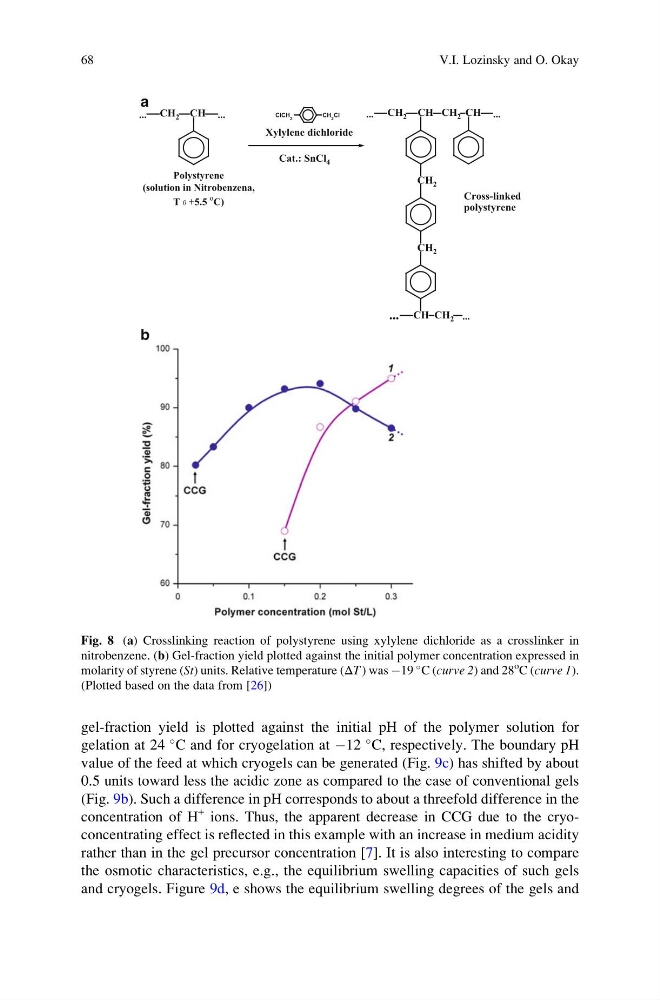
Fig. 8 (a) Crosslinking reaction of polystyrene using xylylene dichloride as a crosslinker in
nitrobenzene. (b) Gel-fraction yield plotted against the initial polymer concentration expressed in
molarity of styrene (St) units. Relative temperature (ΔT ) was À19
C (curve 2) and 28
o
C (curve 1).
(Plotted based on the data from [26])
68
V.I. Lozinsky and O. Okay
gelation at 24
C and for cryogelation at À12
C, respectively. The boundary pH
value of the feed at which cryogels can be generated (Fig. 9c) has shifted by about
0.5 units toward less the acidic zone as compared to the case of conventional gels
(Fig. 9b). Such a difference in pH corresponds to about a threefold difference in the
concentration of H
+ ions. Thus, the apparent decrease in CCG due to the cryoconcentrating effect is reflected in this example with an increase in medium acidity
rather than in the gel precursor concentration [7]. It is also interesting to compare
the osmotic characteristics, e.g., the equilibrium swelling capacities of such gels
and cryogels. Figure 9d, e shows the equilibrium swelling degrees of the gels and
CH
CH 2
ClCH 2
CH 2 Cl
Polystyrene
(solution in Nitrobenzena,
T 0 +5.5 ºC)
Xylylene dichloride
Cat.: SnCl 4
CH
CH 2
CH 2
CH CH 2
CH 2 CH
CH 2
Cross-linked
polystyrene
...
...
...
...
...
...
a
b
Fig. 8 (a) Crosslinking reaction of polystyrene using xylylene dichloride as a crosslinker in
nitrobenzene. (b) Gel-fraction yield plotted against the initial polymer concentration expressed in
molarity of styrene (St) units. Relative temperature (ΔT ) was À19
C (curve 2) and 28
o
C (curve 1).
(Plotted based on the data from [26])
68
V.I. Lozinsky and O. Okay