

Another interesting example illustrating the cryo-concentration effect is the shift
of pH during the acetalation reactions between the OH groups of poly(vinylalcoholco-vinylacetate) (80:20 by mole) and CHO groups of glutaraldehyde (Fig. 9a). The
mechanism of this reaction in acidic media includes the initial protonation of the
carbonyl of aldehyde [134]. Thus, at low concentrations of hydroxonium ions, the
reaction rate is slow and, therefore, the gels are usually synthesized at pH 1.5–1
in order to ensure high-enough yield of the gel-fraction [135, 136]. In Fig. 9b, c, the
O
O
O
O
O
NH 2
OH
CH 2 OH
...
...
HO
NH 2
CH 2 OH
OHC(CH2)3CHO
+
CH 2 OH
O
O
O
O
O
N
OH
CH 2 OH
...
...
HO
NH 2
CH
(CH2)3
CH
CH 2 OH
O
O
NH 2
OH
CH 2 OH
...
...
N
HO
O
O
O
Glutaric
aldehyde
Cross-linked
chitosan
Chitosan
a
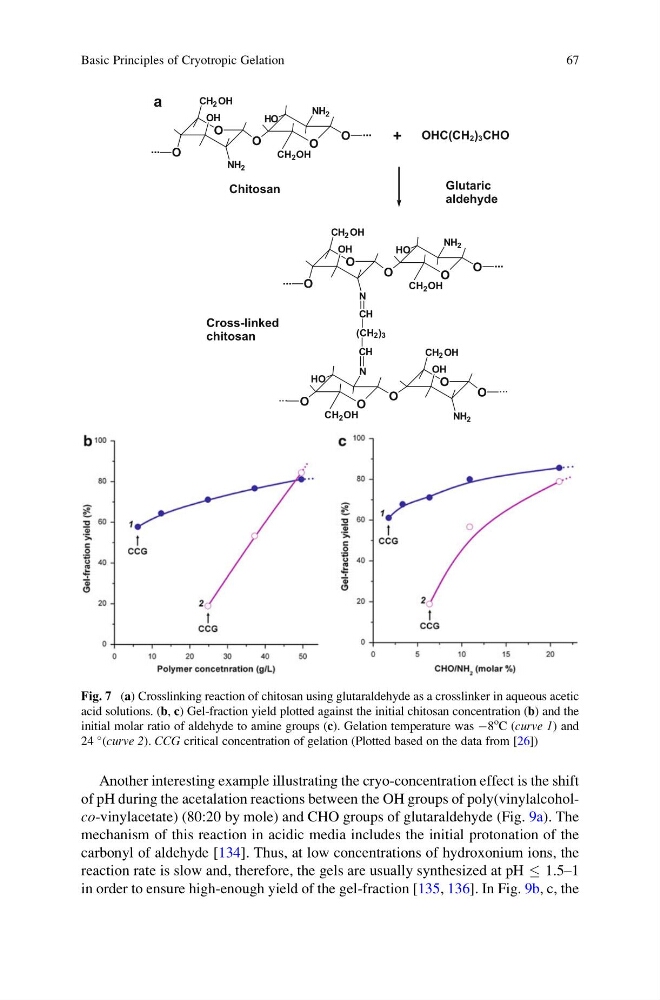
Fig. 7 (a) Crosslinking reaction of chitosan using glutaraldehyde as a crosslinker in aqueous acetic
acid solutions. (b, c) Gel-fraction yield plotted against the initial chitosan concentration (b) and the
initial molar ratio of aldehyde to amine groups (c). Gelation temperature was À8
o
C (curve 1) and
24
(curve 2). CCG critical concentration of gelation (Plotted based on the data from [26])
Basic Principles of Cryotropic Gelation
67
of pH during the acetalation reactions between the OH groups of poly(vinylalcoholco-vinylacetate) (80:20 by mole) and CHO groups of glutaraldehyde (Fig. 9a). The
mechanism of this reaction in acidic media includes the initial protonation of the
carbonyl of aldehyde [134]. Thus, at low concentrations of hydroxonium ions, the
reaction rate is slow and, therefore, the gels are usually synthesized at pH 1.5–1
in order to ensure high-enough yield of the gel-fraction [135, 136]. In Fig. 9b, c, the
O
O
O
O
O
NH 2
OH
CH 2 OH
...
...
HO
NH 2
CH 2 OH
OHC(CH2)3CHO
+
CH 2 OH
O
O
O
O
O
N
OH
CH 2 OH
...
...
HO
NH 2
CH
(CH2)3
CH
CH 2 OH
O
O
NH 2
OH
CH 2 OH
...
...
N
HO
O
O
O
Glutaric
aldehyde
Cross-linked
chitosan
Chitosan
a
Fig. 7 (a) Crosslinking reaction of chitosan using glutaraldehyde as a crosslinker in aqueous acetic
acid solutions. (b, c) Gel-fraction yield plotted against the initial chitosan concentration (b) and the
initial molar ratio of aldehyde to amine groups (c). Gelation temperature was À8
o
C (curve 1) and
24
(curve 2). CCG critical concentration of gelation (Plotted based on the data from [26])
Basic Principles of Cryotropic Gelation
67