

In summary, we can conclude that the conditions of each step in the preparation of
cryogels affect the course of gelation and, hence, the properties and structure of the
resulting gel materials. The extent of the influence of the processing conditions is
different and depends on the chemical nature of the cryogel precursors, their initial
concentrations, and on the temperature regimes of the cryogenic stages, i.e., on the
parameters of freezing, frozen storage, and defrosting. Therefore, there is no general
procedure for the preparation of any cryogel; for each specific case a preliminary
search for the most suitable conditions is required to obtain the materials with desired
characteristics. Such a search can sometimes involve a lot of effort; however, it gives
useful information regarding the factors that are important for each kind of cryotropic
gelation process as well as the fine details of the corresponding mechanisms.
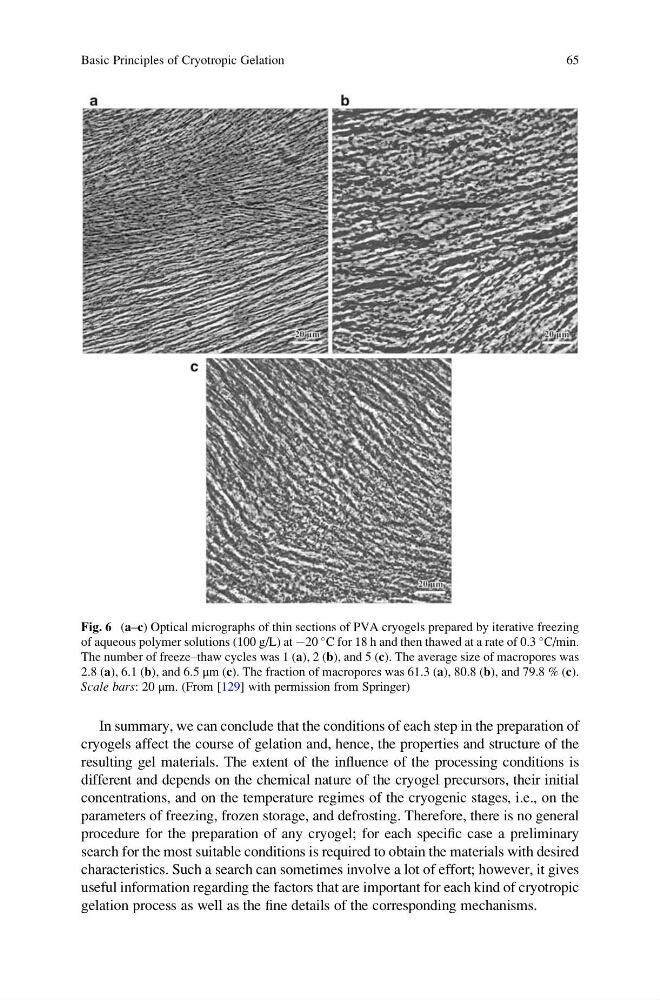
Fig. 6 (a–c) Optical micrographs of thin sections of PVA cryogels prepared by iterative freezing
of aqueous polymer solutions (100 g/L) at À20
C for 18 h and then thawed at a rate of 0.3
C/min.
The number of freeze–thaw cycles was 1 (a), 2 (b), and 5 (c). The average size of macropores was
2.8 (a), 6.1 (b), and 6.5 μm (c). The fraction of macropores was 61.3 (a), 80.8 (b), and 79.8 % (c).
Scale bars: 20 μm. (From [129] with permission from Springer)
Basic Principles of Cryotropic Gelation
65
cryogels affect the course of gelation and, hence, the properties and structure of the
resulting gel materials. The extent of the influence of the processing conditions is
different and depends on the chemical nature of the cryogel precursors, their initial
concentrations, and on the temperature regimes of the cryogenic stages, i.e., on the
parameters of freezing, frozen storage, and defrosting. Therefore, there is no general
procedure for the preparation of any cryogel; for each specific case a preliminary
search for the most suitable conditions is required to obtain the materials with desired
characteristics. Such a search can sometimes involve a lot of effort; however, it gives
useful information regarding the factors that are important for each kind of cryotropic
gelation process as well as the fine details of the corresponding mechanisms.
Fig. 6 (a–c) Optical micrographs of thin sections of PVA cryogels prepared by iterative freezing
of aqueous polymer solutions (100 g/L) at À20
C for 18 h and then thawed at a rate of 0.3
C/min.
The number of freeze–thaw cycles was 1 (a), 2 (b), and 5 (c). The average size of macropores was
2.8 (a), 6.1 (b), and 6.5 μm (c). The fraction of macropores was 61.3 (a), 80.8 (b), and 79.8 % (c).
Scale bars: 20 μm. (From [129] with permission from Springer)
Basic Principles of Cryotropic Gelation
65