

in the average size of macropores (by a factor of 2–3) and in the total (macro)
porosity (by ~30 %), whereas the subsequent cycles cause only a slight increase in
these characteristics. At the same time, both the rigidity and the fusion temperature
of the cryogels continue to increase with every following cycle. These experimental
results demonstrate that the pore space of PVA cryogels is mainly expanded during
the second freezing step when the ice crystals grow inside the micrometer-sized
pores formed after the first freeze–thaw cycle, whereas the gel formation processes
in the gel phase continue to occur at every subsequent thawing stage.
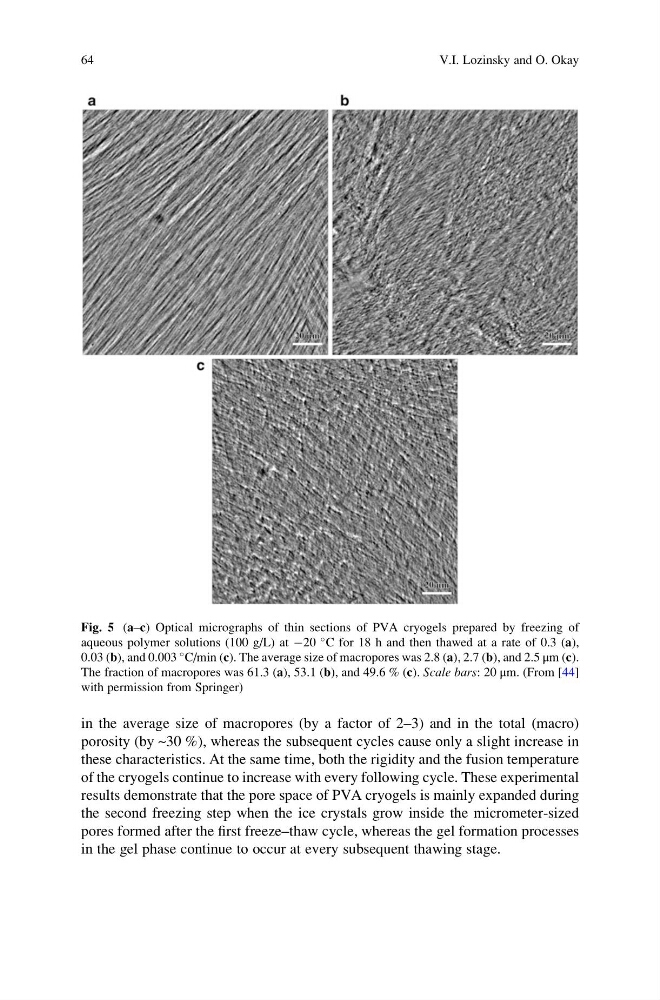
Fig. 5 (a–c) Optical micrographs of thin sections of PVA cryogels prepared by freezing of
aqueous polymer solutions (100 g/L) at À20
C for 18 h and then thawed at a rate of 0.3 (a),
0.03 (b), and 0.003
C/min (c). The average size of macropores was 2.8 (a), 2.7 (b), and 2.5 μm (c).
The fraction of macropores was 61.3 (a), 53.1 (b), and 49.6 % (c). Scale bars: 20 μm. (From [44]
with permission from Springer)
64
V.I. Lozinsky and O. Okay
porosity (by ~30 %), whereas the subsequent cycles cause only a slight increase in
these characteristics. At the same time, both the rigidity and the fusion temperature
of the cryogels continue to increase with every following cycle. These experimental
results demonstrate that the pore space of PVA cryogels is mainly expanded during
the second freezing step when the ice crystals grow inside the micrometer-sized
pores formed after the first freeze–thaw cycle, whereas the gel formation processes
in the gel phase continue to occur at every subsequent thawing stage.
Fig. 5 (a–c) Optical micrographs of thin sections of PVA cryogels prepared by freezing of
aqueous polymer solutions (100 g/L) at À20
C for 18 h and then thawed at a rate of 0.3 (a),
0.03 (b), and 0.003
C/min (c). The average size of macropores was 2.8 (a), 2.7 (b), and 2.5 μm (c).
The fraction of macropores was 61.3 (a), 53.1 (b), and 49.6 % (c). Scale bars: 20 μm. (From [44]
with permission from Springer)
64
V.I. Lozinsky and O. Okay