

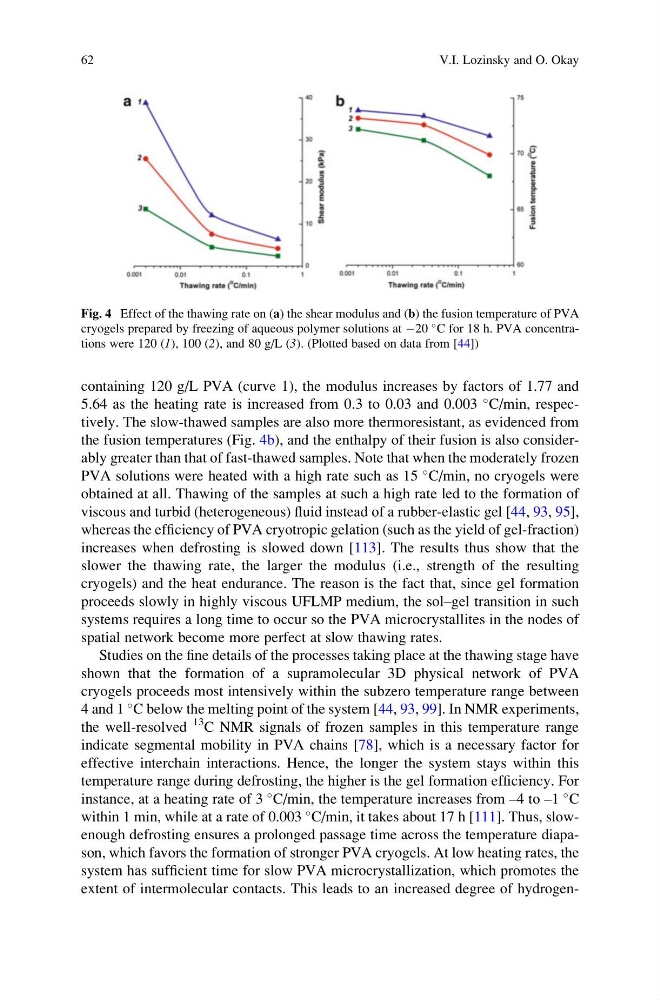
containing 120 g/L PVA (curve 1), the modulus increases by factors of 1.77 and
5.64 as the heating rate is increased from 0.3 to 0.03 and 0.003
C/min, respectively. The slow-thawed samples are also more thermoresistant, as evidenced from
the fusion temperatures (Fig. 4b), and the enthalpy of their fusion is also considerably greater than that of fast-thawed samples. Note that when the moderately frozen
PVA solutions were heated with a high rate such as 15
C/min, no cryogels were
obtained at all. Thawing of the samples at such a high rate led to the formation of
viscous and turbid (heterogeneous) fluid instead of a rubber-elastic gel [44, 93, 95],
whereas the efficiency of PVA cryotropic gelation (such as the yield of gel-fraction)
increases when defrosting is slowed down [113]. The results thus show that the
slower the thawing rate, the larger the modulus (i.e., strength of the resulting
cryogels) and the heat endurance. The reason is the fact that, since gel formation
proceeds slowly in highly viscous UFLMP medium, the sol–gel transition in such
systems requires a long time to occur so the PVA microcrystallites in the nodes of
spatial network become more perfect at slow thawing rates.
Studies on the fine details of the processes taking place at the thawing stage have
shown that the formation of a supramolecular 3D physical network of PVA
cryogels proceeds most intensively within the subzero temperature range between
4 and 1
C below the melting point of the system [44, 93, 99]. In NMR experiments,
the well-resolved
13 C NMR signals of frozen samples in this temperature range
indicate segmental mobility in PVA chains [78], which is a necessary factor for
effective interchain interactions. Hence, the longer the system stays within this
temperature range during defrosting, the higher is the gel formation efficiency. For
instance, at a heating rate of 3
C/min, the temperature increases from –4 to –1
C
within 1 min, while at a rate of 0.003
C/min, it takes about 17 h [111]. Thus, slowenough defrosting ensures a prolonged passage time across the temperature diapason, which favors the formation of stronger PVA cryogels. At low heating rates, the
system has sufficient time for slow PVA microcrystallization, which promotes the
extent of intermolecular contacts. This leads to an increased degree of hydrogenFig. 4 Effect of the thawing rate on (a) the shear modulus and (b) the fusion temperature of PVA
cryogels prepared by freezing of aqueous polymer solutions at À20
C for 18 h. PVA concentrations were 120 (1), 100 (2), and 80 g/L (3). (Plotted based on data from [44])
62
V.I. Lozinsky and O. Okay
5.64 as the heating rate is increased from 0.3 to 0.03 and 0.003
C/min, respectively. The slow-thawed samples are also more thermoresistant, as evidenced from
the fusion temperatures (Fig. 4b), and the enthalpy of their fusion is also considerably greater than that of fast-thawed samples. Note that when the moderately frozen
PVA solutions were heated with a high rate such as 15
C/min, no cryogels were
obtained at all. Thawing of the samples at such a high rate led to the formation of
viscous and turbid (heterogeneous) fluid instead of a rubber-elastic gel [44, 93, 95],
whereas the efficiency of PVA cryotropic gelation (such as the yield of gel-fraction)
increases when defrosting is slowed down [113]. The results thus show that the
slower the thawing rate, the larger the modulus (i.e., strength of the resulting
cryogels) and the heat endurance. The reason is the fact that, since gel formation
proceeds slowly in highly viscous UFLMP medium, the sol–gel transition in such
systems requires a long time to occur so the PVA microcrystallites in the nodes of
spatial network become more perfect at slow thawing rates.
Studies on the fine details of the processes taking place at the thawing stage have
shown that the formation of a supramolecular 3D physical network of PVA
cryogels proceeds most intensively within the subzero temperature range between
4 and 1
C below the melting point of the system [44, 93, 99]. In NMR experiments,
the well-resolved
13 C NMR signals of frozen samples in this temperature range
indicate segmental mobility in PVA chains [78], which is a necessary factor for
effective interchain interactions. Hence, the longer the system stays within this
temperature range during defrosting, the higher is the gel formation efficiency. For
instance, at a heating rate of 3
C/min, the temperature increases from –4 to –1
C
within 1 min, while at a rate of 0.003
C/min, it takes about 17 h [111]. Thus, slowenough defrosting ensures a prolonged passage time across the temperature diapason, which favors the formation of stronger PVA cryogels. At low heating rates, the
system has sufficient time for slow PVA microcrystallization, which promotes the
extent of intermolecular contacts. This leads to an increased degree of hydrogenFig. 4 Effect of the thawing rate on (a) the shear modulus and (b) the fusion temperature of PVA
cryogels prepared by freezing of aqueous polymer solutions at À20
C for 18 h. PVA concentrations were 120 (1), 100 (2), and 80 g/L (3). (Plotted based on data from [44])
62
V.I. Lozinsky and O. Okay