

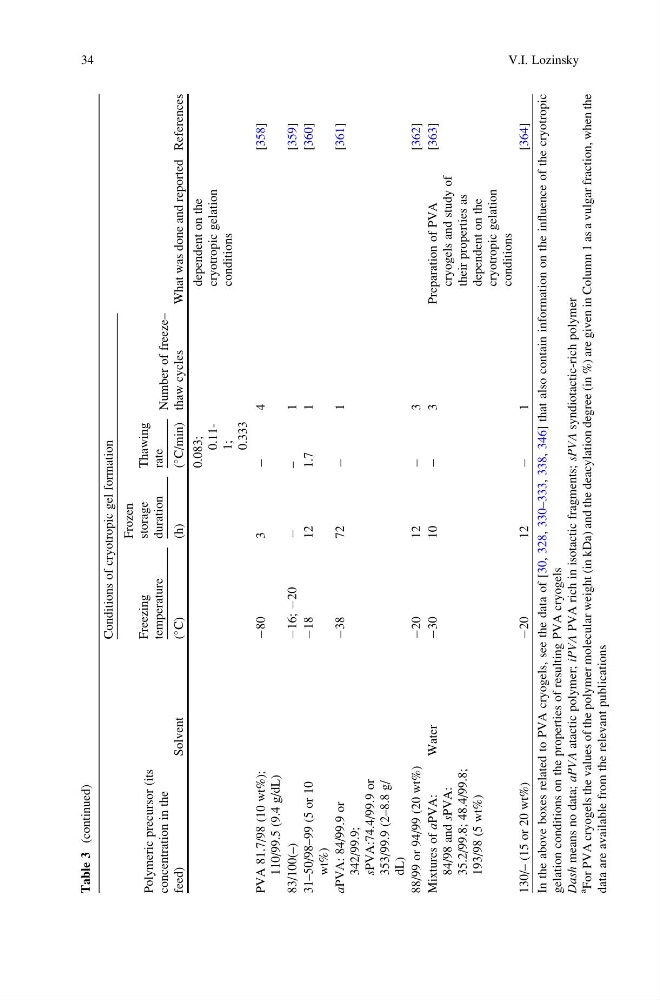
Table 3 (continued)
Polymeric precursor (its
concentration in the
feed)
Solvent
Conditions of cryotropic gel formation
What was done and reported References
Freezing
temperature
Frozen
storage
duration
Thawing
rate
Number of freeze–
thaw cycles
(
C)
(h)
(
C/min)
dependent on the
cryotropic gelation
conditions
0.083;
0.111;
0.333
PVA 81.7/98 (10 wt%);
110/99.5 (9.4 g/dL)
À80
3
À
4
[ 358]
83/100(–)
À16; À20
À
–
1
[ 359]
31–50/98–99 (5 or 10
wt%)
À18
12
1.7
1
[360]
aPVA: 84/99.9 or
342/99.9;
sPVA:74.4/99.9 or
353/99.9 (2–8.8 g/
dL)
À38
72
À
1
[ 361]
88/99 or 94/99 (20 wt%)
À20
12
À
3
[ 362]
Mixtures of
aPVA:
84/98 and
sPVA:
35.2/99.8; 48.4/99.8;
193/98 (5 wt%)
Water
À30
10
À
3
Preparation of PVA
cryogels and study of
their properties as
dependent on the
cryotropic gelation
conditions
[363]
130/– (15 or 20 wt%)
À20
12
À
1
[ 364]
In the above boxes related to PVA cryogels, see the data of [30, 328, 330–333, 338, 346] that also contain information on the influence of the cryotropic
gelation conditions on the properties of resulting PVA cryogels
Dash means no data;
aPVA atactic polymer;
iPVA PVA rich in isotactic fragments;
sPVA syndiotactic-rich polymer
a
For PVA cryogels the values of the polymer molecular weight (in kDa) and the deacylation degree (in %) are given in Column 1 as a vulgar fraction, when the
data are available from the relevant publications
34
V.I. Lozinsky
Polymeric precursor (its
concentration in the
feed)
Solvent
Conditions of cryotropic gel formation
What was done and reported References
Freezing
temperature
Frozen
storage
duration
Thawing
rate
Number of freeze–
thaw cycles
(
C)
(h)
(
C/min)
dependent on the
cryotropic gelation
conditions
0.083;
0.111;
0.333
PVA 81.7/98 (10 wt%);
110/99.5 (9.4 g/dL)
À80
3
À
4
[ 358]
83/100(–)
À16; À20
À
–
1
[ 359]
31–50/98–99 (5 or 10
wt%)
À18
12
1.7
1
[360]
aPVA: 84/99.9 or
342/99.9;
sPVA:74.4/99.9 or
353/99.9 (2–8.8 g/
dL)
À38
72
À
1
[ 361]
88/99 or 94/99 (20 wt%)
À20
12
À
3
[ 362]
Mixtures of
aPVA:
84/98 and
sPVA:
35.2/99.8; 48.4/99.8;
193/98 (5 wt%)
Water
À30
10
À
3
Preparation of PVA
cryogels and study of
their properties as
dependent on the
cryotropic gelation
conditions
[363]
130/– (15 or 20 wt%)
À20
12
À
1
[ 364]
In the above boxes related to PVA cryogels, see the data of [30, 328, 330–333, 338, 346] that also contain information on the influence of the cryotropic
gelation conditions on the properties of resulting PVA cryogels
Dash means no data;
aPVA atactic polymer;
iPVA PVA rich in isotactic fragments;
sPVA syndiotactic-rich polymer
a
For PVA cryogels the values of the polymer molecular weight (in kDa) and the deacylation degree (in %) are given in Column 1 as a vulgar fraction, when the
data are available from the relevant publications
34
V.I. Lozinsky