

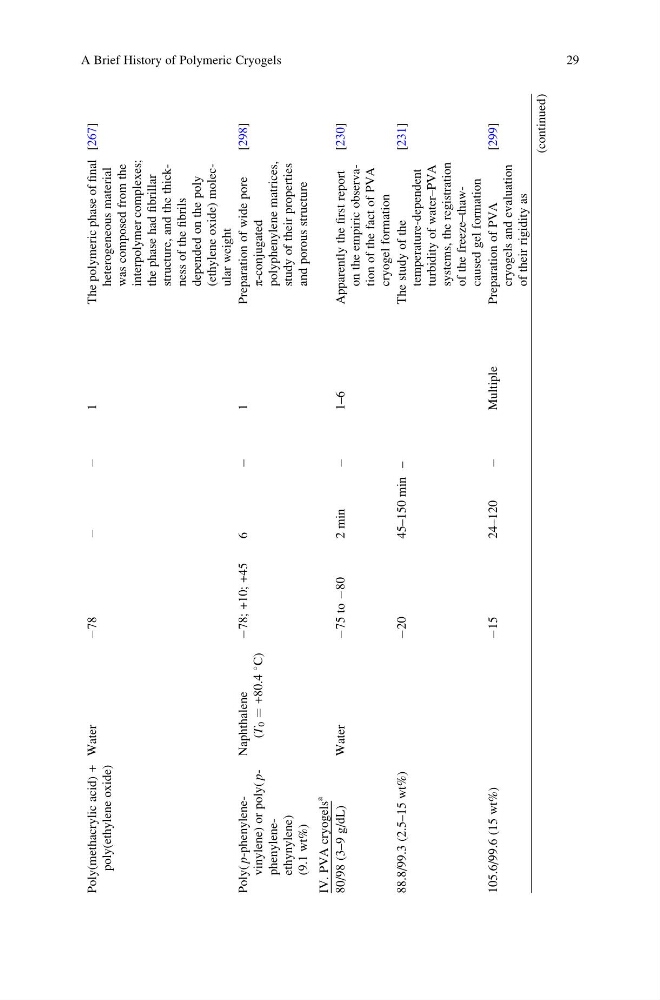
Poly(methacrylic acid) +
poly(ethylene oxide)
Water
À78
À
À
1
The polymeric phase of final
heterogeneous material
was composed from the
interpolymer complexes;
the phase had fibrillar
structure, and the thickness of the fibrils
depended on the poly
(ethylene oxide) molecular weight
[267]
Poly(
p-phenylenevinylene) or poly(
phenyleneethynylene)
(9.1 wt%)
Naphthalene
(T
0
¼ +80.4
C)
À78; +10; +45
6
À
1
Preparation of wide pore
π-conjugated
polyphenylene matrices,
study of their properties
and porous structure
[298]
IV. PVA cryogels
a
80/98 (3–9 g/dL)
Water
À75 to
À80
2 min
À
1–6
Apparently the first report
on the empiric observation of the fact of PVA
cryogel formation
[230]
88.8/99.3 (2.5–15 wt%)
À20
45–150 min –
The study of the
temperature-dependent
turbidity of water–PVA
systems, the registration
of the freeze–thawcaused gel formation
[231]
105.6/99.6 (15 wt%)
À15
24–120
À
Multiple
Preparation of PVA
cryogels and evaluation
of their rigidity as
[299]
(continued)
A Brief History of Polymeric Cryogels
29
poly(ethylene oxide)
Water
À78
À
À
1
The polymeric phase of final
heterogeneous material
was composed from the
interpolymer complexes;
the phase had fibrillar
structure, and the thickness of the fibrils
depended on the poly
(ethylene oxide) molecular weight
[267]
Poly(
p-phenylenevinylene) or poly(
phenyleneethynylene)
(9.1 wt%)
Naphthalene
(T
0
¼ +80.4
C)
À78; +10; +45
6
À
1
Preparation of wide pore
π-conjugated
polyphenylene matrices,
study of their properties
and porous structure
[298]
IV. PVA cryogels
a
80/98 (3–9 g/dL)
Water
À75 to
À80
2 min
À
1–6
Apparently the first report
on the empiric observation of the fact of PVA
cryogel formation
[230]
88.8/99.3 (2.5–15 wt%)
À20
45–150 min –
The study of the
temperature-dependent
turbidity of water–PVA
systems, the registration
of the freeze–thawcaused gel formation
[231]
105.6/99.6 (15 wt%)
À15
24–120
À
Multiple
Preparation of PVA
cryogels and evaluation
of their rigidity as
[299]
(continued)
A Brief History of Polymeric Cryogels
29