

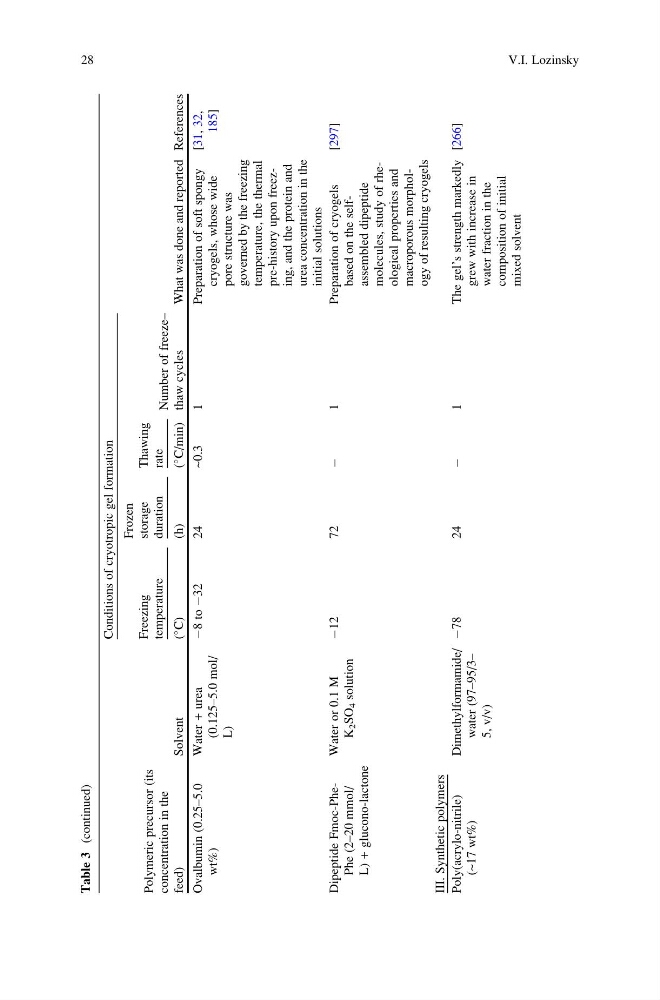
Table 3 (continued)
Polymeric precursor (its
concentration in the
feed)
Solvent
Conditions of cryotropic gel formation
What was done and reported References
Freezing
temperature
Frozen
storage
duration
Thawing
rate
Number of freeze–
thaw cycles
(
C)
(h)
(
C/min)
Ovalbumin (0.25–5.0
wt%)
Water + urea
(0.125–5.0 mol/
L)
À8 to
À32
24
~0.3
1
Preparation of soft spongy
cryogels, whose wide
pore structure was
governed by the freezing
temperature, the thermal
pre-history upon freezing, and the protein and
urea concentration in the
initial solutions
[31, 32,
185]
Dipeptide Fmoc-PhePhe (2–20 mmol/
L) + glucono-lactone
Water or 0.1 M
K
2 SO
4 solution
À12
72
À
1
Preparation of cryogels
based on the selfassembled dipeptide
molecules, study of rheological properties and
macroporous morphology of resulting cryogels
[297]
III. Synthetic polymers
Poly(acrylo-nitrile)
(~17 wt%)
Dimethylformamide/
water (97–95/3–
5, v/v)
À78
24
À
1
The gel’s strength markedly
grew with increase in
water fraction in the
composition of initial
mixed solvent
[266]
28
V.I. Lozinsky
Polymeric precursor (its
concentration in the
feed)
Solvent
Conditions of cryotropic gel formation
What was done and reported References
Freezing
temperature
Frozen
storage
duration
Thawing
rate
Number of freeze–
thaw cycles
(
C)
(h)
(
C/min)
Ovalbumin (0.25–5.0
wt%)
Water + urea
(0.125–5.0 mol/
L)
À8 to
À32
24
~0.3
1
Preparation of soft spongy
cryogels, whose wide
pore structure was
governed by the freezing
temperature, the thermal
pre-history upon freezing, and the protein and
urea concentration in the
initial solutions
[31, 32,
185]
Dipeptide Fmoc-PhePhe (2–20 mmol/
L) + glucono-lactone
Water or 0.1 M
K
2 SO
4 solution
À12
72
À
1
Preparation of cryogels
based on the selfassembled dipeptide
molecules, study of rheological properties and
macroporous morphology of resulting cryogels
[297]
III. Synthetic polymers
Poly(acrylo-nitrile)
(~17 wt%)
Dimethylformamide/
water (97–95/3–
5, v/v)
À78
24
À
1
The gel’s strength markedly
grew with increase in
water fraction in the
composition of initial
mixed solvent
[266]
28
V.I. Lozinsky