

Stammen et al. performed unconfined compression on samples made from two
formulations of Salubria, which is a commercial cryogel of PVA and 0.9% saline
(but the number of FTCs were not specified in the paper), containing 80 wt% water
($20 wt% PVA) and 75 wt% water ($25 wt% PVA). They measured the Young’s
modulus and the compressive failure of the samples in 37
C deionized water using
a compressive ramp to 65 % at a strain rate of 100 %/min (1.67 %/s) and 1,000 %/
min (16.67 %/s). Their objective was to mimic the physiological conditions of
articular cartilage. The authors found that the compressive mechanical properties of
Salubria were significantly affected by strain and strain rate, exhibiting nonlinear
viscoelastic behavior [53]. At strains less than 40 %, the Young’s modulus of the
25 wt% was consistently higher than the 20 wt% samples, irrespective of material
strain rate; however, the trend reversed above 60 % strain. At 30 % strain, a strain
rate increase from 100 to 1,000 %/min had a strong effect on the 25 % samples but
not on the 20 % samples. The compressive Young’s modulus for the 20 % and 25 %
samples were 0.7–6.8 MPa (at a strain rate of 100 %/min) and 1.1–18.4 MPa
(at strain rate of 1,000 %/min), respectively. The compressive failure for the
20 % and the 25 % samples were found to be around 45 % strain at 1.4 MPa stress
and 60 % strain at 2.1 MPa stress, respectively [53].
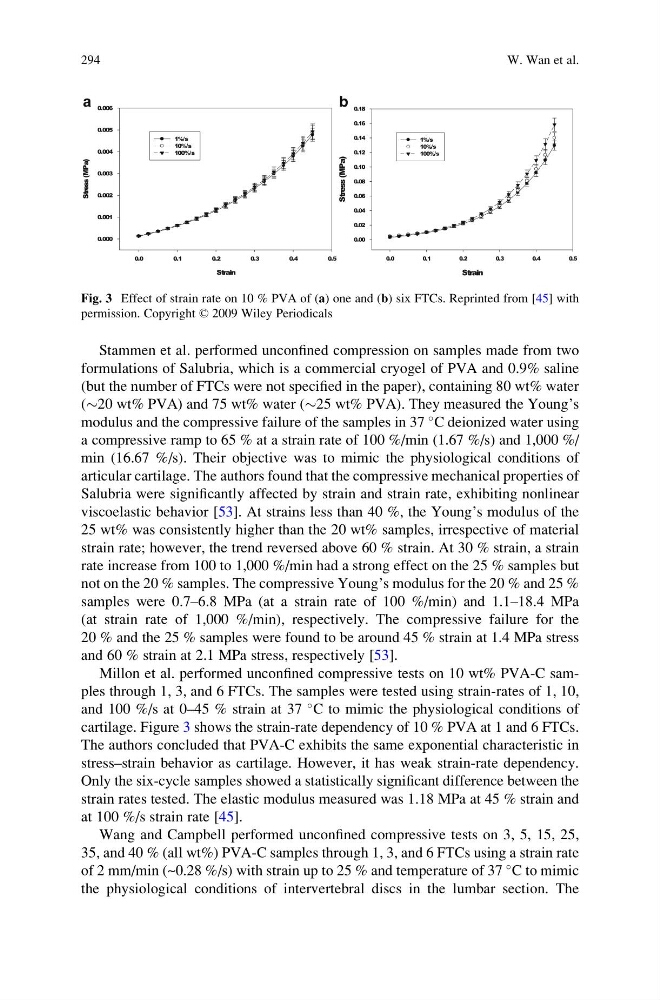
Millon et al. performed unconfined compressive tests on 10 wt% PVA-C samples through 1, 3, and 6 FTCs. The samples were tested using strain-rates of 1, 10,
and 100 %/s at 0–45 % strain at 37
C to mimic the physiological conditions of
cartilage. Figure 3 shows the strain-rate dependency of 10 % PVA at 1 and 6 FTCs.
The authors concluded that PVA-C exhibits the same exponential characteristic in
stress–strain behavior as cartilage. However, it has weak strain-rate dependency.
Only the six-cycle samples showed a statistically significant difference between the
strain rates tested. The elastic modulus measured was 1.18 MPa at 45 % strain and
at 100 %/s strain rate [45].
Wang and Campbell performed unconfined compressive tests on 3, 5, 15, 25,
35, and 40 % (all wt%) PVA-C samples through 1, 3, and 6 FTCs using a strain rate
of 2 mm/min (~0.28 %/s) with strain up to 25 % and temperature of 37
C to mimic
the physiological conditions of intervertebral discs in the lumbar section. The
b
a
Fig. 3 Effect of strain rate on 10 % PVA of (a) one and (b) six FTCs. Reprinted from [45] with
permission. Copyright © 2009 Wiley Periodicals
294
W. Wan et al.
formulations of Salubria, which is a commercial cryogel of PVA and 0.9% saline
(but the number of FTCs were not specified in the paper), containing 80 wt% water
($20 wt% PVA) and 75 wt% water ($25 wt% PVA). They measured the Young’s
modulus and the compressive failure of the samples in 37
C deionized water using
a compressive ramp to 65 % at a strain rate of 100 %/min (1.67 %/s) and 1,000 %/
min (16.67 %/s). Their objective was to mimic the physiological conditions of
articular cartilage. The authors found that the compressive mechanical properties of
Salubria were significantly affected by strain and strain rate, exhibiting nonlinear
viscoelastic behavior [53]. At strains less than 40 %, the Young’s modulus of the
25 wt% was consistently higher than the 20 wt% samples, irrespective of material
strain rate; however, the trend reversed above 60 % strain. At 30 % strain, a strain
rate increase from 100 to 1,000 %/min had a strong effect on the 25 % samples but
not on the 20 % samples. The compressive Young’s modulus for the 20 % and 25 %
samples were 0.7–6.8 MPa (at a strain rate of 100 %/min) and 1.1–18.4 MPa
(at strain rate of 1,000 %/min), respectively. The compressive failure for the
20 % and the 25 % samples were found to be around 45 % strain at 1.4 MPa stress
and 60 % strain at 2.1 MPa stress, respectively [53].
Millon et al. performed unconfined compressive tests on 10 wt% PVA-C samples through 1, 3, and 6 FTCs. The samples were tested using strain-rates of 1, 10,
and 100 %/s at 0–45 % strain at 37
C to mimic the physiological conditions of
cartilage. Figure 3 shows the strain-rate dependency of 10 % PVA at 1 and 6 FTCs.
The authors concluded that PVA-C exhibits the same exponential characteristic in
stress–strain behavior as cartilage. However, it has weak strain-rate dependency.
Only the six-cycle samples showed a statistically significant difference between the
strain rates tested. The elastic modulus measured was 1.18 MPa at 45 % strain and
at 100 %/s strain rate [45].
Wang and Campbell performed unconfined compressive tests on 3, 5, 15, 25,
35, and 40 % (all wt%) PVA-C samples through 1, 3, and 6 FTCs using a strain rate
of 2 mm/min (~0.28 %/s) with strain up to 25 % and temperature of 37
C to mimic
the physiological conditions of intervertebral discs in the lumbar section. The
b
a
Fig. 3 Effect of strain rate on 10 % PVA of (a) one and (b) six FTCs. Reprinted from [45] with
permission. Copyright © 2009 Wiley Periodicals
294
W. Wan et al.