

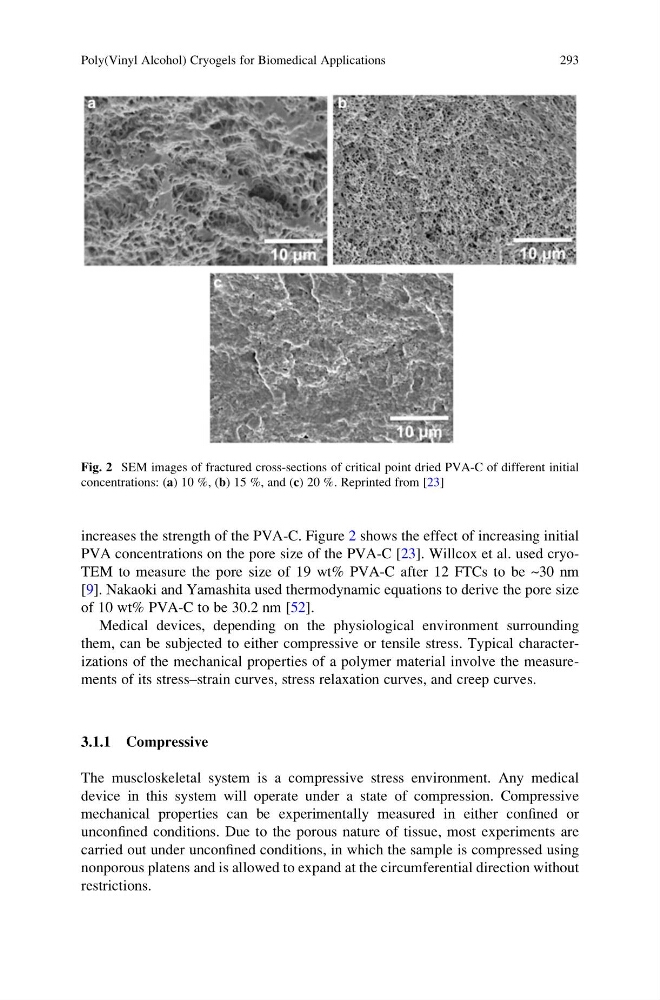
increases the strength of the PVA-C. Figure 2 shows the effect of increasing initial
PVA concentrations on the pore size of the PVA-C [23]. Willcox et al. used cryoTEM to measure the pore size of 19 wt% PVA-C after 12 FTCs to be ~30 nm
[9]. Nakaoki and Yamashita used thermodynamic equations to derive the pore size
of 10 wt% PVA-C to be 30.2 nm [52].
Medical devices, depending on the physiological environment surrounding
them, can be subjected to either compressive or tensile stress. Typical characterizations of the mechanical properties of a polymer material involve the measurements of its stress–strain curves, stress relaxation curves, and creep curves.
3.1.1 Compressive
The muscloskeletal system is a compressive stress environment. Any medical
device in this system will operate under a state of compression. Compressive
mechanical properties can be experimentally measured in either confined or
unconfined conditions. Due to the porous nature of tissue, most experiments are
carried out under unconfined conditions, in which the sample is compressed using
nonporous platens and is allowed to expand at the circumferential direction without
restrictions.
Fig. 2 SEM images of fractured cross-sections of critical point dried PVA-C of different initial
concentrations: (a) 10 %, (b) 15 %, and (c) 20 %. Reprinted from [23]
Poly(Vinyl Alcohol) Cryogels for Biomedical Applications
293
PVA concentrations on the pore size of the PVA-C [23]. Willcox et al. used cryoTEM to measure the pore size of 19 wt% PVA-C after 12 FTCs to be ~30 nm
[9]. Nakaoki and Yamashita used thermodynamic equations to derive the pore size
of 10 wt% PVA-C to be 30.2 nm [52].
Medical devices, depending on the physiological environment surrounding
them, can be subjected to either compressive or tensile stress. Typical characterizations of the mechanical properties of a polymer material involve the measurements of its stress–strain curves, stress relaxation curves, and creep curves.
3.1.1 Compressive
The muscloskeletal system is a compressive stress environment. Any medical
device in this system will operate under a state of compression. Compressive
mechanical properties can be experimentally measured in either confined or
unconfined conditions. Due to the porous nature of tissue, most experiments are
carried out under unconfined conditions, in which the sample is compressed using
nonporous platens and is allowed to expand at the circumferential direction without
restrictions.
Fig. 2 SEM images of fractured cross-sections of critical point dried PVA-C of different initial
concentrations: (a) 10 %, (b) 15 %, and (c) 20 %. Reprinted from [23]
Poly(Vinyl Alcohol) Cryogels for Biomedical Applications
293