

will break whereas others remain. Since it is a dynamic process, there may always
be some interactions keeping the cells bound and thereby preventing successful
elution. This is seen in many traditional chromatographic systems. An advantage
with cryogels is their elasticity. This property was exploited when developing a
chemo–mechanical elution procedure. In this method, the eluting medium is added
to the chromatographic column to weaken the binding of the cells to the gel. The gel
then is compressed. This mechanical force breaks many interactions and it is
possible to elute cells with high yields and high viability [57, 58]. The principle
is schematically illustrated in Fig. 8. In Figs. 9 and 10 some elution data for two
different microbial cells are given.
7.2 Organelles and Other Subcellular Particles
There are also possibilities for using cryogels for isolation of other particulate
structures, e.g., organelles. It has been clearly shown that it is possible to isolate
“viable” mitochondria from a homogenate of mammalian tissue. The isolated
mitochondria expressed their characteristic metabolic behavior [59].
During production of cloned proteins it often happens that inclusion bodies are
formed. Such structures can be harvested using affinity-mediated separation in
cryogels. After lysis of the cells, the inclusion bodies are labeled by antibodies
against the protein that forms the inclusion bodies. Bypassing a homogenate
(including inclusion bodies, cell debris, and soluble proteins) through a cryogel
with immobilized protein A or the semispecific ligand sulfametazin, it is possible to
capture the inclusion bodies selectively. IgG interaction with protein A usually
requires harsher elution conditions, often low pH. After proper washing, one can
then elute the inclusion bodies. With sulfametazin as capturing agent, it was
sufficient to add 1 M NaCl. Yields in these processes were often in the range of
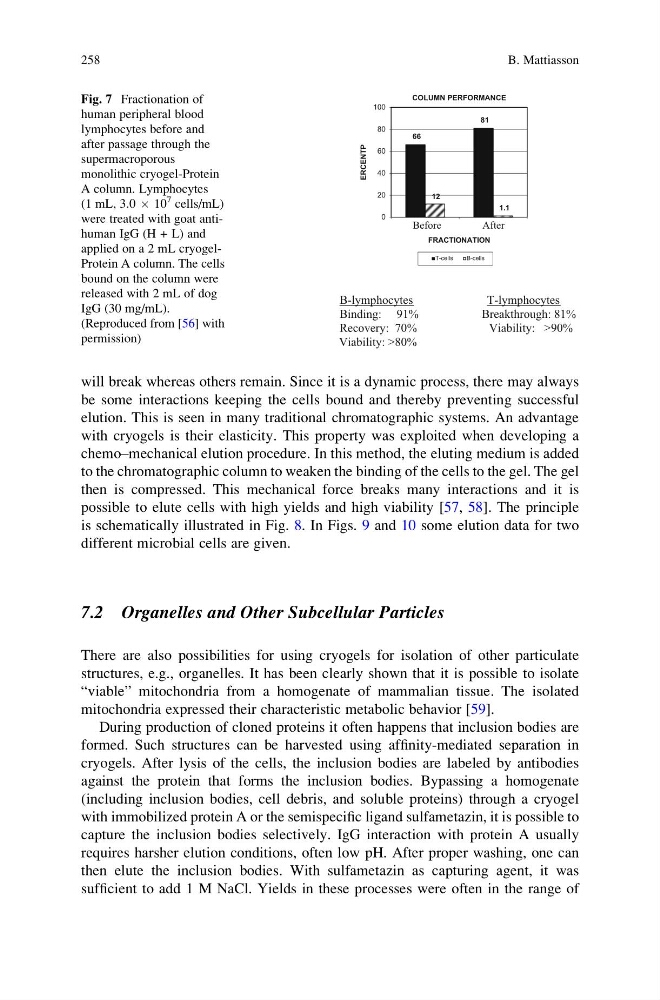
B-lymphocytes
T-lymphocytes
Binding: 91%
Breakthrough: 81%
Recovery: 70%
Viability: >90%
Viability: >80%
66
81
12
1.1
0
20
40
60
80
100
ERCENTP
FRACTIONATION
COLUMN PERFORMANCE
T-cells
B-cells
Before
After
Fig. 7 Fractionation of
human peripheral blood
lymphocytes before and
after passage through the
supermacroporous
monolithic cryogel-Protein
A column. Lymphocytes
(1 mL, 3.0 Â 10
7 cells/mL)
were treated with goat antihuman IgG (H + L) and
applied on a 2 mL cryogelProtein A column. The cells
bound on the column were
released with 2 mL of dog
IgG (30 mg/mL).
(Reproduced from [56] with
permission)
258
B. Mattiasson
be some interactions keeping the cells bound and thereby preventing successful
elution. This is seen in many traditional chromatographic systems. An advantage
with cryogels is their elasticity. This property was exploited when developing a
chemo–mechanical elution procedure. In this method, the eluting medium is added
to the chromatographic column to weaken the binding of the cells to the gel. The gel
then is compressed. This mechanical force breaks many interactions and it is
possible to elute cells with high yields and high viability [57, 58]. The principle
is schematically illustrated in Fig. 8. In Figs. 9 and 10 some elution data for two
different microbial cells are given.
7.2 Organelles and Other Subcellular Particles
There are also possibilities for using cryogels for isolation of other particulate
structures, e.g., organelles. It has been clearly shown that it is possible to isolate
“viable” mitochondria from a homogenate of mammalian tissue. The isolated
mitochondria expressed their characteristic metabolic behavior [59].
During production of cloned proteins it often happens that inclusion bodies are
formed. Such structures can be harvested using affinity-mediated separation in
cryogels. After lysis of the cells, the inclusion bodies are labeled by antibodies
against the protein that forms the inclusion bodies. Bypassing a homogenate
(including inclusion bodies, cell debris, and soluble proteins) through a cryogel
with immobilized protein A or the semispecific ligand sulfametazin, it is possible to
capture the inclusion bodies selectively. IgG interaction with protein A usually
requires harsher elution conditions, often low pH. After proper washing, one can
then elute the inclusion bodies. With sulfametazin as capturing agent, it was
sufficient to add 1 M NaCl. Yields in these processes were often in the range of
B-lymphocytes
T-lymphocytes
Binding: 91%
Breakthrough: 81%
Recovery: 70%
Viability: >90%
Viability: >80%
66
81
12
1.1
0
20
40
60
80
100
ERCENTP
FRACTIONATION
COLUMN PERFORMANCE
T-cells
B-cells
Before
After
Fig. 7 Fractionation of
human peripheral blood
lymphocytes before and
after passage through the
supermacroporous
monolithic cryogel-Protein
A column. Lymphocytes
(1 mL, 3.0 Â 10
7 cells/mL)
were treated with goat antihuman IgG (H + L) and
applied on a 2 mL cryogelProtein A column. The cells
bound on the column were
released with 2 mL of dog
IgG (30 mg/mL).
(Reproduced from [56] with
permission)
258
B. Mattiasson