

Due to the excellent biocompatibility of calcium phosphate, its application as a
particulate cryogel has attracted interest for creating biocompatible substrates for
drug delivery and encapsulation of biomolecules [81]. Hydroxyapatite is one of the
best materials for the production of biocompatible ceramics. Prevention of hard
agglomerate formation during drying significantly enhances its sinterability and,
thus, the high morphological homogeneity of these powders permits reduction of
the sintering temperature [82]. Cryogel-derived microspheres of YPO 4 after the
conversion of stable
89 Y to β-emitter
90
Y by neutron irradiation become an efficient
instrument of local intra-arterial radiotherapy [83].
Synthesis of gold cryogels is similar to the corresponding procedure for
supported catalysts described above, and involves reduction of HAuCl 4 by
NaBH 4 solution followed by separation and freeze-drying of the obtained gold
particles. Despite significant catalytic activity of the nanocrystalline gold, recent
studies on these cryogels also show their plasmonic properties. Here, an important
option of the cryogel method is the possibility of functionalization of nanoparticles
in the course of their synthesis. The dried gold particles demonstrate a good
re-dispersibility and retain their plasmonic properties [84, 85]. The application of
2-[4-(2-hydroxyethyl)-1-piperazinyl]ethanesulfonic acid (HEPES) as both template
and reducing agent instead of borohydride leads to branched gold nanocrystals [86].
2.3 Cryogels for Particle Isolation
One of the basic methods for investigation of chemical reactions is the analysis of
reaction intermediates by various physico-chemical methods. The best method for
such studies is analysis in situ, in real time, and in the real reaction environment.
However, in many cases, analysis in situ is complicated by the limitations of
analysis methods, e.g., the time of sample study may exceed the reaction time. In
order to overcome these limitations, a series of reaction intermediates should be
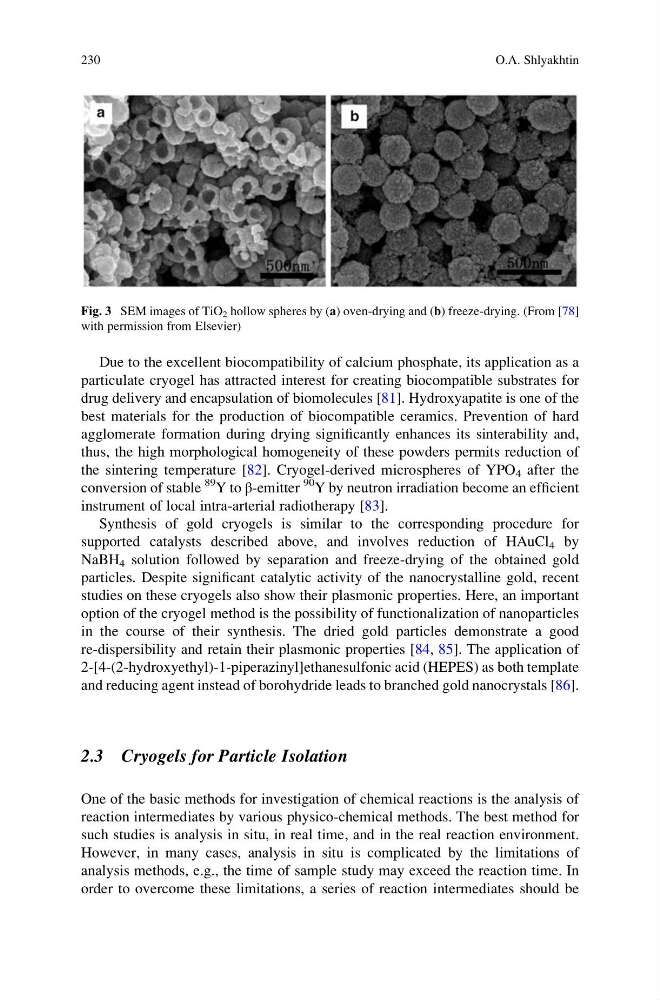
Fig. 3 SEM images of TiO 2 hollow spheres by (a) oven-drying and (b) freeze-drying. (From [78]
with permission from Elsevier)
230
O.A. Shlyakhtin
particulate cryogel has attracted interest for creating biocompatible substrates for
drug delivery and encapsulation of biomolecules [81]. Hydroxyapatite is one of the
best materials for the production of biocompatible ceramics. Prevention of hard
agglomerate formation during drying significantly enhances its sinterability and,
thus, the high morphological homogeneity of these powders permits reduction of
the sintering temperature [82]. Cryogel-derived microspheres of YPO 4 after the
conversion of stable
89 Y to β-emitter
90
Y by neutron irradiation become an efficient
instrument of local intra-arterial radiotherapy [83].
Synthesis of gold cryogels is similar to the corresponding procedure for
supported catalysts described above, and involves reduction of HAuCl 4 by
NaBH 4 solution followed by separation and freeze-drying of the obtained gold
particles. Despite significant catalytic activity of the nanocrystalline gold, recent
studies on these cryogels also show their plasmonic properties. Here, an important
option of the cryogel method is the possibility of functionalization of nanoparticles
in the course of their synthesis. The dried gold particles demonstrate a good
re-dispersibility and retain their plasmonic properties [84, 85]. The application of
2-[4-(2-hydroxyethyl)-1-piperazinyl]ethanesulfonic acid (HEPES) as both template
and reducing agent instead of borohydride leads to branched gold nanocrystals [86].
2.3 Cryogels for Particle Isolation
One of the basic methods for investigation of chemical reactions is the analysis of
reaction intermediates by various physico-chemical methods. The best method for
such studies is analysis in situ, in real time, and in the real reaction environment.
However, in many cases, analysis in situ is complicated by the limitations of
analysis methods, e.g., the time of sample study may exceed the reaction time. In
order to overcome these limitations, a series of reaction intermediates should be
Fig. 3 SEM images of TiO 2 hollow spheres by (a) oven-drying and (b) freeze-drying. (From [78]
with permission from Elsevier)
230
O.A. Shlyakhtin