

7 Conclusions
The combination of cryogenic treatment and UV irradiation is a facile method for
the synthesis of chemically crosslinked supermacroporous polymer cryogels from
both polymer and monomer precursors. Effective crosslinking and a high gel
fraction yield can be achieved by irradiation of partly frozen systems with a UV
curing equipment comprising a 400 W metal halide flood lamp emitting fullspectrum UV–visible light at an irradiation dose rate of 5.7 J/cm
2 min (input
power 93 mW/cm
2 ) for 2–5 min. The cryogels obtained possess an open porous
structure, which imparts a very rapid water uptake and, in the case of stimuliresponsive polymers, reversible ultrarapid volume phase transition.
Cryogels of cellulose derivatives were successfully synthesized by UV irradiation of their partly frozen solutions. The use of H 2 O 2 initiator for photocrosslinking
of biocompatible and biodegradable polymers allows preparation of “green” gel
materials that can be further exploited without any additional purification.
In general, different species such as water-soluble drugs, enzymes,
nanoparticles, and nanotubes can be immobilized either within the cryogel walls
or into the cryogel pores, depending on the experimental protocol. Hence, one can
fabricate materials with specific properties, for instance, drug carriers exhibiting
either fast or prolonged release profiles.
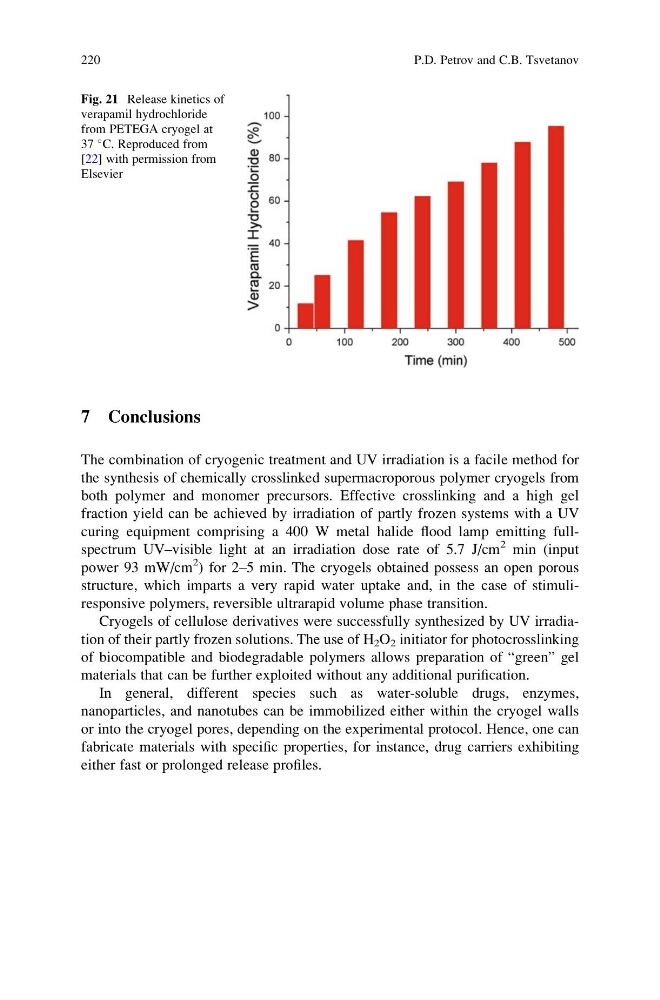
Fig. 21 Release kinetics of
verapamil hydrochloride
from PETEGA cryogel at
37
C. Reproduced from
[22] with permission from
Elsevier
220
P.D. Petrov and C.B. Tsvetanov
The combination of cryogenic treatment and UV irradiation is a facile method for
the synthesis of chemically crosslinked supermacroporous polymer cryogels from
both polymer and monomer precursors. Effective crosslinking and a high gel
fraction yield can be achieved by irradiation of partly frozen systems with a UV
curing equipment comprising a 400 W metal halide flood lamp emitting fullspectrum UV–visible light at an irradiation dose rate of 5.7 J/cm
2 min (input
power 93 mW/cm
2 ) for 2–5 min. The cryogels obtained possess an open porous
structure, which imparts a very rapid water uptake and, in the case of stimuliresponsive polymers, reversible ultrarapid volume phase transition.
Cryogels of cellulose derivatives were successfully synthesized by UV irradiation of their partly frozen solutions. The use of H 2 O 2 initiator for photocrosslinking
of biocompatible and biodegradable polymers allows preparation of “green” gel
materials that can be further exploited without any additional purification.
In general, different species such as water-soluble drugs, enzymes,
nanoparticles, and nanotubes can be immobilized either within the cryogel walls
or into the cryogel pores, depending on the experimental protocol. Hence, one can
fabricate materials with specific properties, for instance, drug carriers exhibiting
either fast or prolonged release profiles.
Fig. 21 Release kinetics of
verapamil hydrochloride
from PETEGA cryogel at
37
C. Reproduced from
[22] with permission from
Elsevier
220
P.D. Petrov and C.B. Tsvetanov