

encapsulation and sustained release of hydrophilic drugs has been investigated [21,
22]. By design, the water-soluble drug verapamil hydrochloride was entrapped in
the walls of different cryogels. In vitro experiments showed that the swelling
behavior of polymer matrices at physiological temperature plays a key role in the
drug release profile. For instance, the temperature-responsive PETEGA (Fig. 21)
and PNIPAAm cryogels, which are in a hydrophobic state at 37
C, released the
drug over a period of more than 8 h. Following a slight initial burst effect, from the
second hour post-incubation the drug release process is characterized by timeindependent kinetics (zero-order kinetics with correlation coefficient R ¼ 0.998).
This sustained release is attributed to the hindered diffusion of drug molecules
across the deswollen polymer network.
On the other hand, drug delivery systems based on hydrophilic PHEMA or
HEC–chitosan cryogels exhibited prolonged drug release at 37
C after incorporation of a high amount of crosslinking agent (30 mass%) into the polymer network
[19, 22]. It is suggested that the high crosslink density of the polymer network is
responsible for the reduced rate of diffusion of drug molecules.
Fig. 20 Digital image of
double-layered gel
comprising a PHEMA core
containing urease and a
PEO outer layer. Reprinted
from [35] with permission
from John Wiley & Sons
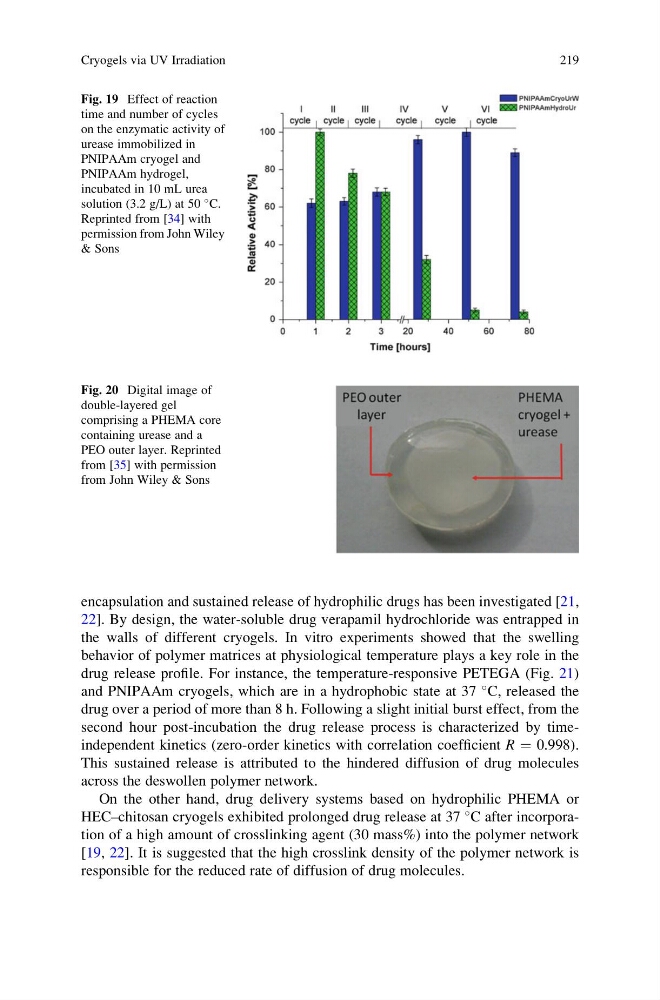
Fig. 19 Effect of reaction
time and number of cycles
on the enzymatic activity of
urease immobilized in
PNIPAAm cryogel and
PNIPAAm hydrogel,
incubated in 10 mL urea
solution (3.2 g/L) at 50
C.
Reprinted from [34] with
permission from John Wiley
& Sons
Cryogels via UV Irradiation
219
22]. By design, the water-soluble drug verapamil hydrochloride was entrapped in
the walls of different cryogels. In vitro experiments showed that the swelling
behavior of polymer matrices at physiological temperature plays a key role in the
drug release profile. For instance, the temperature-responsive PETEGA (Fig. 21)
and PNIPAAm cryogels, which are in a hydrophobic state at 37
C, released the
drug over a period of more than 8 h. Following a slight initial burst effect, from the
second hour post-incubation the drug release process is characterized by timeindependent kinetics (zero-order kinetics with correlation coefficient R ¼ 0.998).
This sustained release is attributed to the hindered diffusion of drug molecules
across the deswollen polymer network.
On the other hand, drug delivery systems based on hydrophilic PHEMA or
HEC–chitosan cryogels exhibited prolonged drug release at 37
C after incorporation of a high amount of crosslinking agent (30 mass%) into the polymer network
[19, 22]. It is suggested that the high crosslink density of the polymer network is
responsible for the reduced rate of diffusion of drug molecules.
Fig. 20 Digital image of
double-layered gel
comprising a PHEMA core
containing urease and a
PEO outer layer. Reprinted
from [35] with permission
from John Wiley & Sons
Fig. 19 Effect of reaction
time and number of cycles
on the enzymatic activity of
urease immobilized in
PNIPAAm cryogel and
PNIPAAm hydrogel,
incubated in 10 mL urea
solution (3.2 g/L) at 50
C.
Reprinted from [34] with
permission from John Wiley
& Sons
Cryogels via UV Irradiation
219