

more dilute PVA solutions with Φ ¼ 0.042 (curve b of Fig. 17b). In fact, the SANS
data in Fig. 17b indicate that in dilute PVA solution (Φ ¼ 0.042), crystallization of
PVA probably also takes place, even though a macroscopic gel is not formed upon
defrosting because the relative amount of the gel microphase is too low to give rise
to an interconnected macroscopic gel network at subzero temperatures [77].
The data in Fig. 17b may be used to extrapolate the value of the reduced
scattering invariant Ψ high (t) at infinite time Ψ high (t!1) [77]. The ratio of Ψ high (t)
to Ψ high (t!1) is proportional to the extent of PVA crystallization in the unfrozen
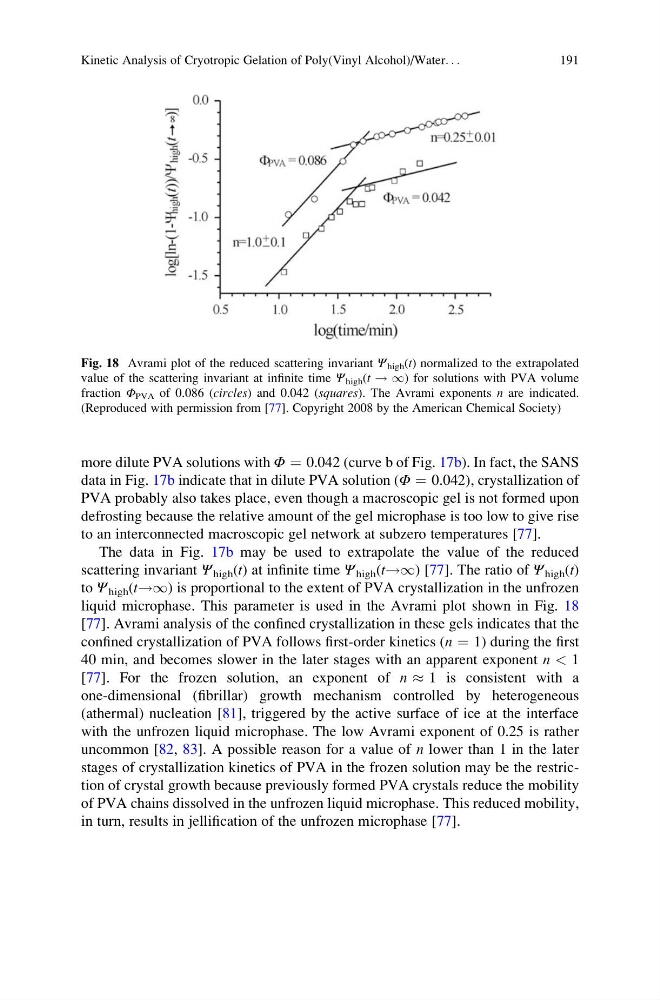
liquid microphase. This parameter is used in the Avrami plot shown in Fig. 18
[77]. Avrami analysis of the confined crystallization in these gels indicates that the
confined crystallization of PVA follows first-order kinetics (n ¼ 1) during the first
40 min, and becomes slower in the later stages with an apparent exponent n < 1
[77]. For the frozen solution, an exponent of n % 1 is consistent with a
one-dimensional (fibrillar) growth mechanism controlled by heterogeneous
(athermal) nucleation [81], triggered by the active surface of ice at the interface
with the unfrozen liquid microphase. The low Avrami exponent of 0.25 is rather
uncommon [82, 83]. A possible reason for a value of n lower than 1 in the later
stages of crystallization kinetics of PVA in the frozen solution may be the restriction of crystal growth because previously formed PVA crystals reduce the mobility
of PVA chains dissolved in the unfrozen liquid microphase. This reduced mobility,
in turn, results in jellification of the unfrozen microphase [77].
Fig. 18 Avrami plot of the reduced scattering invariant Ψ high (t) normalized to the extrapolated
value of the scattering invariant at infinite time Ψ high (t ! 1) for solutions with PVA volume
fraction Φ PVA of 0.086 (circles) and 0.042 (squares). The Avrami exponents n are indicated.
(Reproduced with permission from [77]. Copyright 2008 by the American Chemical Society)
Kinetic Analysis of Cryotropic Gelation of Poly(Vinyl Alcohol)/Water. . .
191
data in Fig. 17b indicate that in dilute PVA solution (Φ ¼ 0.042), crystallization of
PVA probably also takes place, even though a macroscopic gel is not formed upon
defrosting because the relative amount of the gel microphase is too low to give rise
to an interconnected macroscopic gel network at subzero temperatures [77].
The data in Fig. 17b may be used to extrapolate the value of the reduced
scattering invariant Ψ high (t) at infinite time Ψ high (t!1) [77]. The ratio of Ψ high (t)
to Ψ high (t!1) is proportional to the extent of PVA crystallization in the unfrozen
liquid microphase. This parameter is used in the Avrami plot shown in Fig. 18
[77]. Avrami analysis of the confined crystallization in these gels indicates that the
confined crystallization of PVA follows first-order kinetics (n ¼ 1) during the first
40 min, and becomes slower in the later stages with an apparent exponent n < 1
[77]. For the frozen solution, an exponent of n % 1 is consistent with a
one-dimensional (fibrillar) growth mechanism controlled by heterogeneous
(athermal) nucleation [81], triggered by the active surface of ice at the interface
with the unfrozen liquid microphase. The low Avrami exponent of 0.25 is rather
uncommon [82, 83]. A possible reason for a value of n lower than 1 in the later
stages of crystallization kinetics of PVA in the frozen solution may be the restriction of crystal growth because previously formed PVA crystals reduce the mobility
of PVA chains dissolved in the unfrozen liquid microphase. This reduced mobility,
in turn, results in jellification of the unfrozen microphase [77].
Fig. 18 Avrami plot of the reduced scattering invariant Ψ high (t) normalized to the extrapolated
value of the scattering invariant at infinite time Ψ high (t ! 1) for solutions with PVA volume
fraction Φ PVA of 0.086 (circles) and 0.042 (squares). The Avrami exponents n are indicated.
(Reproduced with permission from [77]. Copyright 2008 by the American Chemical Society)
Kinetic Analysis of Cryotropic Gelation of Poly(Vinyl Alcohol)/Water. . .
191