

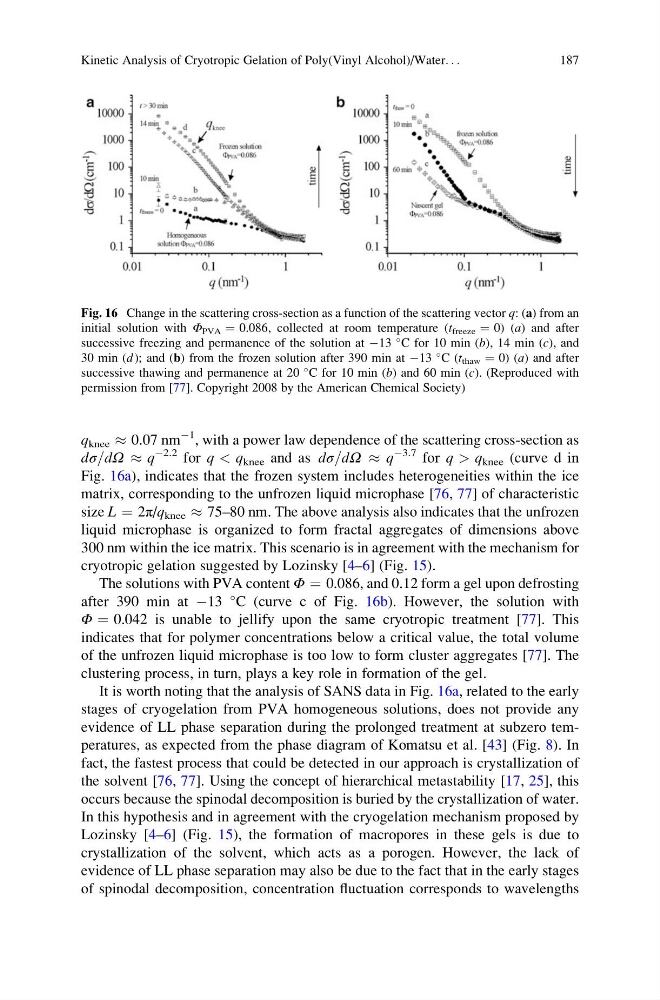
q knee % 0.07 nm
À1 , with a power law dependence of the scattering cross-section as
dσ=dΩ % q
À2.2 for q < q knee and as dσ=dΩ % q
À3.7 for q > q knee (curve d in
Fig. 16a), indicates that the frozen system includes heterogeneities within the ice
matrix, corresponding to the unfrozen liquid microphase [76, 77] of characteristic
size L ¼ 2π/q knee % 75–80 nm. The above analysis also indicates that the unfrozen
liquid microphase is organized to form fractal aggregates of dimensions above
300 nm within the ice matrix. This scenario is in agreement with the mechanism for
cryotropic gelation suggested by Lozinsky [4–6] (Fig. 15).
The solutions with PVA content Φ ¼ 0.086, and 0.12 form a gel upon defrosting
after 390 min at À13
C (curve c of Fig. 16b). However, the solution with
Φ ¼ 0.042 is unable to jellify upon the same cryotropic treatment [77]. This
indicates that for polymer concentrations below a critical value, the total volume
of the unfrozen liquid microphase is too low to form cluster aggregates [77]. The
clustering process, in turn, plays a key role in formation of the gel.
It is worth noting that the analysis of SANS data in Fig. 16a, related to the early
stages of cryogelation from PVA homogeneous solutions, does not provide any
evidence of LL phase separation during the prolonged treatment at subzero temperatures, as expected from the phase diagram of Komatsu et al. [43] (Fig. 8). In
fact, the fastest process that could be detected in our approach is crystallization of
the solvent [76, 77]. Using the concept of hierarchical metastability [17, 25], this
occurs because the spinodal decomposition is buried by the crystallization of water.
In this hypothesis and in agreement with the cryogelation mechanism proposed by
Lozinsky [4–6] (Fig. 15), the formation of macropores in these gels is due to
crystallization of the solvent, which acts as a porogen. However, the lack of
evidence of LL phase separation may also be due to the fact that in the early stages
of spinodal decomposition, concentration fluctuation corresponds to wavelengths
Fig. 16 Change in the scattering cross-section as a function of the scattering vector q: (a) from an
initial solution with Φ PVA ¼ 0.086, collected at room temperature (t freeze ¼ 0) (a) and after
successive freezing and permanence of the solution at À13
C for 10 min (b), 14 min (c), and
30 min (d ); and (b) from the frozen solution after 390 min at À13
C (t thaw ¼ 0) (a) and after
successive thawing and permanence at 20
C for 10 min (b) and 60 min (c). (Reproduced with
permission from [77]. Copyright 2008 by the American Chemical Society)
Kinetic Analysis of Cryotropic Gelation of Poly(Vinyl Alcohol)/Water. . .
187
À1 , with a power law dependence of the scattering cross-section as
dσ=dΩ % q
À2.2 for q < q knee and as dσ=dΩ % q
À3.7 for q > q knee (curve d in
Fig. 16a), indicates that the frozen system includes heterogeneities within the ice
matrix, corresponding to the unfrozen liquid microphase [76, 77] of characteristic
size L ¼ 2π/q knee % 75–80 nm. The above analysis also indicates that the unfrozen
liquid microphase is organized to form fractal aggregates of dimensions above
300 nm within the ice matrix. This scenario is in agreement with the mechanism for
cryotropic gelation suggested by Lozinsky [4–6] (Fig. 15).
The solutions with PVA content Φ ¼ 0.086, and 0.12 form a gel upon defrosting
after 390 min at À13
C (curve c of Fig. 16b). However, the solution with
Φ ¼ 0.042 is unable to jellify upon the same cryotropic treatment [77]. This
indicates that for polymer concentrations below a critical value, the total volume
of the unfrozen liquid microphase is too low to form cluster aggregates [77]. The
clustering process, in turn, plays a key role in formation of the gel.
It is worth noting that the analysis of SANS data in Fig. 16a, related to the early
stages of cryogelation from PVA homogeneous solutions, does not provide any
evidence of LL phase separation during the prolonged treatment at subzero temperatures, as expected from the phase diagram of Komatsu et al. [43] (Fig. 8). In
fact, the fastest process that could be detected in our approach is crystallization of
the solvent [76, 77]. Using the concept of hierarchical metastability [17, 25], this
occurs because the spinodal decomposition is buried by the crystallization of water.
In this hypothesis and in agreement with the cryogelation mechanism proposed by
Lozinsky [4–6] (Fig. 15), the formation of macropores in these gels is due to
crystallization of the solvent, which acts as a porogen. However, the lack of
evidence of LL phase separation may also be due to the fact that in the early stages
of spinodal decomposition, concentration fluctuation corresponds to wavelengths
Fig. 16 Change in the scattering cross-section as a function of the scattering vector q: (a) from an
initial solution with Φ PVA ¼ 0.086, collected at room temperature (t freeze ¼ 0) (a) and after
successive freezing and permanence of the solution at À13
C for 10 min (b), 14 min (c), and
30 min (d ); and (b) from the frozen solution after 390 min at À13
C (t thaw ¼ 0) (a) and after
successive thawing and permanence at 20
C for 10 min (b) and 60 min (c). (Reproduced with
permission from [77]. Copyright 2008 by the American Chemical Society)
Kinetic Analysis of Cryotropic Gelation of Poly(Vinyl Alcohol)/Water. . .
187