

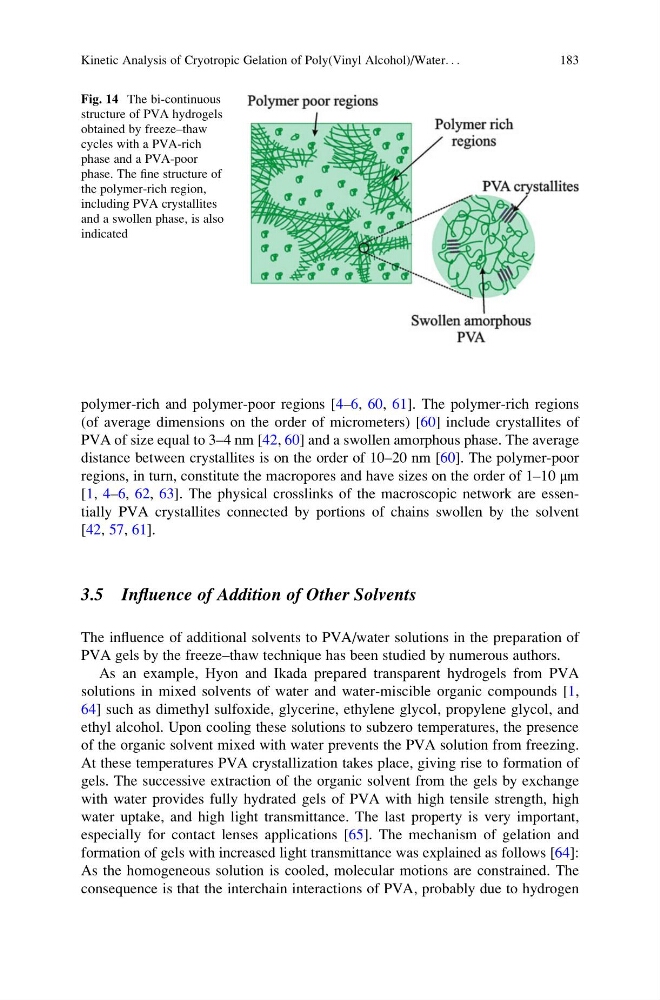
polymer-rich and polymer-poor regions [4–6, 60, 61]. The polymer-rich regions
(of average dimensions on the order of micrometers) [60] include crystallites of
PVA of size equal to 3–4 nm [42, 60] and a swollen amorphous phase. The average
distance between crystallites is on the order of 10–20 nm [60]. The polymer-poor
regions, in turn, constitute the macropores and have sizes on the order of 1–10 μm
[1, 4–6, 62, 63]. The physical crosslinks of the macroscopic network are essentially PVA crystallites connected by portions of chains swollen by the solvent
[42, 57, 61].
3.5 Influence of Addition of Other Solvents
The influence of additional solvents to PVA/water solutions in the preparation of
PVA gels by the freeze–thaw technique has been studied by numerous authors.
As an example, Hyon and Ikada prepared transparent hydrogels from PVA
solutions in mixed solvents of water and water-miscible organic compounds [1,
64] such as dimethyl sulfoxide, glycerine, ethylene glycol, propylene glycol, and
ethyl alcohol. Upon cooling these solutions to subzero temperatures, the presence
of the organic solvent mixed with water prevents the PVA solution from freezing.
At these temperatures PVA crystallization takes place, giving rise to formation of
gels. The successive extraction of the organic solvent from the gels by exchange
with water provides fully hydrated gels of PVA with high tensile strength, high
water uptake, and high light transmittance. The last property is very important,
especially for contact lenses applications [65]. The mechanism of gelation and
formation of gels with increased light transmittance was explained as follows [64]:
As the homogeneous solution is cooled, molecular motions are constrained. The
consequence is that the interchain interactions of PVA, probably due to hydrogen
Fig. 14 The bi-continuous
structure of PVA hydrogels
obtained by freeze–thaw
cycles with a PVA-rich
phase and a PVA-poor
phase. The fine structure of
the polymer-rich region,
including PVA crystallites
and a swollen phase, is also
indicated
Kinetic Analysis of Cryotropic Gelation of Poly(Vinyl Alcohol)/Water. . .
183
(of average dimensions on the order of micrometers) [60] include crystallites of
PVA of size equal to 3–4 nm [42, 60] and a swollen amorphous phase. The average
distance between crystallites is on the order of 10–20 nm [60]. The polymer-poor
regions, in turn, constitute the macropores and have sizes on the order of 1–10 μm
[1, 4–6, 62, 63]. The physical crosslinks of the macroscopic network are essentially PVA crystallites connected by portions of chains swollen by the solvent
[42, 57, 61].
3.5 Influence of Addition of Other Solvents
The influence of additional solvents to PVA/water solutions in the preparation of
PVA gels by the freeze–thaw technique has been studied by numerous authors.
As an example, Hyon and Ikada prepared transparent hydrogels from PVA
solutions in mixed solvents of water and water-miscible organic compounds [1,
64] such as dimethyl sulfoxide, glycerine, ethylene glycol, propylene glycol, and
ethyl alcohol. Upon cooling these solutions to subzero temperatures, the presence
of the organic solvent mixed with water prevents the PVA solution from freezing.
At these temperatures PVA crystallization takes place, giving rise to formation of
gels. The successive extraction of the organic solvent from the gels by exchange
with water provides fully hydrated gels of PVA with high tensile strength, high
water uptake, and high light transmittance. The last property is very important,
especially for contact lenses applications [65]. The mechanism of gelation and
formation of gels with increased light transmittance was explained as follows [64]:
As the homogeneous solution is cooled, molecular motions are constrained. The
consequence is that the interchain interactions of PVA, probably due to hydrogen
Fig. 14 The bi-continuous
structure of PVA hydrogels
obtained by freeze–thaw
cycles with a PVA-rich
phase and a PVA-poor
phase. The fine structure of
the polymer-rich region,
including PVA crystallites
and a swollen phase, is also
indicated
Kinetic Analysis of Cryotropic Gelation of Poly(Vinyl Alcohol)/Water. . .
183