

occurs at q* % 0.03 nm
À1 , indicating a distance between crystallites of the order
of 20 nm.
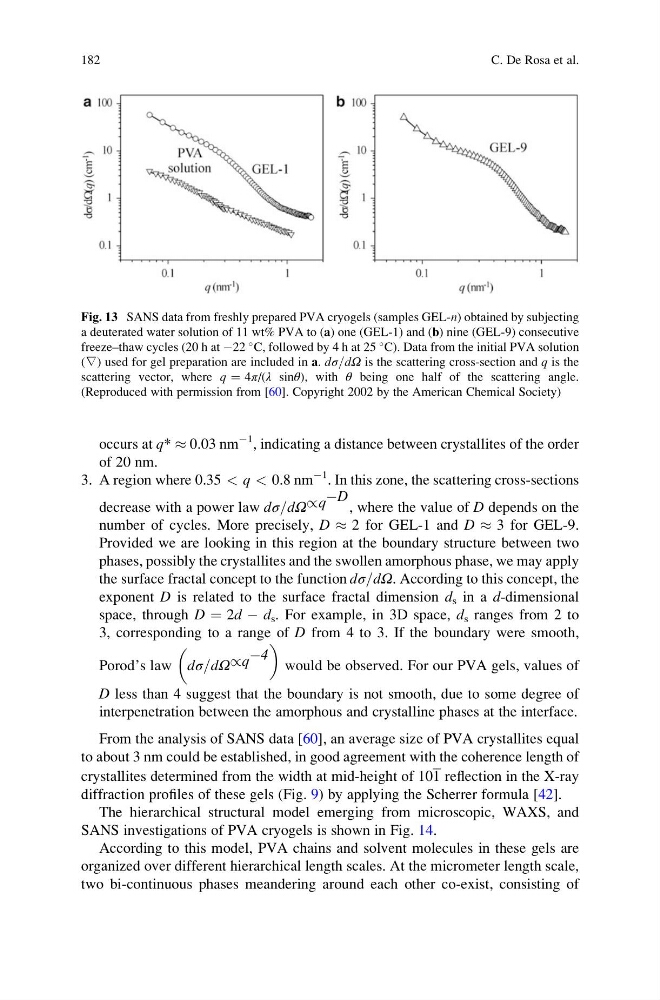
3. A region where 0.35 < q < 0.8 nm
À1 . In this zone, the scattering cross-sections
decrease with a power law dσ=dΩ /q ÀD
, where the value of D depends on the
number of cycles. More precisely, D % 2 for GEL-1 and D % 3 for GEL-9.
Provided we are looking in this region at the boundary structure between two
phases, possibly the crystallites and the swollen amorphous phase, we may apply
the surface fractal concept to the function dσ=dΩ. According to this concept, the
exponent D is related to the surface fractal dimension d s in a d-dimensional
space, through D ¼ 2d À d s . For example, in 3D space, d s ranges from 2 to
3, corresponding to a range of D from 4 to 3. If the boundary were smooth,
Porod’s law
dσ=dΩ /q À4
would be observed. For our PVA gels, values of
D less than 4 suggest that the boundary is not smooth, due to some degree of
interpenetration between the amorphous and crystalline phases at the interface.
From the analysis of SANS data [60], an average size of PVA crystallites equal
to about 3 nm could be established, in good agreement with the coherence length of
crystallites determined from the width at mid-height of 101 reflection in the X-ray
diffraction profiles of these gels (Fig. 9) by applying the Scherrer formula [42].
The hierarchical structural model emerging from microscopic, WAXS, and
SANS investigations of PVA cryogels is shown in Fig. 14.
According to this model, PVA chains and solvent molecules in these gels are
organized over different hierarchical length scales. At the micrometer length scale,
two bi-continuous phases meandering around each other co-exist, consisting of
Fig. 13 SANS data from freshly prepared PVA cryogels (samples GEL-n) obtained by subjecting
a deuterated water solution of 11 wt% PVA to (a) one (GEL-1) and (b) nine (GEL-9) consecutive
freeze–thaw cycles (20 h at À22
C, followed by 4 h at 25
C). Data from the initial PVA solution
(∇) used for gel preparation are included in a. dσ=dΩ is the scattering cross-section and q is the
scattering vector, where q ¼ 4π/(λ sinθ), with θ being one half of the scattering angle.
(Reproduced with permission from [60]. Copyright 2002 by the American Chemical Society)
182
C. De Rosa et al.
À1 , indicating a distance between crystallites of the order
of 20 nm.
3. A region where 0.35 < q < 0.8 nm
À1 . In this zone, the scattering cross-sections
decrease with a power law dσ=dΩ /q ÀD
, where the value of D depends on the
number of cycles. More precisely, D % 2 for GEL-1 and D % 3 for GEL-9.
Provided we are looking in this region at the boundary structure between two
phases, possibly the crystallites and the swollen amorphous phase, we may apply
the surface fractal concept to the function dσ=dΩ. According to this concept, the
exponent D is related to the surface fractal dimension d s in a d-dimensional
space, through D ¼ 2d À d s . For example, in 3D space, d s ranges from 2 to
3, corresponding to a range of D from 4 to 3. If the boundary were smooth,
Porod’s law
dσ=dΩ /q À4
would be observed. For our PVA gels, values of
D less than 4 suggest that the boundary is not smooth, due to some degree of
interpenetration between the amorphous and crystalline phases at the interface.
From the analysis of SANS data [60], an average size of PVA crystallites equal
to about 3 nm could be established, in good agreement with the coherence length of
crystallites determined from the width at mid-height of 101 reflection in the X-ray
diffraction profiles of these gels (Fig. 9) by applying the Scherrer formula [42].
The hierarchical structural model emerging from microscopic, WAXS, and
SANS investigations of PVA cryogels is shown in Fig. 14.
According to this model, PVA chains and solvent molecules in these gels are
organized over different hierarchical length scales. At the micrometer length scale,
two bi-continuous phases meandering around each other co-exist, consisting of
Fig. 13 SANS data from freshly prepared PVA cryogels (samples GEL-n) obtained by subjecting
a deuterated water solution of 11 wt% PVA to (a) one (GEL-1) and (b) nine (GEL-9) consecutive
freeze–thaw cycles (20 h at À22
C, followed by 4 h at 25
C). Data from the initial PVA solution
(∇) used for gel preparation are included in a. dσ=dΩ is the scattering cross-section and q is the
scattering vector, where q ¼ 4π/(λ sinθ), with θ being one half of the scattering angle.
(Reproduced with permission from [60]. Copyright 2002 by the American Chemical Society)
182
C. De Rosa et al.