

cryogels were obtained using the same protocol, starting from a D 2 O solution of
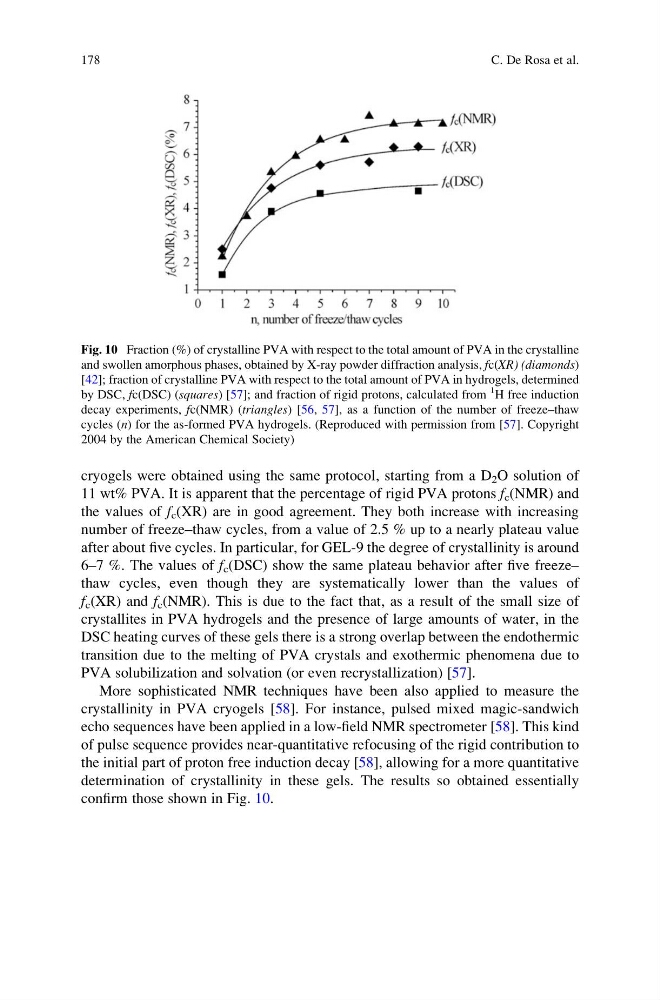
11 wt% PVA. It is apparent that the percentage of rigid PVA protons f c (NMR) and
the values of f c (XR) are in good agreement. They both increase with increasing
number of freeze–thaw cycles, from a value of 2.5 % up to a nearly plateau value
after about five cycles. In particular, for GEL-9 the degree of crystallinity is around
6–7 %. The values of f c (DSC) show the same plateau behavior after five freeze–
thaw cycles, even though they are systematically lower than the values of
f c (XR) and f c (NMR). This is due to the fact that, as a result of the small size of
crystallites in PVA hydrogels and the presence of large amounts of water, in the
DSC heating curves of these gels there is a strong overlap between the endothermic
transition due to the melting of PVA crystals and exothermic phenomena due to
PVA solubilization and solvation (or even recrystallization) [57].
More sophisticated NMR techniques have been also applied to measure the
crystallinity in PVA cryogels [58]. For instance, pulsed mixed magic-sandwich
echo sequences have been applied in a low-field NMR spectrometer [58]. This kind
of pulse sequence provides near-quantitative refocusing of the rigid contribution to
the initial part of proton free induction decay [58], allowing for a more quantitative
determination of crystallinity in these gels. The results so obtained essentially
confirm those shown in Fig. 10.
Fig. 10 Fraction (%) of crystalline PVA with respect to the total amount of PVA in the crystalline
and swollen amorphous phases, obtained by X-ray powder diffraction analysis, fc(XR) (diamonds)
[42]; fraction of crystalline PVA with respect to the total amount of PVA in hydrogels, determined
by DSC, fc(DSC) (squares) [57]; and fraction of rigid protons, calculated from
1
H free induction
decay experiments, fc(NMR) (triangles) [56, 57], as a function of the number of freeze–thaw
cycles (n) for the as-formed PVA hydrogels. (Reproduced with permission from [57]. Copyright
2004 by the American Chemical Society)
178
C. De Rosa et al.
11 wt% PVA. It is apparent that the percentage of rigid PVA protons f c (NMR) and
the values of f c (XR) are in good agreement. They both increase with increasing
number of freeze–thaw cycles, from a value of 2.5 % up to a nearly plateau value
after about five cycles. In particular, for GEL-9 the degree of crystallinity is around
6–7 %. The values of f c (DSC) show the same plateau behavior after five freeze–
thaw cycles, even though they are systematically lower than the values of
f c (XR) and f c (NMR). This is due to the fact that, as a result of the small size of
crystallites in PVA hydrogels and the presence of large amounts of water, in the
DSC heating curves of these gels there is a strong overlap between the endothermic
transition due to the melting of PVA crystals and exothermic phenomena due to
PVA solubilization and solvation (or even recrystallization) [57].
More sophisticated NMR techniques have been also applied to measure the
crystallinity in PVA cryogels [58]. For instance, pulsed mixed magic-sandwich
echo sequences have been applied in a low-field NMR spectrometer [58]. This kind
of pulse sequence provides near-quantitative refocusing of the rigid contribution to
the initial part of proton free induction decay [58], allowing for a more quantitative
determination of crystallinity in these gels. The results so obtained essentially
confirm those shown in Fig. 10.
Fig. 10 Fraction (%) of crystalline PVA with respect to the total amount of PVA in the crystalline
and swollen amorphous phases, obtained by X-ray powder diffraction analysis, fc(XR) (diamonds)
[42]; fraction of crystalline PVA with respect to the total amount of PVA in hydrogels, determined
by DSC, fc(DSC) (squares) [57]; and fraction of rigid protons, calculated from
1
H free induction
decay experiments, fc(NMR) (triangles) [56, 57], as a function of the number of freeze–thaw
cycles (n) for the as-formed PVA hydrogels. (Reproduced with permission from [57]. Copyright
2004 by the American Chemical Society)
178
C. De Rosa et al.