

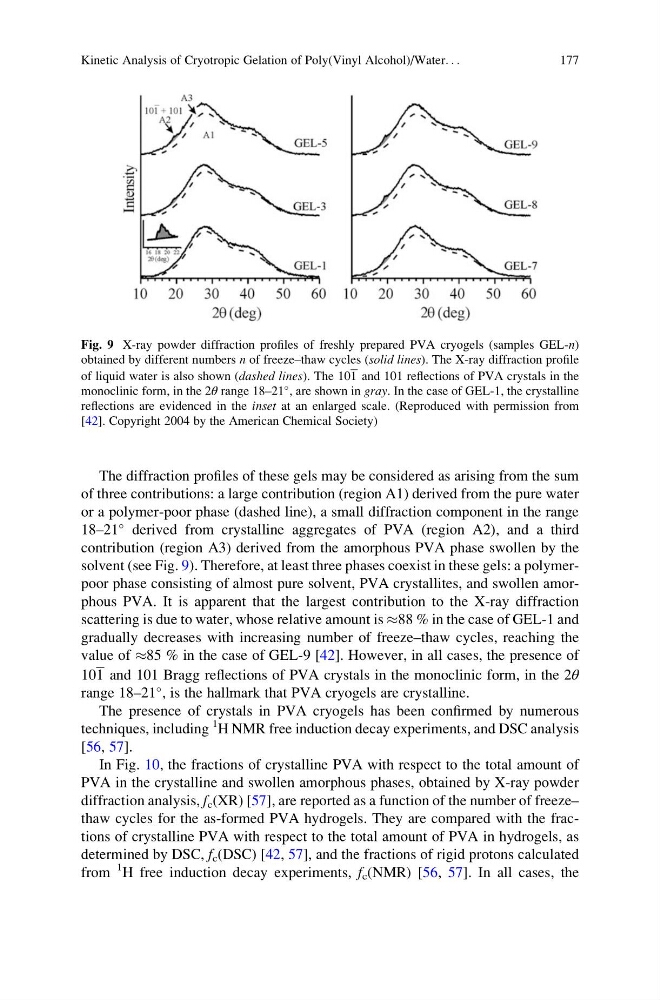
The diffraction profiles of these gels may be considered as arising from the sum
of three contributions: a large contribution (region A1) derived from the pure water
or a polymer-poor phase (dashed line), a small diffraction component in the range
18–21
derived from crystalline aggregates of PVA (region A2), and a third
contribution (region A3) derived from the amorphous PVA phase swollen by the
solvent (see Fig. 9). Therefore, at least three phases coexist in these gels: a polymerpoor phase consisting of almost pure solvent, PVA crystallites, and swollen amorphous PVA. It is apparent that the largest contribution to the X-ray diffraction
scattering is due to water, whose relative amount is %88 % in the case of GEL-1 and
gradually decreases with increasing number of freeze–thaw cycles, reaching the
value of %85 % in the case of GEL-9 [42]. However, in all cases, the presence of
101 and 101 Bragg reflections of PVA crystals in the monoclinic form, in the 2θ
range 18–21
, is the hallmark that PVA cryogels are crystalline.
The presence of crystals in PVA cryogels has been confirmed by numerous
techniques, including
1 H NMR free induction decay experiments, and DSC analysis
[56, 57].
In Fig. 10, the fractions of crystalline PVA with respect to the total amount of
PVA in the crystalline and swollen amorphous phases, obtained by X-ray powder
diffraction analysis, f c (XR) [57], are reported as a function of the number of freeze–
thaw cycles for the as-formed PVA hydrogels. They are compared with the fractions of crystalline PVA with respect to the total amount of PVA in hydrogels, as
determined by DSC, f c (DSC) [42, 57], and the fractions of rigid protons calculated
from
1 H free induction decay experiments, f c (NMR) [56, 57]. In all cases, the
Fig. 9 X-ray powder diffraction profiles of freshly prepared PVA cryogels (samples GEL-n)
obtained by different numbers n of freeze–thaw cycles (solid lines). The X-ray diffraction profile
of liquid water is also shown (dashed lines). The 101 and 101 reflections of PVA crystals in the
monoclinic form, in the 2θ range 18–21
, are shown in gray. In the case of GEL-1, the crystalline
reflections are evidenced in the inset at an enlarged scale. (Reproduced with permission from
[42]. Copyright 2004 by the American Chemical Society)
Kinetic Analysis of Cryotropic Gelation of Poly(Vinyl Alcohol)/Water. . .
177
of three contributions: a large contribution (region A1) derived from the pure water
or a polymer-poor phase (dashed line), a small diffraction component in the range
18–21
derived from crystalline aggregates of PVA (region A2), and a third
contribution (region A3) derived from the amorphous PVA phase swollen by the
solvent (see Fig. 9). Therefore, at least three phases coexist in these gels: a polymerpoor phase consisting of almost pure solvent, PVA crystallites, and swollen amorphous PVA. It is apparent that the largest contribution to the X-ray diffraction
scattering is due to water, whose relative amount is %88 % in the case of GEL-1 and
gradually decreases with increasing number of freeze–thaw cycles, reaching the
value of %85 % in the case of GEL-9 [42]. However, in all cases, the presence of
101 and 101 Bragg reflections of PVA crystals in the monoclinic form, in the 2θ
range 18–21
, is the hallmark that PVA cryogels are crystalline.
The presence of crystals in PVA cryogels has been confirmed by numerous
techniques, including
1 H NMR free induction decay experiments, and DSC analysis
[56, 57].
In Fig. 10, the fractions of crystalline PVA with respect to the total amount of
PVA in the crystalline and swollen amorphous phases, obtained by X-ray powder
diffraction analysis, f c (XR) [57], are reported as a function of the number of freeze–
thaw cycles for the as-formed PVA hydrogels. They are compared with the fractions of crystalline PVA with respect to the total amount of PVA in hydrogels, as
determined by DSC, f c (DSC) [42, 57], and the fractions of rigid protons calculated
from
1 H free induction decay experiments, f c (NMR) [56, 57]. In all cases, the
Fig. 9 X-ray powder diffraction profiles of freshly prepared PVA cryogels (samples GEL-n)
obtained by different numbers n of freeze–thaw cycles (solid lines). The X-ray diffraction profile
of liquid water is also shown (dashed lines). The 101 and 101 reflections of PVA crystals in the
monoclinic form, in the 2θ range 18–21
, are shown in gray. In the case of GEL-1, the crystalline
reflections are evidenced in the inset at an enlarged scale. (Reproduced with permission from
[42]. Copyright 2004 by the American Chemical Society)
Kinetic Analysis of Cryotropic Gelation of Poly(Vinyl Alcohol)/Water. . .
177