

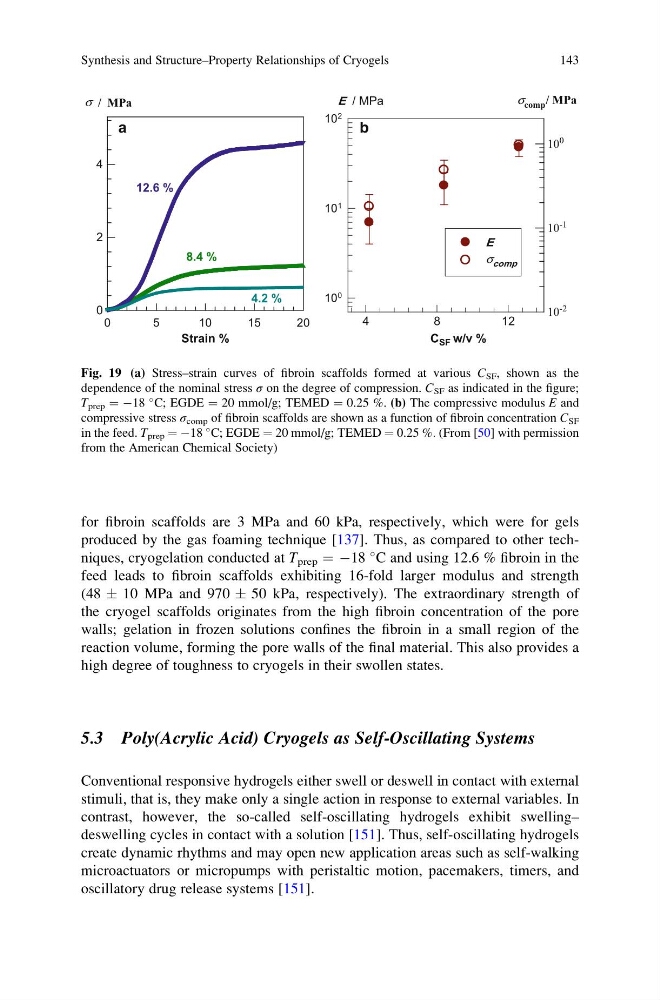
for fibroin scaffolds are 3 MPa and 60 kPa, respectively, which were for gels
produced by the gas foaming technique [137]. Thus, as compared to other techniques, cryogelation conducted at T prep ¼ À18
C and using 12.6 % fibroin in the
feed leads to fibroin scaffolds exhibiting 16-fold larger modulus and strength
(48 Æ 10 MPa and 970 Æ 50 kPa, respectively). The extraordinary strength of
the cryogel scaffolds originates from the high fibroin concentration of the pore
walls; gelation in frozen solutions confines the fibroin in a small region of the
reaction volume, forming the pore walls of the final material. This also provides a
high degree of toughness to cryogels in their swollen states.
5.3 Poly(Acrylic Acid) Cryogels as Self-Oscillating Systems
Conventional responsive hydrogels either swell or deswell in contact with external
stimuli, that is, they make only a single action in response to external variables. In
contrast, however, the so-called self-oscillating hydrogels exhibit swelling–
deswelling cycles in contact with a solution [151]. Thus, self-oscillating hydrogels
create dynamic rhythms and may open new application areas such as self-walking
microactuators or micropumps with peristaltic motion, pacemakers, timers, and
oscillatory drug release systems [151].
C SF w/v %
4
8
1 2
E / MPa
10
0
10
1
10
2
σ comp / MPa
10
-2
10
-1
10
0
E
σ comp
Strain %
0
5
10
15
20
σ / MPa
0
2
4
a
b
4.2 %
8.4 %
12.6 %
Fig. 19 (a) Stress–strain curves of fibroin scaffolds formed at various C SF , shown as the
dependence of the nominal stress σ on the degree of compression. C SF as indicated in the figure;
T prep ¼ À18
C; EGDE ¼ 20 mmol/g; TEMED ¼ 0.25 %. (b) The compressive modulus E and
compressive stress σ comp of fibroin scaffolds are shown as a function of fibroin concentration C SF
in the feed. T prep ¼ À18
C; EGDE ¼ 20 mmol/g; TEMED ¼ 0.25 %. (From [50] with permission
from the American Chemical Society)
Synthesis and Structure–Property Relationships of Cryogels
143
produced by the gas foaming technique [137]. Thus, as compared to other techniques, cryogelation conducted at T prep ¼ À18
C and using 12.6 % fibroin in the
feed leads to fibroin scaffolds exhibiting 16-fold larger modulus and strength
(48 Æ 10 MPa and 970 Æ 50 kPa, respectively). The extraordinary strength of
the cryogel scaffolds originates from the high fibroin concentration of the pore
walls; gelation in frozen solutions confines the fibroin in a small region of the
reaction volume, forming the pore walls of the final material. This also provides a
high degree of toughness to cryogels in their swollen states.
5.3 Poly(Acrylic Acid) Cryogels as Self-Oscillating Systems
Conventional responsive hydrogels either swell or deswell in contact with external
stimuli, that is, they make only a single action in response to external variables. In
contrast, however, the so-called self-oscillating hydrogels exhibit swelling–
deswelling cycles in contact with a solution [151]. Thus, self-oscillating hydrogels
create dynamic rhythms and may open new application areas such as self-walking
microactuators or micropumps with peristaltic motion, pacemakers, timers, and
oscillatory drug release systems [151].
C SF w/v %
4
8
1 2
E / MPa
10
0
10
1
10
2
σ comp / MPa
10
-2
10
-1
10
0
E
σ comp
Strain %
0
5
10
15
20
σ / MPa
0
2
4
a
b
4.2 %
8.4 %
12.6 %
Fig. 19 (a) Stress–strain curves of fibroin scaffolds formed at various C SF , shown as the
dependence of the nominal stress σ on the degree of compression. C SF as indicated in the figure;
T prep ¼ À18
C; EGDE ¼ 20 mmol/g; TEMED ¼ 0.25 %. (b) The compressive modulus E and
compressive stress σ comp of fibroin scaffolds are shown as a function of fibroin concentration C SF
in the feed. T prep ¼ À18
C; EGDE ¼ 20 mmol/g; TEMED ¼ 0.25 %. (From [50] with permission
from the American Chemical Society)
Synthesis and Structure–Property Relationships of Cryogels
143