

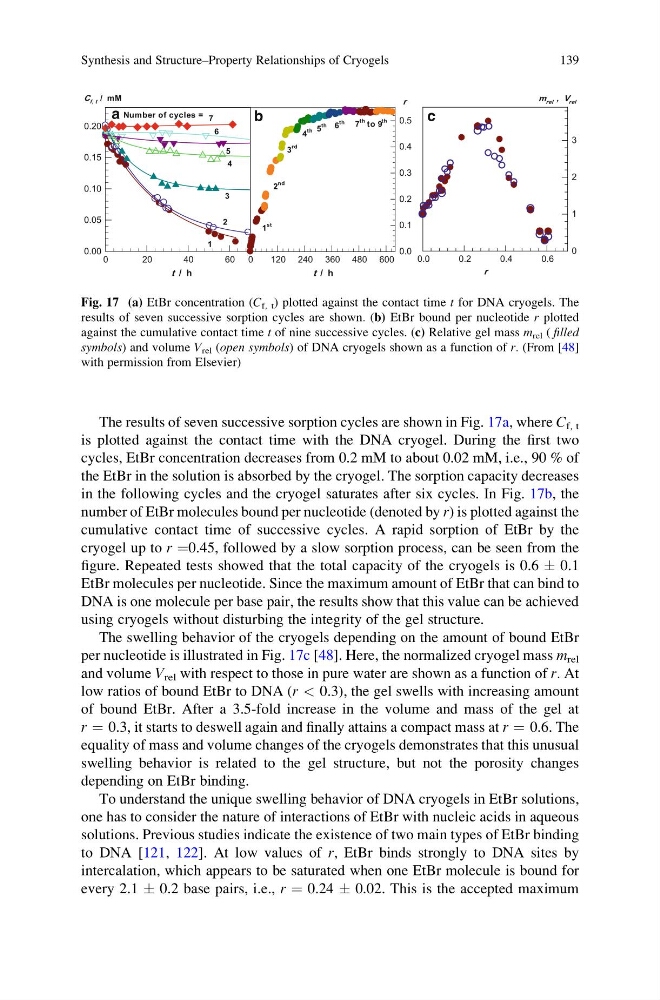
The results of seven successive sorption cycles are shown in Fig. 17a, where C f, t
is plotted against the contact time with the DNA cryogel. During the first two
cycles, EtBr concentration decreases from 0.2 mM to about 0.02 mM, i.e., 90 % of
the EtBr in the solution is absorbed by the cryogel. The sorption capacity decreases
in the following cycles and the cryogel saturates after six cycles. In Fig. 17b, the
number of EtBr molecules bound per nucleotide (denoted by r) is plotted against the
cumulative contact time of successive cycles. A rapid sorption of EtBr by the
cryogel up to r ¼0.45, followed by a slow sorption process, can be seen from the
figure. Repeated tests showed that the total capacity of the cryogels is 0.6 Æ 0.1
EtBr molecules per nucleotide. Since the maximum amount of EtBr that can bind to
DNA is one molecule per base pair, the results show that this value can be achieved
using cryogels without disturbing the integrity of the gel structure.
The swelling behavior of the cryogels depending on the amount of bound EtBr
per nucleotide is illustrated in Fig. 17c [48]. Here, the normalized cryogel mass m rel
and volume V rel with respect to those in pure water are shown as a function of r. At
low ratios of bound EtBr to DNA (r < 0.3), the gel swells with increasing amount
of bound EtBr. After a 3.5-fold increase in the volume and mass of the gel at
r ¼ 0.3, it starts to deswell again and finally attains a compact mass at r ¼ 0.6. The
equality of mass and volume changes of the cryogels demonstrates that this unusual
swelling behavior is related to the gel structure, but not the porosity changes
depending on EtBr binding.
To understand the unique swelling behavior of DNA cryogels in EtBr solutions,
one has to consider the nature of interactions of EtBr with nucleic acids in aqueous
solutions. Previous studies indicate the existence of two main types of EtBr binding
to DNA [121, 122]. At low values of r, EtBr binds strongly to DNA sites by
intercalation, which appears to be saturated when one EtBr molecule is bound for
every 2.1 Æ 0.2 base pairs, i.e., r ¼ 0.24 Æ 0.02. This is the accepted maximum
t / h
0
2 0
4 0
6 0
C f, t / mM
0.00
0.05
0.10
0.15
0.20
Number of cycles =
1
2
3
4
5
6
7
t / h
0
120 240 360 480 600
r
0.0
0.1
0.2
0.3
0.4
0.5
a
b
1
st
2
nd
3
rd
4
th 5
th 6
th
7
th to 9
th
r
0.0
0.2
0.4
0.6
m rel , V rel
0
1
2
3
c
Fig. 17 (a) EtBr concentration (C f, t ) plotted against the contact time t for DNA cryogels. The
results of seven successive sorption cycles are shown. (b) EtBr bound per nucleotide r plotted
against the cumulative contact time t of nine successive cycles. (c) Relative gel mass m rel ( filled
symbols) and volume V rel (open symbols) of DNA cryogels shown as a function of r. (From [48]
with permission from Elsevier)
Synthesis and Structure–Property Relationships of Cryogels
139
is plotted against the contact time with the DNA cryogel. During the first two
cycles, EtBr concentration decreases from 0.2 mM to about 0.02 mM, i.e., 90 % of
the EtBr in the solution is absorbed by the cryogel. The sorption capacity decreases
in the following cycles and the cryogel saturates after six cycles. In Fig. 17b, the
number of EtBr molecules bound per nucleotide (denoted by r) is plotted against the
cumulative contact time of successive cycles. A rapid sorption of EtBr by the
cryogel up to r ¼0.45, followed by a slow sorption process, can be seen from the
figure. Repeated tests showed that the total capacity of the cryogels is 0.6 Æ 0.1
EtBr molecules per nucleotide. Since the maximum amount of EtBr that can bind to
DNA is one molecule per base pair, the results show that this value can be achieved
using cryogels without disturbing the integrity of the gel structure.
The swelling behavior of the cryogels depending on the amount of bound EtBr
per nucleotide is illustrated in Fig. 17c [48]. Here, the normalized cryogel mass m rel
and volume V rel with respect to those in pure water are shown as a function of r. At
low ratios of bound EtBr to DNA (r < 0.3), the gel swells with increasing amount
of bound EtBr. After a 3.5-fold increase in the volume and mass of the gel at
r ¼ 0.3, it starts to deswell again and finally attains a compact mass at r ¼ 0.6. The
equality of mass and volume changes of the cryogels demonstrates that this unusual
swelling behavior is related to the gel structure, but not the porosity changes
depending on EtBr binding.
To understand the unique swelling behavior of DNA cryogels in EtBr solutions,
one has to consider the nature of interactions of EtBr with nucleic acids in aqueous
solutions. Previous studies indicate the existence of two main types of EtBr binding
to DNA [121, 122]. At low values of r, EtBr binds strongly to DNA sites by
intercalation, which appears to be saturated when one EtBr molecule is bound for
every 2.1 Æ 0.2 base pairs, i.e., r ¼ 0.24 Æ 0.02. This is the accepted maximum
t / h
0
2 0
4 0
6 0
C f, t / mM
0.00
0.05
0.10
0.15
0.20
Number of cycles =
1
2
3
4
5
6
7
t / h
0
120 240 360 480 600
r
0.0
0.1
0.2
0.3
0.4
0.5
a
b
1
st
2
nd
3
rd
4
th 5
th 6
th
7
th to 9
th
r
0.0
0.2
0.4
0.6
m rel , V rel
0
1
2
3
c
Fig. 17 (a) EtBr concentration (C f, t ) plotted against the contact time t for DNA cryogels. The
results of seven successive sorption cycles are shown. (b) EtBr bound per nucleotide r plotted
against the cumulative contact time t of nine successive cycles. (c) Relative gel mass m rel ( filled
symbols) and volume V rel (open symbols) of DNA cryogels shown as a function of r. (From [48]
with permission from Elsevier)
Synthesis and Structure–Property Relationships of Cryogels
139