

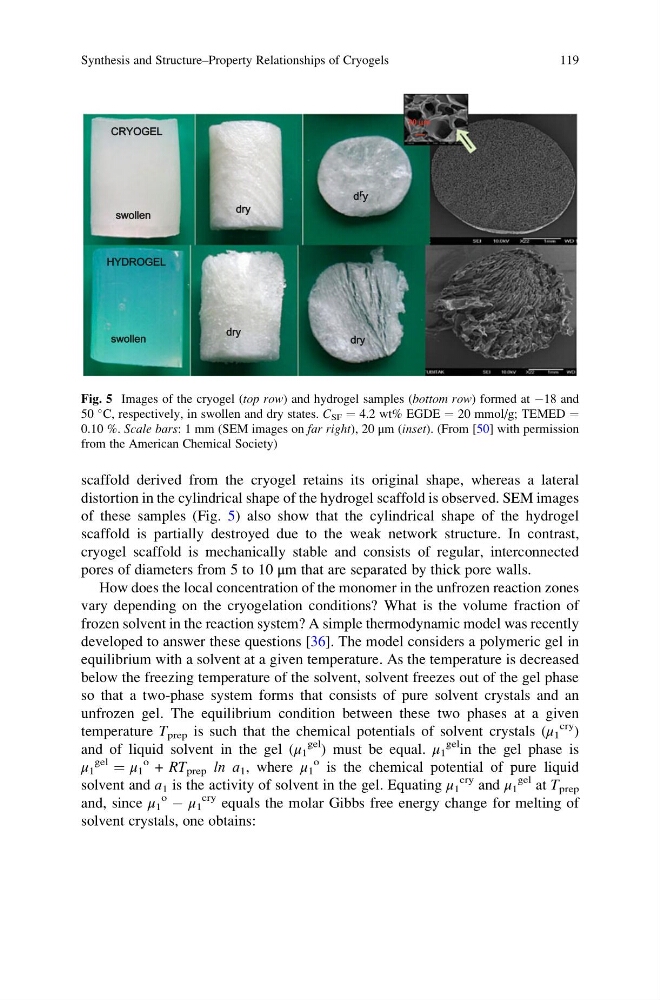
scaffold derived from the cryogel retains its original shape, whereas a lateral
distortion in the cylindrical shape of the hydrogel scaffold is observed. SEM images
of these samples (Fig. 5) also show that the cylindrical shape of the hydrogel
scaffold is partially destroyed due to the weak network structure. In contrast,
cryogel scaffold is mechanically stable and consists of regular, interconnected
pores of diameters from 5 to 10 μm that are separated by thick pore walls.
How does the local concentration of the monomer in the unfrozen reaction zones
vary depending on the cryogelation conditions? What is the volume fraction of
frozen solvent in the reaction system? A simple thermodynamic model was recently
developed to answer these questions [36]. The model considers a polymeric gel in
equilibrium with a solvent at a given temperature. As the temperature is decreased
below the freezing temperature of the solvent, solvent freezes out of the gel phase
so that a two-phase system forms that consists of pure solvent crystals and an
unfrozen gel. The equilibrium condition between these two phases at a given
temperature T prep is such that the chemical potentials of solvent crystals (μ 1
cry )
and of liquid solvent in the gel (μ 1
gel ) must be equal. μ 1
gel in the gel phase is
μ 1
gel
¼ μ 1
o + RT prep ln a 1 , where μ 1
o is the chemical potential of pure liquid
solvent and a 1 is the activity of solvent in the gel. Equating μ 1
cry and μ 1
gel at T prep
and, since μ 1
o
À μ 1
cry equals the molar Gibbs free energy change for melting of
solvent crystals, one obtains:
Fig. 5 Images of the cryogel (top row) and hydrogel samples (bottom row) formed at À18 and
50
C, respectively, in swollen and dry states. C SF ¼ 4.2 wt% EGDE ¼ 20 mmol/g; TEMED ¼
0.10 %. Scale bars: 1 mm (SEM images on far right), 20 μm (inset). (From [50] with permission
from the American Chemical Society)
Synthesis and Structure–Property Relationships of Cryogels
119
distortion in the cylindrical shape of the hydrogel scaffold is observed. SEM images
of these samples (Fig. 5) also show that the cylindrical shape of the hydrogel
scaffold is partially destroyed due to the weak network structure. In contrast,
cryogel scaffold is mechanically stable and consists of regular, interconnected
pores of diameters from 5 to 10 μm that are separated by thick pore walls.
How does the local concentration of the monomer in the unfrozen reaction zones
vary depending on the cryogelation conditions? What is the volume fraction of
frozen solvent in the reaction system? A simple thermodynamic model was recently
developed to answer these questions [36]. The model considers a polymeric gel in
equilibrium with a solvent at a given temperature. As the temperature is decreased
below the freezing temperature of the solvent, solvent freezes out of the gel phase
so that a two-phase system forms that consists of pure solvent crystals and an
unfrozen gel. The equilibrium condition between these two phases at a given
temperature T prep is such that the chemical potentials of solvent crystals (μ 1
cry )
and of liquid solvent in the gel (μ 1
gel ) must be equal. μ 1
gel in the gel phase is
μ 1
gel
¼ μ 1
o + RT prep ln a 1 , where μ 1
o is the chemical potential of pure liquid
solvent and a 1 is the activity of solvent in the gel. Equating μ 1
cry and μ 1
gel at T prep
and, since μ 1
o
À μ 1
cry equals the molar Gibbs free energy change for melting of
solvent crystals, one obtains:
Fig. 5 Images of the cryogel (top row) and hydrogel samples (bottom row) formed at À18 and
50
C, respectively, in swollen and dry states. C SF ¼ 4.2 wt% EGDE ¼ 20 mmol/g; TEMED ¼
0.10 %. Scale bars: 1 mm (SEM images on far right), 20 μm (inset). (From [50] with permission
from the American Chemical Society)
Synthesis and Structure–Property Relationships of Cryogels
119