

and poly(ethylene glycol) diacrylate in aqueous solutions. It was found that the
local concentration of the monomers in the unfrozen zones was 32.6 and 45.5 wt%
at T prep ¼ À10 and À20
C, respectively, as compared to the initial (nominal)
monomer concentration of 6 wt% [28]. Thus, the actual concentration of the
monomer in the microchannels is about sixfold larger than its nominal concentration. As a consequence, the critical monomer concentration for the onset of gelation
is much lower in cryogelation compared to the conventional gelation systems. This
cryo-concentration effect is also responsible for the fact that a high polymer content
of the gel phase produces thick and dense pore walls in the resulting cryogels.
The transition from conventional gelation to the cryogelation regime requires
that the cryo-concentration of reaction constituents occurs before onset of the
gelation reactions. For instance, freeze-drying of an already formed gel does not
lead to materials with cryogel properties due to the formation of ice crystals in a gel
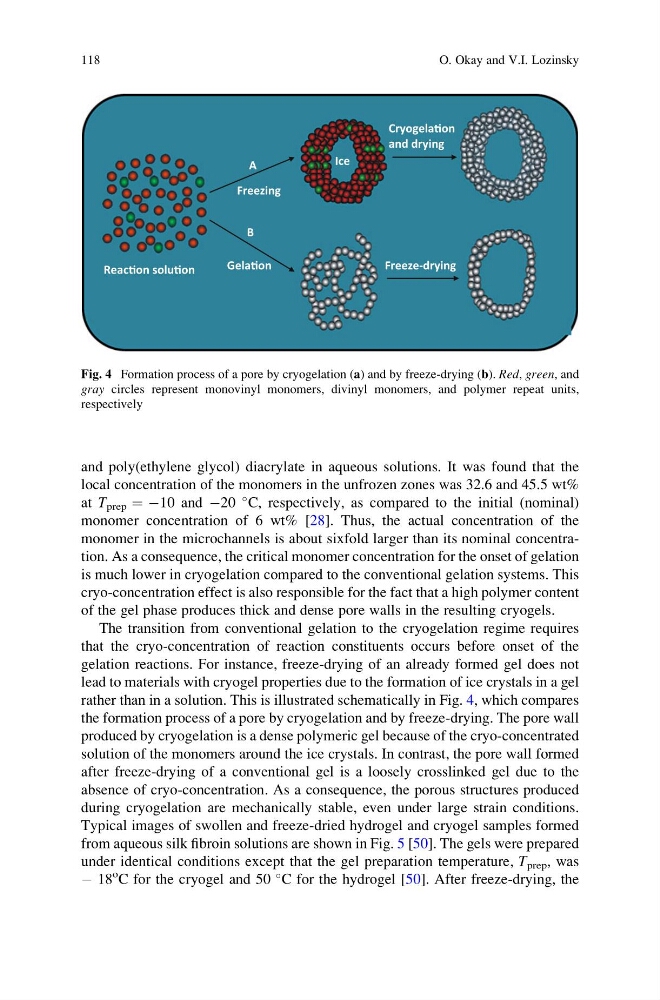
rather than in a solution. This is illustrated schematically in Fig. 4, which compares
the formation process of a pore by cryogelation and by freeze-drying. The pore wall
produced by cryogelation is a dense polymeric gel because of the cryo-concentrated
solution of the monomers around the ice crystals. In contrast, the pore wall formed
after freeze-drying of a conventional gel is a loosely crosslinked gel due to the
absence of cryo-concentration. As a consequence, the porous structures produced
during cryogelation are mechanically stable, even under large strain conditions.
Typical images of swollen and freeze-dried hydrogel and cryogel samples formed
from aqueous silk fibroin solutions are shown in Fig. 5 [50]. The gels were prepared
under identical conditions except that the gel preparation temperature, T prep , was
À 18
o C for the cryogel and 50
C for the hydrogel [50]. After freeze-drying, the
Ice
GelaƟon
A
B
CryogelaƟon
and drying
Freeze-drying
ReacƟon soluƟon
Freezing
Fig. 4 Formation process of a pore by cryogelation (a) and by freeze-drying (b). Red, green, and
gray circles represent monovinyl monomers, divinyl monomers, and polymer repeat units,
respectively
118
O. Okay and V.I. Lozinsky
local concentration of the monomers in the unfrozen zones was 32.6 and 45.5 wt%
at T prep ¼ À10 and À20
C, respectively, as compared to the initial (nominal)
monomer concentration of 6 wt% [28]. Thus, the actual concentration of the
monomer in the microchannels is about sixfold larger than its nominal concentration. As a consequence, the critical monomer concentration for the onset of gelation
is much lower in cryogelation compared to the conventional gelation systems. This
cryo-concentration effect is also responsible for the fact that a high polymer content
of the gel phase produces thick and dense pore walls in the resulting cryogels.
The transition from conventional gelation to the cryogelation regime requires
that the cryo-concentration of reaction constituents occurs before onset of the
gelation reactions. For instance, freeze-drying of an already formed gel does not
lead to materials with cryogel properties due to the formation of ice crystals in a gel
rather than in a solution. This is illustrated schematically in Fig. 4, which compares
the formation process of a pore by cryogelation and by freeze-drying. The pore wall
produced by cryogelation is a dense polymeric gel because of the cryo-concentrated
solution of the monomers around the ice crystals. In contrast, the pore wall formed
after freeze-drying of a conventional gel is a loosely crosslinked gel due to the
absence of cryo-concentration. As a consequence, the porous structures produced
during cryogelation are mechanically stable, even under large strain conditions.
Typical images of swollen and freeze-dried hydrogel and cryogel samples formed
from aqueous silk fibroin solutions are shown in Fig. 5 [50]. The gels were prepared
under identical conditions except that the gel preparation temperature, T prep , was
À 18
o C for the cryogel and 50
C for the hydrogel [50]. After freeze-drying, the
Ice
GelaƟon
A
B
CryogelaƟon
and drying
Freeze-drying
ReacƟon soluƟon
Freezing
Fig. 4 Formation process of a pore by cryogelation (a) and by freeze-drying (b). Red, green, and
gray circles represent monovinyl monomers, divinyl monomers, and polymer repeat units,
respectively
118
O. Okay and V.I. Lozinsky