

crosslinkers in the preparation of DNA and fibroin cryogels [47–50]. EGDE and
BDDE contain epoxide groups on both ends that can react with nucleophiles such as
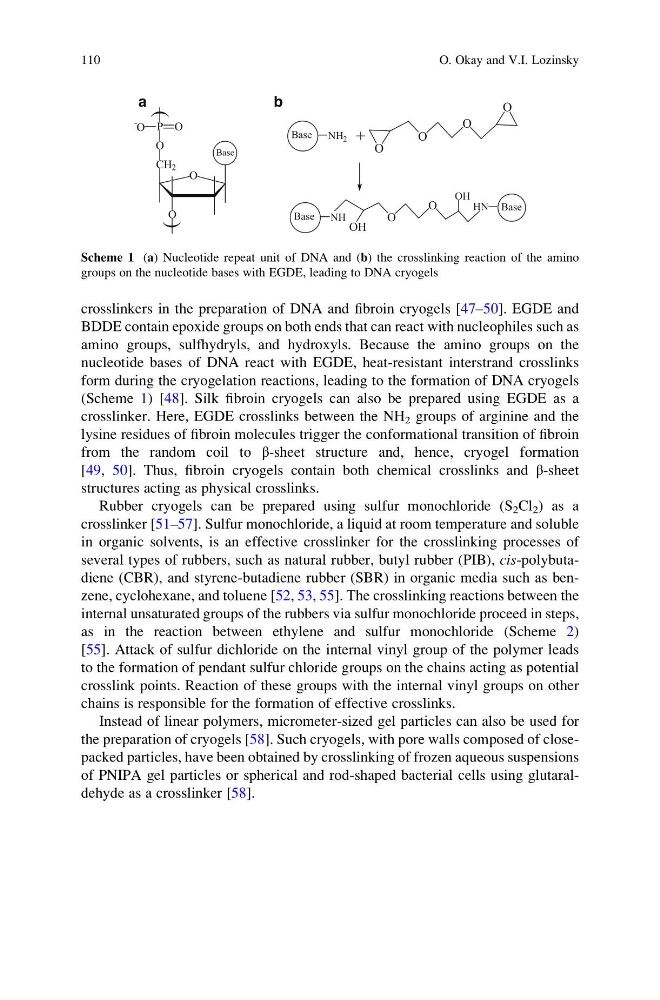
amino groups, sulfhydryls, and hydroxyls. Because the amino groups on the
nucleotide bases of DNA react with EGDE, heat-resistant interstrand crosslinks
form during the cryogelation reactions, leading to the formation of DNA cryogels
(Scheme 1) [48]. Silk fibroin cryogels can also be prepared using EGDE as a
crosslinker. Here, EGDE crosslinks between the NH 2 groups of arginine and the
lysine residues of fibroin molecules trigger the conformational transition of fibroin
from the random coil to β-sheet structure and, hence, cryogel formation
[49, 50]. Thus, fibroin cryogels contain both chemical crosslinks and β-sheet
structures acting as physical crosslinks.
Rubber cryogels can be prepared using sulfur monochloride (S 2 Cl 2 ) as a
crosslinker [51–57]. Sulfur monochloride, a liquid at room temperature and soluble
in organic solvents, is an effective crosslinker for the crosslinking processes of
several types of rubbers, such as natural rubber, butyl rubber (PIB), cis-polybutadiene (CBR), and styrene-butadiene rubber (SBR) in organic media such as benzene, cyclohexane, and toluene [52, 53, 55]. The crosslinking reactions between the
internal unsaturated groups of the rubbers via sulfur monochloride proceed in steps,
as in the reaction between ethylene and sulfur monochloride (Scheme 2)
[55]. Attack of sulfur dichloride on the internal vinyl group of the polymer leads
to the formation of pendant sulfur chloride groups on the chains acting as potential
crosslink points. Reaction of these groups with the internal vinyl groups on other
chains is responsible for the formation of effective crosslinks.
Instead of linear polymers, micrometer-sized gel particles can also be used for
the preparation of cryogels [58]. Such cryogels, with pore walls composed of closepacked particles, have been obtained by crosslinking of frozen aqueous suspensions
of PNIPA gel particles or spherical and rod-shaped bacterial cells using glutaraldehyde as a crosslinker [58].
(
(
O
O
CH 2
O
P O
-
O
Base
O
O
O
O
NH 2
Base
NH
Base
OH
O
O
OH
HN
+
Base
a
b
Scheme 1 (a) Nucleotide repeat unit of DNA and (b) the crosslinking reaction of the amino
groups on the nucleotide bases with EGDE, leading to DNA cryogels
110
O. Okay and V.I. Lozinsky
BDDE contain epoxide groups on both ends that can react with nucleophiles such as
amino groups, sulfhydryls, and hydroxyls. Because the amino groups on the
nucleotide bases of DNA react with EGDE, heat-resistant interstrand crosslinks
form during the cryogelation reactions, leading to the formation of DNA cryogels
(Scheme 1) [48]. Silk fibroin cryogels can also be prepared using EGDE as a
crosslinker. Here, EGDE crosslinks between the NH 2 groups of arginine and the
lysine residues of fibroin molecules trigger the conformational transition of fibroin
from the random coil to β-sheet structure and, hence, cryogel formation
[49, 50]. Thus, fibroin cryogels contain both chemical crosslinks and β-sheet
structures acting as physical crosslinks.
Rubber cryogels can be prepared using sulfur monochloride (S 2 Cl 2 ) as a
crosslinker [51–57]. Sulfur monochloride, a liquid at room temperature and soluble
in organic solvents, is an effective crosslinker for the crosslinking processes of
several types of rubbers, such as natural rubber, butyl rubber (PIB), cis-polybutadiene (CBR), and styrene-butadiene rubber (SBR) in organic media such as benzene, cyclohexane, and toluene [52, 53, 55]. The crosslinking reactions between the
internal unsaturated groups of the rubbers via sulfur monochloride proceed in steps,
as in the reaction between ethylene and sulfur monochloride (Scheme 2)
[55]. Attack of sulfur dichloride on the internal vinyl group of the polymer leads
to the formation of pendant sulfur chloride groups on the chains acting as potential
crosslink points. Reaction of these groups with the internal vinyl groups on other
chains is responsible for the formation of effective crosslinks.
Instead of linear polymers, micrometer-sized gel particles can also be used for
the preparation of cryogels [58]. Such cryogels, with pore walls composed of closepacked particles, have been obtained by crosslinking of frozen aqueous suspensions
of PNIPA gel particles or spherical and rod-shaped bacterial cells using glutaraldehyde as a crosslinker [58].
(
(
O
O
CH 2
O
P O
-
O
Base
O
O
O
O
NH 2
Base
NH
Base
OH
O
O
OH
HN
+
Base
a
b
Scheme 1 (a) Nucleotide repeat unit of DNA and (b) the crosslinking reaction of the amino
groups on the nucleotide bases with EGDE, leading to DNA cryogels
110
O. Okay and V.I. Lozinsky