

diffusion. According to the theory of molecular diffusion, the time needed for
molecular diffusion is proportional to the square of the length of the diffusion
path. Therefore, the marked shortening of the diffusion path in a microreactor
results in a mixing speed that is unobtainable in a macroreactor. The working
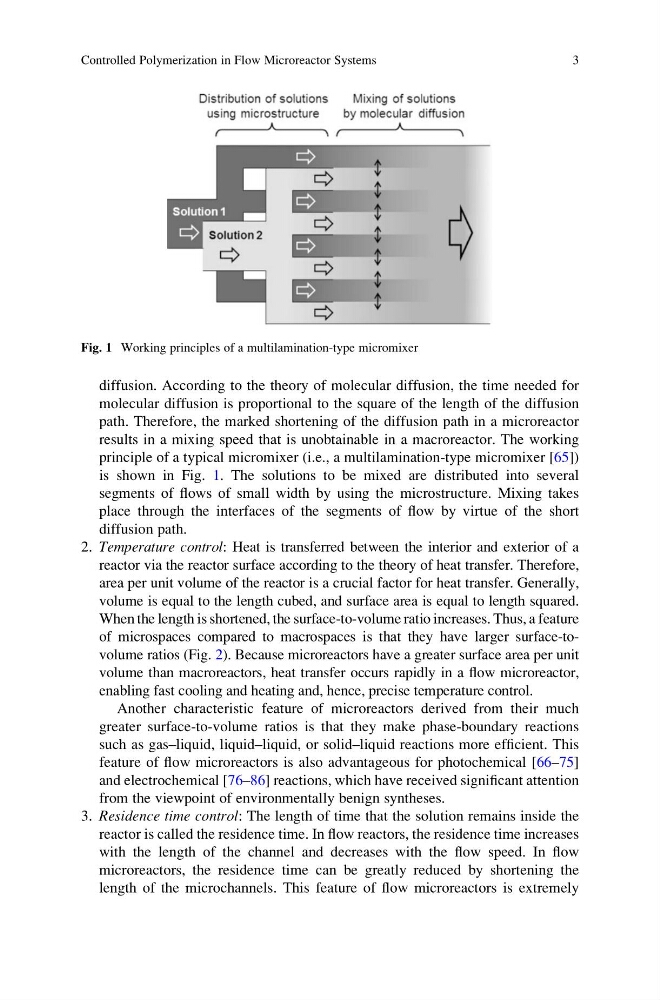
principle of a typical micromixer (i.e., a multilamination-type micromixer [65])
is shown in Fig. 1. The solutions to be mixed are distributed into several
segments of flows of small width by using the microstructure. Mixing takes
place through the interfaces of the segments of flow by virtue of the short
diffusion path.
2. Temperature control: Heat is transferred between the interior and exterior of a
reactor via the reactor surface according to the theory of heat transfer. Therefore,
area per unit volume of the reactor is a crucial factor for heat transfer. Generally,
volume is equal to the length cubed, and surface area is equal to length squared.
When the length is shortened, the surface-to-volume ratio increases. Thus, a feature
of microspaces compared to macrospaces is that they have larger surface-tovolume ratios (Fig. 2). Because microreactors have a greater surface area per unit
volume than macroreactors, heat transfer occurs rapidly in a flow microreactor,
enabling fast cooling and heating and, hence, precise temperature control.
Another characteristic feature of microreactors derived from their much
greater surface-to-volume ratios is that they make phase-boundary reactions
such as gas–liquid, liquid–liquid, or solid–liquid reactions more efficient. This
feature of flow microreactors is also advantageous for photochemical [66–75]
and electrochemical [76–86] reactions, which have received significant attention
from the viewpoint of environmentally benign syntheses.
3. Residence time control: The length of time that the solution remains inside the
reactor is called the residence time. In flow reactors, the residence time increases
with the length of the channel and decreases with the flow speed. In flow
microreactors, the residence time can be greatly reduced by shortening the
length of the microchannels. This feature of flow microreactors is extremely
Fig. 1 Working principles of a multilamination-type micromixer
Controlled Polymerization in Flow Microreactor Systems
3
molecular diffusion is proportional to the square of the length of the diffusion
path. Therefore, the marked shortening of the diffusion path in a microreactor
results in a mixing speed that is unobtainable in a macroreactor. The working
principle of a typical micromixer (i.e., a multilamination-type micromixer [65])
is shown in Fig. 1. The solutions to be mixed are distributed into several
segments of flows of small width by using the microstructure. Mixing takes
place through the interfaces of the segments of flow by virtue of the short
diffusion path.
2. Temperature control: Heat is transferred between the interior and exterior of a
reactor via the reactor surface according to the theory of heat transfer. Therefore,
area per unit volume of the reactor is a crucial factor for heat transfer. Generally,
volume is equal to the length cubed, and surface area is equal to length squared.
When the length is shortened, the surface-to-volume ratio increases. Thus, a feature
of microspaces compared to macrospaces is that they have larger surface-tovolume ratios (Fig. 2). Because microreactors have a greater surface area per unit
volume than macroreactors, heat transfer occurs rapidly in a flow microreactor,
enabling fast cooling and heating and, hence, precise temperature control.
Another characteristic feature of microreactors derived from their much
greater surface-to-volume ratios is that they make phase-boundary reactions
such as gas–liquid, liquid–liquid, or solid–liquid reactions more efficient. This
feature of flow microreactors is also advantageous for photochemical [66–75]
and electrochemical [76–86] reactions, which have received significant attention
from the viewpoint of environmentally benign syntheses.
3. Residence time control: The length of time that the solution remains inside the
reactor is called the residence time. In flow reactors, the residence time increases
with the length of the channel and decreases with the flow speed. In flow
microreactors, the residence time can be greatly reduced by shortening the
length of the microchannels. This feature of flow microreactors is extremely
Fig. 1 Working principles of a multilamination-type micromixer
Controlled Polymerization in Flow Microreactor Systems
3