

1.3.4 Controlled/Living Anionic Block Copolymerization of Styrenes and
Alkyl Methacrylates Using Integrated Flow Microreactor Systems
As mentioned above, flow microreactors are effective for accomplishing the controlled anionic polymerization of styrenes and alkyl methacrylates. A high level of
molecular weight distribution control can be achieved under easily accessible
conditions such as 24
C to À28
C by virtue of the characteristic features of flow
microreactors, which include fast mixing, fast heat transfer, and precise residence
time control. Another advantage of flow-microreactor-controlled polymerization is
easy modulation of flow microreactors to integrate polymerization reactions. In fact,
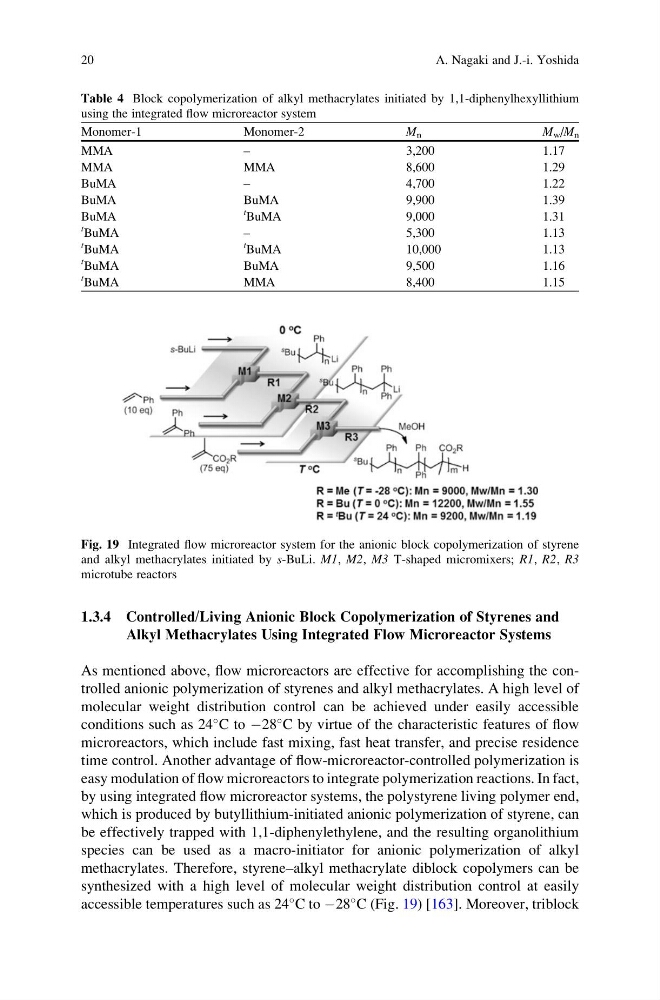
by using integrated flow microreactor systems, the polystyrene living polymer end,
which is produced by butyllithium-initiated anionic polymerization of styrene, can
be effectively trapped with 1,1-diphenylethylene, and the resulting organolithium
species can be used as a macro-initiator for anionic polymerization of alkyl
methacrylates. Therefore, styrene–alkyl methacrylate diblock copolymers can be
synthesized with a high level of molecular weight distribution control at easily
accessible temperatures such as 24
C to À28
C (Fig. 19) [163]. Moreover, triblock
Table 4 Block copolymerization of alkyl methacrylates initiated by 1,1-diphenylhexyllithium
using the integrated flow microreactor system
Monomer-1
Monomer-2
M n
M w /M n
MMA
–
3,200
1.17
MMA
MMA
8,600
1.29
BuMA
–
4,700
1.22
BuMA
BuMA
9,900
1.39
BuMA
t
BuMA
9,000
1.31
t BuMA
–
5,300
1.13
t BuMA
t
BuMA
10,000
1.13
t BuMA
BuMA
9,500
1.16
t BuMA
MMA
8,400
1.15
Fig. 19 Integrated flow microreactor system for the anionic block copolymerization of styrene
and alkyl methacrylates initiated by s-BuLi. M1, M2, M3 T-shaped micromixers; R1, R2, R3
microtube reactors
20
A. Nagaki and J.-i. Yoshida
Alkyl Methacrylates Using Integrated Flow Microreactor Systems
As mentioned above, flow microreactors are effective for accomplishing the controlled anionic polymerization of styrenes and alkyl methacrylates. A high level of
molecular weight distribution control can be achieved under easily accessible
conditions such as 24
C to À28
C by virtue of the characteristic features of flow
microreactors, which include fast mixing, fast heat transfer, and precise residence
time control. Another advantage of flow-microreactor-controlled polymerization is
easy modulation of flow microreactors to integrate polymerization reactions. In fact,
by using integrated flow microreactor systems, the polystyrene living polymer end,
which is produced by butyllithium-initiated anionic polymerization of styrene, can
be effectively trapped with 1,1-diphenylethylene, and the resulting organolithium
species can be used as a macro-initiator for anionic polymerization of alkyl
methacrylates. Therefore, styrene–alkyl methacrylate diblock copolymers can be
synthesized with a high level of molecular weight distribution control at easily
accessible temperatures such as 24
C to À28
C (Fig. 19) [163]. Moreover, triblock
Table 4 Block copolymerization of alkyl methacrylates initiated by 1,1-diphenylhexyllithium
using the integrated flow microreactor system
Monomer-1
Monomer-2
M n
M w /M n
MMA
–
3,200
1.17
MMA
MMA
8,600
1.29
BuMA
–
4,700
1.22
BuMA
BuMA
9,900
1.39
BuMA
t
BuMA
9,000
1.31
t BuMA
–
5,300
1.13
t BuMA
t
BuMA
10,000
1.13
t BuMA
BuMA
9,500
1.16
t BuMA
MMA
8,400
1.15
Fig. 19 Integrated flow microreactor system for the anionic block copolymerization of styrene
and alkyl methacrylates initiated by s-BuLi. M1, M2, M3 T-shaped micromixers; R1, R2, R3
microtube reactors
20
A. Nagaki and J.-i. Yoshida