

The intensity of the doping-induced Q mode at 1,404 cm
À1 decreased gradually
with increasing E-beam dose. The intensities, positions, and line widths of the
Raman peaks at 1,457 and 1,510 cm
À1 , corresponding to the disorder mode (D) and
the antisymmetric C α ═C β ring stretching mode (ν 1 ), respectively [67, 134, 135],
were increased, up-shifted, and broadened with increasing E-beam dose. The
changes in the D and ν 1 vibration peaks indicate structural modifications to the
main polymeric chains in the NW. The spectra reveal that focused E-beam irradiation induces conformational changes in the polymer chains at the nanoscale level
and causes a decrease in the doping level of the polymer [67].
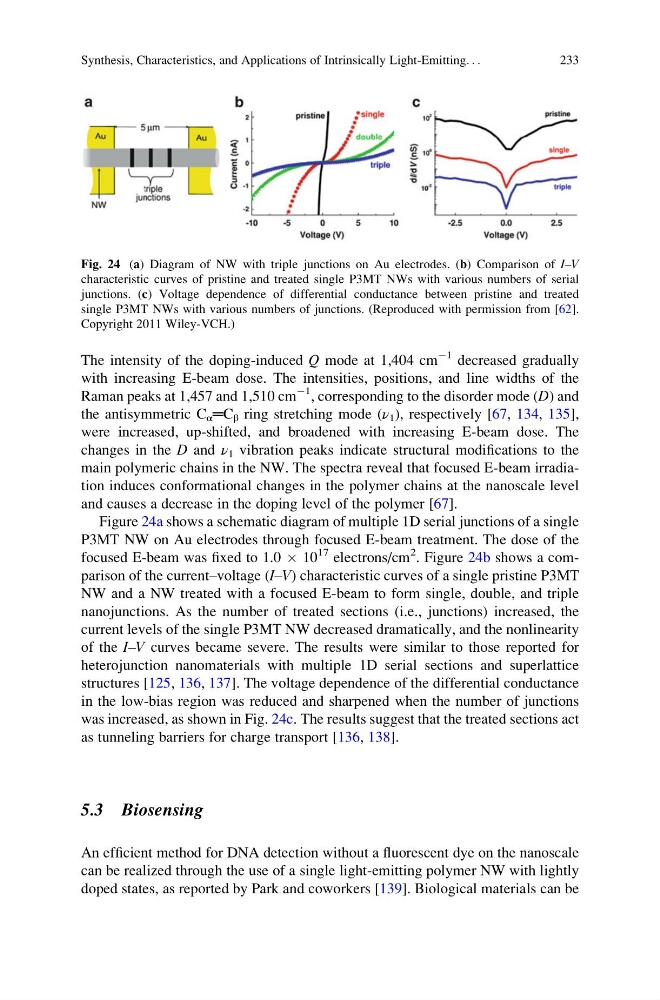
Figure 24a shows a schematic diagram of multiple 1D serial junctions of a single
P3MT NW on Au electrodes through focused E-beam treatment. The dose of the
focused E-beam was fixed to 1.0 Â 10
17 electrons/cm
2 . Figure 24b shows a comparison of the current–voltage (I–V) characteristic curves of a single pristine P3MT
NW and a NW treated with a focused E-beam to form single, double, and triple
nanojunctions. As the number of treated sections (i.e., junctions) increased, the
current levels of the single P3MT NW decreased dramatically, and the nonlinearity
of the I–V curves became severe. The results were similar to those reported for
heterojunction nanomaterials with multiple 1D serial sections and superlattice
structures [125, 136, 137]. The voltage dependence of the differential conductance
in the low-bias region was reduced and sharpened when the number of junctions
was increased, as shown in Fig. 24c. The results suggest that the treated sections act
as tunneling barriers for charge transport [136, 138].
5.3 Biosensing
An efficient method for DNA detection without a fluorescent dye on the nanoscale
can be realized through the use of a single light-emitting polymer NW with lightly
doped states, as reported by Park and coworkers [139]. Biological materials can be
Fig. 24 (a) Diagram of NW with triple junctions on Au electrodes. (b) Comparison of I–V
characteristic curves of pristine and treated single P3MT NWs with various numbers of serial
junctions. (c) Voltage dependence of differential conductance between pristine and treated
single P3MT NWs with various numbers of junctions. (Reproduced with permission from [62].
Copyright 2011 Wiley-VCH.)
Synthesis, Characteristics, and Applications of Intrinsically Light-Emitting. . .
233
À1 decreased gradually
with increasing E-beam dose. The intensities, positions, and line widths of the
Raman peaks at 1,457 and 1,510 cm
À1 , corresponding to the disorder mode (D) and
the antisymmetric C α ═C β ring stretching mode (ν 1 ), respectively [67, 134, 135],
were increased, up-shifted, and broadened with increasing E-beam dose. The
changes in the D and ν 1 vibration peaks indicate structural modifications to the
main polymeric chains in the NW. The spectra reveal that focused E-beam irradiation induces conformational changes in the polymer chains at the nanoscale level
and causes a decrease in the doping level of the polymer [67].
Figure 24a shows a schematic diagram of multiple 1D serial junctions of a single
P3MT NW on Au electrodes through focused E-beam treatment. The dose of the
focused E-beam was fixed to 1.0 Â 10
17 electrons/cm
2 . Figure 24b shows a comparison of the current–voltage (I–V) characteristic curves of a single pristine P3MT
NW and a NW treated with a focused E-beam to form single, double, and triple
nanojunctions. As the number of treated sections (i.e., junctions) increased, the
current levels of the single P3MT NW decreased dramatically, and the nonlinearity
of the I–V curves became severe. The results were similar to those reported for
heterojunction nanomaterials with multiple 1D serial sections and superlattice
structures [125, 136, 137]. The voltage dependence of the differential conductance
in the low-bias region was reduced and sharpened when the number of junctions
was increased, as shown in Fig. 24c. The results suggest that the treated sections act
as tunneling barriers for charge transport [136, 138].
5.3 Biosensing
An efficient method for DNA detection without a fluorescent dye on the nanoscale
can be realized through the use of a single light-emitting polymer NW with lightly
doped states, as reported by Park and coworkers [139]. Biological materials can be
Fig. 24 (a) Diagram of NW with triple junctions on Au electrodes. (b) Comparison of I–V
characteristic curves of pristine and treated single P3MT NWs with various numbers of serial
junctions. (c) Voltage dependence of differential conductance between pristine and treated
single P3MT NWs with various numbers of junctions. (Reproduced with permission from [62].
Copyright 2011 Wiley-VCH.)
Synthesis, Characteristics, and Applications of Intrinsically Light-Emitting. . .
233